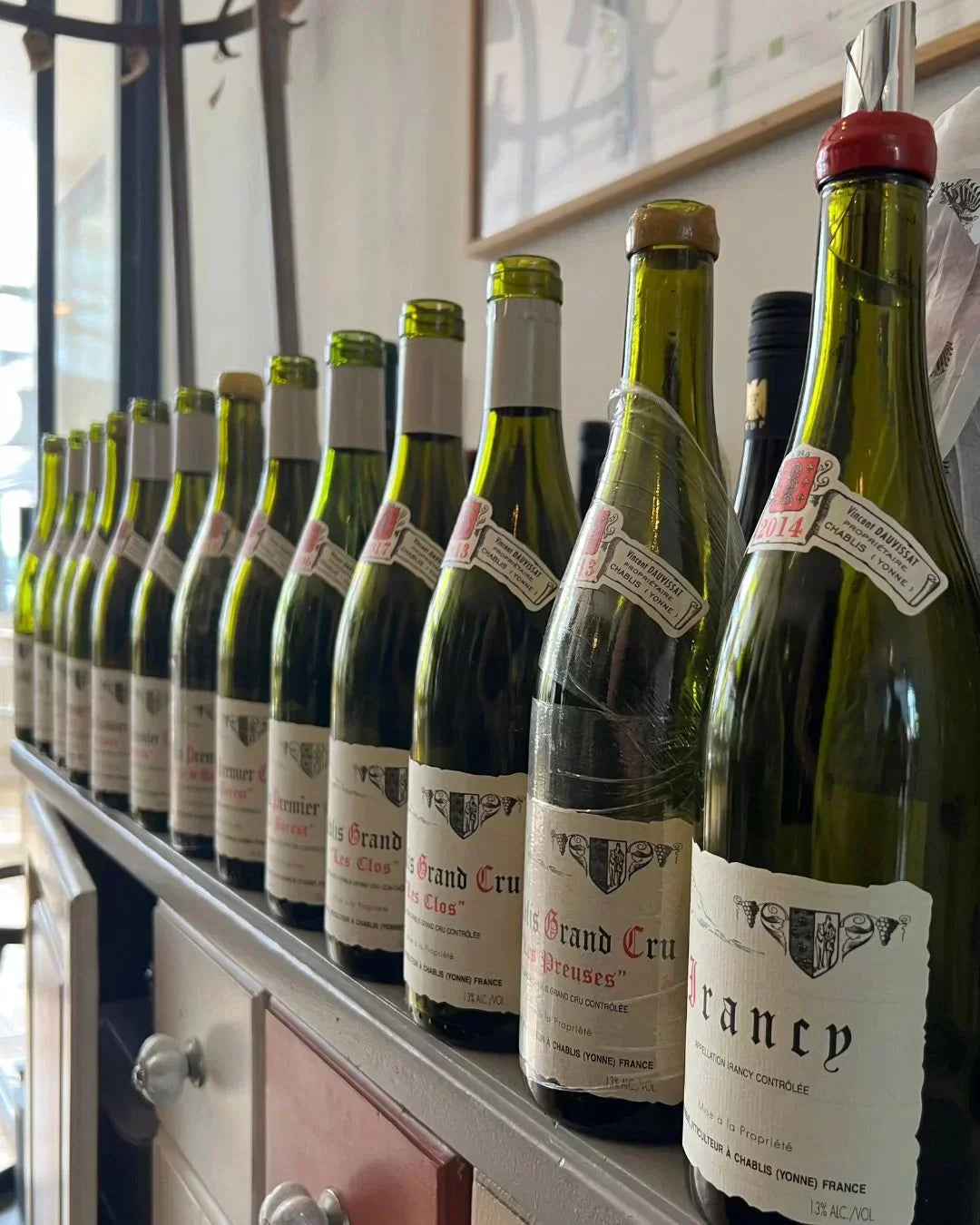
On Sunday, August 4th, Le Club and WINESTABRAM jointly traveled to the charming town of Utrecht to taste the wines of one Vincent Dauvissat. Perhaps you've heard of this gentleman?
He is among the absolute top of the Chablis region, and we couldn't pass up the opportunity to taste not only his entire portfolio, but also older vintages.
The tasting took place at Café-Restaurant Terroir in Utrecht, where it Utrecht Wine House This summer, they're having a pop-up wine bar. They're open until August 12th, and the wine list alone is worth the visit, so head over there.
Domaine Vincent Dauvissat has existed since the 1920s, but the first vintage—of just one hectare—wasn't released until 1931. Today, Vincent and his son and daughter (the fourth generation since 2013) are at the helm and together manage 13 hectares of vineyards, a large portion of which are premier and grand cru vineyards.
Chablis 101
Chablis, a charming wine region just north of Dijon, is officially considered part of Burgundy, although it's closer to Troyes (Champagne) and Beaune (Burgundy). With a unique, refreshing style of Chardonnay, Chablis stands out from the rest. This is due to two specific soil types and the cool climate.
Chablis's soil is fossil-rich and calcareous, but there are important differences. The most famous and best soil consists of Kimmeridgian limestone, which dates back to the Jurassic period, some 150 million years ago. These very old soils are rich in fossils, but poor in nutrients, have excellent drainage, and are therefore ideal for Chardonnay. Then there is the younger (only 135 million years old) Portlandian limestone. The latter is harder, allowing the vines to root less deeply. When the Alps formed forty million years ago, both soils rose to the surface, and erosion eventually created the hills surrounding what is now the village of Chablis.
Chablis is always made from 100% Chardonnay grapes, as it is believed that Chardonnay best reflects the terroir of Chablis.
Within Chablis we find four AOCs:
Petit Chablis
Highest vineyards, often with the thinnest (Portlandian) soils.
Chablis Village
Made from the lower-lying vineyards in and around the villages near Chablis. A blend of Portlandian and Kimmeridgian soils.
Chablis Premier Cru
Most premier cru vineyards have a more southerly to southeasterly exposure and are therefore often a little too cool for grand cru quality. These vineyards contain only Kimmeridgian soils. There are 40 premier crus, 17 of which are "umbrella" premier crus.
Chablis Grand Cru
A large AOC northeast of the village with a southerly to southwesterly exposure. The grapes here benefit from the warm afternoon sun, allowing them to reach peak ripeness in the best years. This is also the only AOC where (old) oak is the standard. The AOC comprises seven different plots, each with its own distinct character, which can be noted on the bottle.

The AOCs around the village of Chablis. Source: chablis-wines.com
Dauvissat: vineyard & cellar
The Dauvissat family practices biodynamic farming in their vineyards whenever possible. However, the cool, wet climate of Chablis can sometimes disrupt their efforts, forcing them to intervene to combat powdery mildew and mold. Strict selection is the norm in the vineyard, with extensive leaf pruning and green harvesting to reduce yields and increase quality.
In the cellar, everything is done as naturally as possible, with minimal intervention. After manual harvesting, the grapes are gently pressed with a pneumatic press. The must then settles for 24 hours in steel tanks. Fermentation occurs spontaneously with indigenous yeast cultures, primarily in stainless steel, with only a small portion in old wooden barrels. Malolactic fermentation also occurs spontaneously and only when nature permits. No adjustments are made. The wines are aged in both stainless steel and old wood, and for some wines, they even use antique 132-liter Feuilletés barrels for optimal micro-oxidation.
Around 80,000 bottles are produced annually, which sounds like a lot, but pales in comparison to the Chablis coop. La Chablisienne produces 8.5 million bottles annually. Dauvissat wines are scarce and increasingly difficult to find, especially outside of France.
Tasting notes
In total we tasted 13(!) wines from the estate of Petit Chablis to several Grand Crus . Dylan donated a total of 10 flights, in which vintages were regularly compared. WHAT A PARTY!
Vincent Dauvissat Petit Chablis 2015
Fruit from three plots just north of Grand Cru Les Clos. Anyone who says Petit Chablis can't produce good wines should consider this one (or those from, for example, Patrick Piuze (just give it a try).
Beautiful golden color in the glass and medium intensity on the nose. Notes of quince, ripe peach, yellow apple, roasted hazelnuts, flint, salty notes, and honey. Medium+ acidity, long with a salty, drying finish.
Vincent Dauvissat Chablis Village 2018 vs. 2012
The 2018 had a lemon-yellow color and medium intensity on the nose. I smelled yellow apple, pineapple, firecrackers, pears, nectarine, and anise. Substantial acidity, intense flavor, a nice salty note, and a long finish.
The 2012 was already more golden in color, but with a slightly more restrained character. The wine smelled of beeswax, honey, ripe nectarine, some floral notes, and iodine, without seeming old or tired. Again, high acidity, but noticeably creamier and softer than the 2018, with a flinty and salty finish.
Vincent Dauvissat Chablis Séchet Premier Cru 2017
The Climat Séchet falls under the umbrella of the premier cru Vaillons, but is often bottled under its own name. Because this Climat faces southeast, has a relatively thin soil, and there is a fair amount of wind through the valley (Vaillons is small valley (in Latin), the grapes ripen slowly, resulting in beautiful, intense aromas and high acidity. Dauvissat owns 0.4 hectares here.
Another beautiful golden color and a medium-intense aroma. Fennel, green apples, pineapple, chalk, some iron, and a hint of grass. Substantial acidity, clearly a tight wine with a somewhat iron-like character.
Nadien's tasting note : so nice to read that Bram also has fennel. I really enjoyed this with rusk and mice. I thought this was a beautiful, clean, linear wine, much livelier than the Village 2012, with super fresh aromas of oyster shells, seaweed, candied lemon, and fennel seeds.
Vincent Dauvissat Chablis Vaillons Premier Cru 2018 vs. 2006
This spacious Premier Cru, with an easterly to southeasterly exposure, enjoys plenty of morning sun (a plus; less chance of frost). The soil has a thin layer of Kimmeridgian limestone with a higher clay content (a deeper soil than Séchet).
The Dauvissat family owns 1.4 hectares here, divided between one-third in Beugnons and two-thirds in Châtains. Generally, the wines from this vineyard are slightly riper than those from Séchet.

The Premier Cry Vaillons, or "little valley." Source: chablis-wines.com .
The 2018 Vaillons has a beautiful lemon-yellow color and a wonderful aroma: beeswax, lemon zest, ripe peaches, mango, and flint. High acidity, balanced by a creamy mouthfeel and a long, tight finish.
The 2006 was noticeably more mature in character, with a beautiful golden color and more tertiary notes: honey, floral notes, beeswax, Nutella, marzipan, and oyster shell. The acidity was slightly milder (medium+) and the finish was a bit butterier.
Nadien's tasting note : It was already a treat to smell the 2018 (hazelnuts, lemon zest, chalk, and freshness), but the 2006 really hit the spot. Beautifully matured with aromas of marzipan, beeswax, lemon yogurt, and lemon meringue tart. The acidity is beautifully wrapped in a creamy, buttery coat. Absolutely beautiful!
Vincent Dauvissat Chablis Montée de Tonnerre Premier Cru 2016
This premier cru is located on the right bank and has a westerly exposure, resulting in a warmer vineyard and more intense wines. Since 2012, the Dauvissat family has owned approximately 0.3 hectares of vineyards here.
Unfortunately, the wine's deep golden color already betrayed that something was amiss. The aroma confirmed this: cheesy, bruised apple, and nutty. The taste was slightly better, but unfortunately: oxidized.
Vincent Dauvissat Chablis Forêts Premier Cru 2018 vs. 2006
Within the Premier Cru Montmains region are three renowned climats: Butteaux, Forêts, and Mont Mains. Dauvissat owns 3.7 hectares in Forêts, where the southeasterly exposure allows the grapes to ripen optimally all day long. The wines from Forêts are often considered the most powerful on the Left Bank.
The 2018 Forêts is already developing a golden hue. The aromas range from ripe apple, mango, and peach to chalk and hay. The wine has high acidity, an oily texture, pleasant bitterness, and a long, salty finish.
The 2006 was a beautiful gold color and intense aromas: honey, beeswax, caramel, lemon oil, straw, and ripe peach. This concentrated wine had medium+ acidity and a creamy finish.
Nadien's tasting note : I'm starting to think I recognize the Dauvissat style. Almost all the wines have a slightly bitter note for me, like grapefruit peel. But also that wonderful salty note, limestone, more citrus, roundness, and for me, the 2018 had more acidity than the 2006. I found the 2006 a bit too much of a cheese board.
Vincent Dauvissat Chablis Les Clos Grand Cru 2017 vs. 2013
The family manages three plots totaling 1.4 hectares in the Les Clos climat within the Chablis Grand Cru, with vines averaging 65 years old. The moment we've all been waiting for...
The 2017 Les Clos was a beautiful lemon yellow color, intense on the nose, and smelled fan-tas-tic! Aromas of lemon oil, lime, hazelnuts, oyster shell, pineapple, and reductive ( @sommeljj (I'd say "firecrackers"), floral, apple, and stone fruit. Incredibly high acidity, tight, yet creamy and round, and the longest finish of the afternoon.
The very reductive 2013 had a beautiful golden glow and was even more intense in aroma. The wine smelled of flint (although it diminished after a vigorous swirling), iodine, ripe mango, honey, custard, beeswax, and croissants. Full and rounded with milder acidity than the 2017 and a delightfully salty finish.
Nadien's tasting note : The use of wood is evident here, especially in 2017. And it's fantastic too – don't get me wrong. Hazelnuts from the best nut stall, toasted bread, lemon zest, unmistakably high acidity, flint, smoky, layered. Don't serve this wine too cold and be patient.
The 2013 was, if possible, even more beautiful. It was like literally cycling past a bakery at 5:00 in the morning. The aroma of freshly baked croissants and rolls wafts towards you. But also: lemon zest, vanilla, flint, smoky notes, beautiful, integrated acidity – incredible!
Vincent Dauvissat Chablis Les Preuses Grand Cru 2013
A climat on the west side of the Grand Cru hillside with warmer, brown soil and plenty of sunshine. These ingredients produce more robust wines. Dauvissat manages 1 hectare here (of the 10.8 hectares).
Deep golden color, bordering on oxidation, yet still with hints of tropical fruit, apples, and hay. A hint of volatile acidity and iodine added tension. A highly structured wine, creamy, thick, and long.
Vincent Dauvissat Irancy 2014
Just outside Chablis, the Dauvissats also make a 100% Pinot Noir, bottled under the AOC Irancy. They have a 0.6-hectare plot here. After tasting the Irancy 2018 at the Utregs Wijnhuis pop-up last year, I immediately fell in love with this wine.
The wine has already developed some color, with a beautiful garnet-red hint. The aroma offers ripe strawberries, cinnamon, pepper, raspberry candy, a hint of nail polish remover, red cherries, and a touch of rusticity. The distinct yet soft tannins and lovely acidity make this a beautiful and exciting glass of Pinot Grigio.
Nadien's tasting note : A lovely glass with beautiful development. In addition to the above tasting note: cardamom. And I'm in love with this wine too!
Can you taste terroir or not?
Opinions are still divided on this point, even between Nadien and Bram. However, I noticed that the wines of Dauvissat have many similarities with those of François Cotat From Sancerre in the Loire Valley. And although those wines naturally have more of a Sauvignon Blanc character, Cotat's grapes are grown on exactly the same soil as Vincent Dauvissat's. I think we should just do more comparative tastings... To be continued?
You might also like this
Guest blogger: Bram Faber
After more than fifteen years as a (master) sommelier at the finest (Michelin-star) restaurants, Bram decided three years ago to leave the hospitality industry behind. Since then, Bram has worked as a wine instructor, leads wine tastings, and recently settled in Rotterdam at Wijnkoperij Platenburg as a wine consultant and account manager for the hospitality industry.
Share:
The sommelier's favorite natural wine
Haut Les Mains: the favorites (part 1)