In mid-July, I drove to Burgundy for Haut Les Mains, a wine event I saw on Instagram that instantly gave me FOMO. It's where the crème de la crème of the Burgundian natural wine community gathers. It's like going to a Taylor Swift concert before she became famous. Although, mainstream Taylor might not quite fit in with the winemakers on duty. The National, that is, the band that played for half a field at DTRH because everyone was spacing out in some techno bunker.
Anyway, those winemakers really got my heart racing. Chanterêves, Cassiopée, Reno Pacalet, Derain, Dandelion, and Le Grappin were there, and I also spotted all sorts of new names, including Mai Roblion Bazin from Juliénas, who presented her first two vintages, and Louis-Auguste Duband (son of, yes) from Chevannes, who is now also making wine under his own label. Mega!

Winemakers from outside Burgundy were also present, such as Salima and Iain Cordeuil (Champagne) and – very un-French – from outside France, such as Wasenhaus (Baden) and Carsten Saalwächter (Rheinhessen).
Below you'll find my favorites from Burgundy. In the next blog post, I'll tell you more about my favorite producers outside of Burgundy.
Chanterêves
My current crush . Super energetic wines from Tomoko Kuriyama and Guillaume Bott. Tomoko, originally from Japan, learned the wine trade in Germany, while Guillaume is a native of Beaune. They started as négoce, buying grapes from various vineyards, but for several years now they have also owned vineyards. Thanks to their experience outside Burgundy, they approach their wines with a fresh, unique perspective. Tomoko and Guillaume conduct extensive soil analysis to ensure the terroir, however small, is accurately reflected in their wines. They work in a minimalist way; their team uses whole-cluster fermentation and spontaneous fermentation. No mechanical pump-overs, but pigéage by foot. Not an easy path, but a sustainable one. A domaine to watch.
- Hautes-Côtes de Beaune Mainbey Aligoté 2022: Crisp, salty, lemon salt, stone.
- Hautes-Côtes de Beaune Mainbey Chardonnay 2022: Fuller than the Aligoté. A touch of reduction. Creamy, yet focused and taut with the freshness of lemon zest. A Chardonnay with finesse.
- Bleu Cerise 2023: Two-thirds Aligoté, one-third Gamay. Frivolous, juicy, not complex, yet tasty, a bit Jura-esque.
- Savigny-lès-Beaune Dessus de Montchenevoy 2022: Soft and inviting, with flavours of ripe strawberries, raspberries, cranberries, pomegranate and some pepper.
Reno Pacalet / Maison Reno
Never heard of it, but perhaps the finest aligoté of the afternoon. Did I really say that? Yes, I did. I'd love to try it again, but it's nowhere to be found in the Netherlands. It is in Beaune, so I wouldn't rule out another trip south. My tasting note is: " suuuper fresh, clean, and pure, a textbook example of aligoté." Reno Pacalet, son of natural wine icon Philippe Pacalet and second cousin of Marcel Lapierre, is clearly following in his family's footsteps. He embraces the same philosophy: natural methods, terroir-centric, and minimal sulfite use.
Domaines des Lutternes
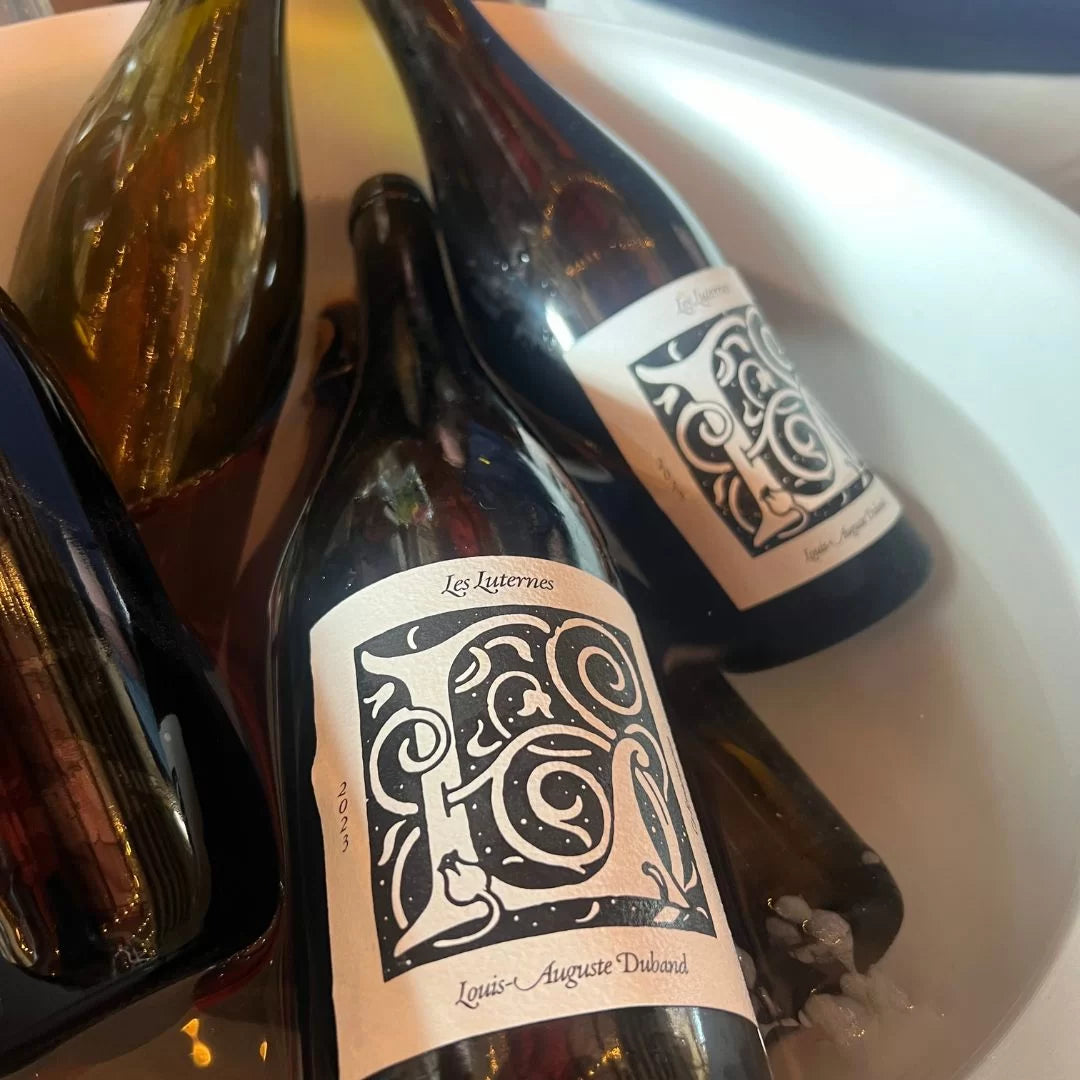
Domaine des Lutternes is the project of Louis-Auguste Duband, the son of the classic David Duband from Chevannes. Within a family, you hope to pass on a passion for the craft to the next generation. Sometimes it works, sometimes it doesn't. Some faithfully follow in their parents' footsteps, while others forge new paths. In recent decades, especially among millennial winemakers, it has become much more common to gain international experience. They travel more than their parents did and seek internships with producers they view as peers, rather than as subordinates, which was often the case in the past.
Louis-Auguste's first cuvée – Domaine des Lutternes 2023 – is an unusual blend of whole bunches of Pinot Noir and destemmed Chardonnay. The grapes come from a single vineyard planted sixty years ago by his grandfather. After harvest, the grapes are macerated for six days. Alcoholic fermentation occurs spontaneously. The wine then matures for another six months in eleven "dames Jeannes" (glass bottles) and four old oak barrels. The result is a truly delightful cuvée: pure, juicy, red fruit, a touch spicy, and above all, easy to drink!
David Duband is imported by Okhuysen, but Domaine des Lutternes has not yet been added to the range.
Domaine Derain
Domaine Derain is located in Saint-Aubin, where Dominique Derain bought his first plot over 30 years ago. Back then, it was a small village next to the famous Meursault and Chassagne, but now it's an integral part of the Burgundian landscape. Derain was recently taken over by his assistant winemaker, Julien, and his wife, Carole Altaber. What strikes me about Domaine Derain's wines is their incredibly tight core; always precise and refined. Besides their own wines, they also have the "Sextant" line, a négoce project where they give free rein to their creativity.
The table is full of different cuvées, I tasted some of them:
- Métisse 2023: Made from Gamay grapes, 50% of which are directly pressed. A juicy wine with red fruit, more Pinot Grigio but fuller.
- Côte Chalonnaise Bourgogne Pinot Noir 2023: Made with 30-50% pressed grapes, the rest whole bunches, aged in 500-liter barrels for 6 months. Delicate spiciness from the stems, cherries, subtle tannins, beautifully balanced with fine acidity.
- Saint-Aubin 2022 Pinot Noir: Same treatment as the Côte Chalonnaise, but aged for 12 months in barrel. Slightly more concentrated, with red fruit, thyme, and a hint of cedar.
- Pommard Noizets 2022: Rhubarb and sour cherries, surprisingly not heavier than the Saint-Aubin.
- Sextant 2023 Bourgogne Chardonnay: Pure, drinkable, really good.
- Saint-Aubin 2022 Chardonnay: Lightly reduced, beautiful with notes of lemon biscuit, white flowers, and a subtle nutty undertone. Medium+ acidity.
- Saint-Aubin and Remilly 2022: Intense and layered, with a hint of reduction, grapefruit, orange peel, hazelnut, and a touch of melon and pineapple. Super beautiful and complex.
Domaine Derain (including Sextant) is available through Vleck Wijnen.
The Grappin
Some producers stay with you, and for me, Le Grappin is a perfect example. In 2019, I drank a bottle for the first time. Noble Rot And that wine has always stuck with me. Le Grappin is perhaps the new voice of Burgundy—or rather, of all of France. Andrew Nielsen, an Australian, and his wife Emma, originally from the United Kingdom, aren't limited by region. They make wine in the Côte d'Or, but also in Maçon, Beaujolais, and the Rhône. The wines from the Côte d'Or are marketed under the Le Grappin label, while the rest are sold as Du Grappin.
Andrew learned his trade at Felton Road in New Zealand and Simon Bize in Savigny-lès-Beaune, among others. It was with Bize that he became captivated by the diverse terroirs of Savigny-les-Beaune that were essentially neglected (or underused). He decided to become a micro-négociant, selecting and bottling special parcels separately, to tell the story of these often-overlooked terroirs. A nearly impossible task, as it requires a lot of work, time, and therefore money. To finance this, Andrew and Emma are taking a creative approach. They earn their living with vin de soif – easy-drinking wines packaged in sustainable 1.5-liter "bagnums." These wines are ideal for immediate consumption and allow them to afford the precision and care required for Le Grappin. Want to know more? I wrote a short blog including some tasting notes about Le Grappin .
Le Grappin is difficult to obtain in the Netherlands. The Le Grappin website lists winestories.nl as the importer, but nothing can be found online.
Domaine Cassiopée
Domaine Cassiopée is the estate everyone's talking about, and for good reason. The young couple Hugo Mathurin and Talloulah Dubourg, both born in 1994, took the plunge after internships with giants like Roulot to make their own wines in Sampigny-les-Maranges. Maranges is a region that's suddenly popping up everywhere—probably because it's the only place left where you can buy anything, and the terroir seems interesting in times of climate change, but we'll talk about that another time. They're getting help from all sides. Terroir boss Pedro Parra has already visited, and the men from Comando G are fans. This is an estate to watch.
- Cassiopée Mitancherie Aligoté 2021: From Maranges, once unremarkable, but now increasingly interesting due to climate change. Crisp and fresh, yet full of flavor, flint, and a salty, exciting lemon zest.
- Maranges Les Plantes Chardonnay 2022: 60-year-old vines. Wonderfully fresh and clean, with a light scent of hay and dandelion, like a crisp spring day. Gimme more.
- Maranges Les Paizets Pinot Noir 2022: A wine with some warmth, spiciness from thyme, cranberry, buttermilk acidity, and cherries, with slightly astringent tannins. Not a fan, but perhaps it needs time?
- Maranges Le Bas du Clos Pinot Noir 2022 (from magnum): From 90-year-old vines. Intense nose, cherries and spices, more refined tannins than Les Paizets.
- Maranges Le Saugeot Pinot Noir 2021: Boerser, with sour cherries and cranberries. Curious how this will age.
Cassiopée is available through Janselijn.
The Grain of Wine
At the last minute, I tasted the wines from Le Grain du Vin. Admittedly, I was drawn to the label. You shouldn't assume it, but at the same time, I think: if you put so much effort into the design of the label, the content must be good too. Of course, that's not always the case. Just look at the wines from Laurent-Ponsot, fantastic wines with a terrible label. Label . Mélanie and Vincent Zuber's first vintage was released in 2022 under the name Le Grain du Vin, remarkable that the name was still available. Both are experienced oenologists, having learned their craft at other estates.
They work biodynamically in the vineyards and minimalistically in the wine cellar. Red Burgundy This wine comes from grapes harvested in the commune of Ladoix, from vines over 80 years old and situated on a southeastern slope. Spontaneous fermentation, without additives, takes place, and it is aged for 18 months in used wooden barrels.
The result? A wine that's vibrant and seductive, just like the label. The next time I'm in Beaune, I'll be picking up a few more bottles.
Le Grain du Vin is available at Puike Wijnen.
In part 2 more about the wines outside Burgundy.
Next year again
This year marked the third edition of the event, organized by Jon Purcell of Vin Noé in Saint-Aubin. What began as a modest gathering for winemaker friends has since grown into an event that draws crowds from far and wide. It was pleasantly crowded, but perfectly manageable. We'll be back next year.

Share:
13x Dauvissat at Utregs Wijnhuis
6 podcast episodes you can't miss