
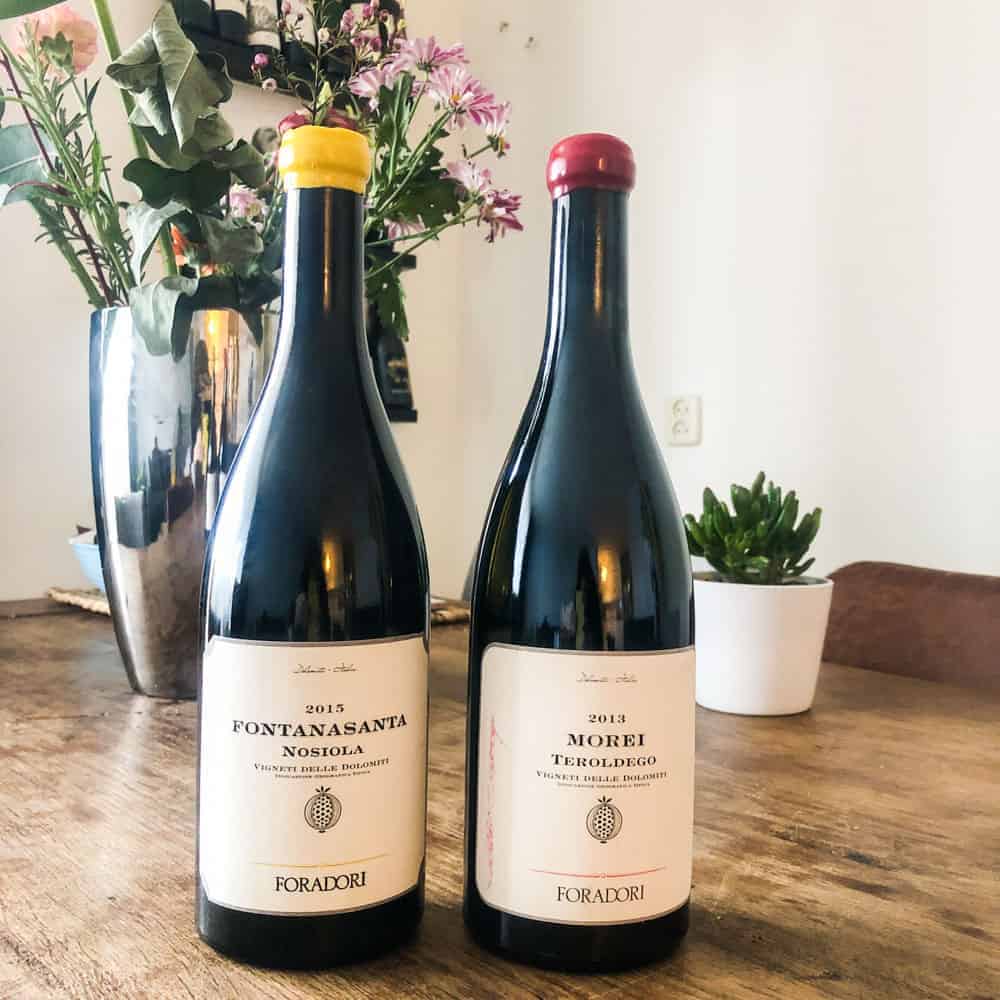
The fruit already greets me as I pour a glass of Teroldego with the Coravin. Terol—who? Teroldego, a native grape variety from northern Italy—from Trentino, to be precise—that was almost extinct. Fortunately, Elisabetta Foradori put a stop to that.
“ Lively, tooth-smacking varietal specialty of Trentino rescued by Elisabetta Foradori which responds well to careful vinification and oak aging” – Jancis Robinson
A beautiful life goal: saving a grape variety. It quickly became clear to me that Elisabetta Foradori doesn't shy away from a challenge. Since 2009, she's been working biodynamically and has even dusted off her amphora. And she's doing it all successfully.
The story of Foradori
That started at a young age. Where we still hang out in the disco and think about our In the face of life choices , Elizabetta Foradori took over her mother's winery at the age of 20 (her father died when she was 11). Her first vintage was released in 1984. It was a fine wine, but she wasn't satisfied; it was too neat and too commercial. The following year, she conducted extensive research on Teroldego vines, ultimately registering and replanting fifteen clones on her largest vineyard. The quality improved, but something was still missing.
“ The wines I produced back then lacked soul ,” she says yourself .
In 1999 Foradori stopped using chemicals and in 2002 she decided to switch to Biodynamics . In 2009, she received the Demeter certificate. Biodynamics goes beyond a bit of farming. It's a philosophy—a way of life. Most importantly, it prioritizes soil life. Biodynamics leaves the vineyard to the vineyard and ensures minimal disruption to the terroir. It's therefore no wonder that proponents claim that wines from a biodynamic vineyard truly express the grape variety and the terroir. Isn't that wonderful?
“A whole variety had to be rebuilt, viticultural practices had to be brought back to quality levels, the soil had to be enriched with life, the plants brought to an equilibrium,” Foradori writes in an email to The New York Times .
What a hero.
In between, she also cultivates a white grape variety, the indigenous nosiola. Never heard of it, but recently tasted it, and wow! Foradori discovered that nosiola used to be fermented with the skins. The wines back then had character, a stark difference from the light, neutral wines produced from it today.
“Wines vinified in amphorae give the purest expression of the grape and terroir.” – Elisabetta Foradori in Winemag.com
Good story, right? It also depends on how you write it, right? I mean, it's a good story, but imagine that for a moment – 20 years and responsibility for an entire winery. Do you even want that? Was there even a choice? Probably not. Fortunately, she was able to chart her own course and put her own stamp on the wines. Wines that wine fans around the world know and love.
Who run the world.

Tasting notes
In 2018 I bought some bottles of Foradori at Emerald Wines . I've now tasted them all. You can find the tasting notes below.
Foradori Fuoripista Pinot Grigio 2015 (tasted in August 2018)
Let me just tell you this: this Pinot Grigio is a thousand times different from any Pinot Grigio I've ever tasted. And I've seen it, because this Pinot Grigio has an orange color. The grapes, skins and all, go into the amphora, where fermentation takes place, followed by eight months of aging. This creates light, pleasant tannins. There's a distinct tangerine note on the aroma.
Slightly off-topic, but I'm reminded of the artichoke puree we were served at the 010/020 sommelier dinner at Restaurant Heroine. Sounds like a perfect combination.
Elisabetta Foradori Nosiola Anfora (tasted in January 2019)
May I quote Jancis again? Yes, I may: Nosiola Trentino's zippy indigenous specialty . Amphora is also used here. The wine is aged for eight months. The aroma reveals notes of orange peel, a touch of fennel, and chamomile. Slight bitterness from the skins.
Foradori Morei Teroldego 2013 (tasted in May 2019)
Wow, what intensity! A scent of fresh blackberries and dark cherries greets me. I think I can also smell the soil: it must be something stony. Besides the fruit, there's a distinct minerality (yes, that's a difficult word, but I'll use it anyway).
More of this?
Are you a fan of natural wine and/or orange wine? I understand that perfectly, so I've compiled a few reading tips for you.

Share:
Médoc in a nutshell
Tokaj, the liquid gold from Hungary