
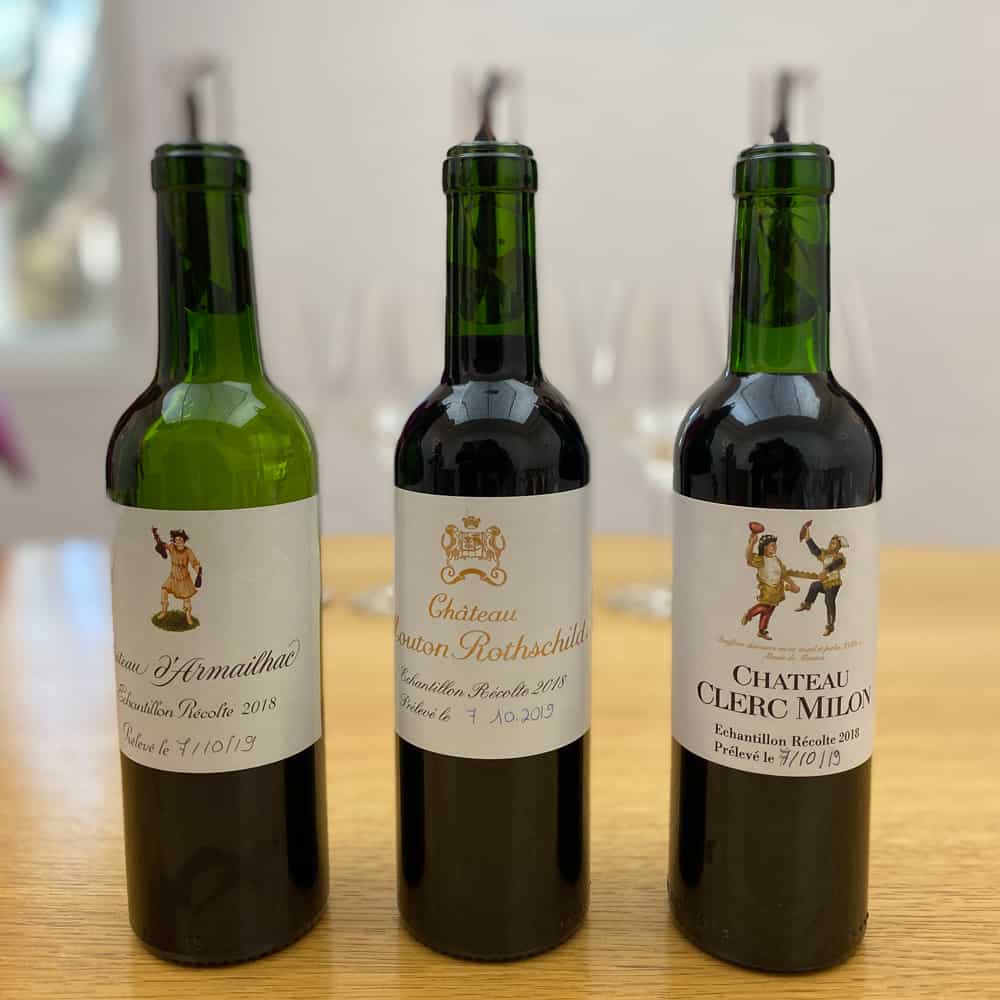
It's Monday, time for a new article. Since I'm going to spend all day in Bordeaux at the Beurs van Berlage, I thought it would be a good opportunity to take a closer look at the main villages of the Médoc.
Saint-Estèphe
The northernmost commune of the Haut-Médoc and also the coolest, as Saint-Estèphe is closest to the Atlantic Ocean. More Cabernet Sauvignon is still grown here than Merlot, but the Merlot share is higher than in Saint-Julien, Pauillac, and Margaux. Cabernet Sauvignon is mainly found on the gravelly soils. Due to the cooler climate, the wines of Saint-Estèphe are often considered rustic Described. Wines that are difficult to drink when young. Although that doesn't always have to be the case. A warm year, more Merlot in the blend, or more Cabernet Sauv from gravelly soils makes the wine much softer. Saint-Estèphe doesn't have any Premiers Crus Classés, but it does have several Deuxièmes. The most famous wine is, of course, Cos d'Estournel, which is located on the border with Pauillac.
Big tip
Château Le Crock, a Cru Bourgeois from the Cuvelier family of Château Léoville-Poyferré. Typical Bordeaux and very affordable.
Pauillac
Pauillac may be one of the world's most famous wine villages, but you wouldn't immediately guess it just by driving through. It's utterly boring. Yet it has so much potential. Not only because of the wines, but also because of its charming riverside location. In the autumn of 2019, I visited the Médoc and ended up in Pauillac. After a long search, we finally found the restaurant, Le Pauillac , on the water where we had a delicious meal.
Pauillac's vineyards are also located near the river, which contributes to the ripeness of the grapes. The majority, just over 60%, are Cabernet Sauvignon. Among the top estates, that percentage is even higher. It's therefore not surprising that these are wines that age for a very long time. This is Cabernet Sauvignon at its finest: high acidity, rich tannins, and aromas of cassis and blackberry that, with the necessary oak and bottle aging, transform into notes of dried fruit, tobacco, and cedar. A full 85% of Pauillac's production is classified as Cru Classé. Three of the five Premier Cru Classés come from Pauillac.
Big tip
In Le Pauillac, we drank a Prelude a Grand-Puy-Ducasse, the second wine from Château Grand-Puy Ducasse, made from young vines. It was enjoyable, but that may also have been due to the atmosphere (not of the village, but of the company).
Saint-Julien
Continuing south, we pass Saint-Julien. It boasts abundant gravel soils, resulting in a high proportion of Cabernet Sauvignon. It lies literally between Pauillac and Margaux in both location and style. Structured like Pauillac, but with the friendliness and elegance of Margaux. Despite the absence of any Premiers Crus Classés, the rest of the classification is well represented, accounting for 95% of the production. It is the smallest appellation, at 910 hectares, of which Château Lagrange owns the largest (123 hectares).
Big tip
Never tasted it before, but I'm intrigued by Domaine de Jaugaret. Yes, a domaine, not a chateau. This wine is more reminiscent of Burgundy than Bordeaux. The winemaker, Jean-François Fillastre, has pre-phylloxera vines and uses tonneau for fermentation and aging. old barriques for three years.
Margaux
Margaux is located a little further south and therefore a bit warmer. In terms of harvest time, that means a difference of about 7 to 10 days compared to Pauillac. Jancis Robinson calls it "the most seductive appellation" in the Haut-Médoc, so do the math. A typical Margaux is fragrant and silky smooth compared to its neighbors.
Big tip
Palmer. Go all out and score Chateau Palmer, or keep it small and choose their other property in Margaux: Chateau d'Angludet . Worth mentioning, to say the least, is Chateau Bel-Air Marquis d'Aligre, a Margaux without oak aging. Say what?
Bordeaux is hip to hate
But don't. Bordeaux had lost its way a bit in the battle for points, wood, and money, but is catching up. And yes, sometimes you need patience, and it takes a while for a bottle to finish. The question is, does that matter? There's plenty to enjoy in the meantime. Your patience will be rewarded.
Share: