Anyone who's been following Le Club des Vins for a while knows I'm crazy about sherry. It all started during WSET4, when we had to write a case study on "The Rise and Fall and Rise of Sherry."
Suddenly, I was captivated: it's such a unique product, something you won't find anywhere else in the world. The idea that sherry was once among the most beloved wines in the world, the idea that the Netherlands once drank 40 million liters a year ( is that really true? ), then fell into obscurity, and is now slowly regaining its place in the spotlight, is fascinating to me. Since then, my love for sherry has only grown stronger.
Since 2018, I've been visiting Jerez, the beating heart of the sherry world, every year. It's a wonderful place full of culture, history, sunshine, and phenomenal wines. Looking for tips on where to sleep, eat, and wine? You can find them here .
Every time I learn something new, and last September (2024) I reached a new milestone: I was able to take the Sherry Educator Course. Ole!
Before the Sherry Educator Course, I made a pit stop in Sanlúcar and had two days off to do as I pleased. I visited Muchada-Léclapart, Raul Moreno, Bodegas Vinificate, and Bodegas Poniente. You can read more about it here.
Sherry Educator Course
Day 1: Lustau & Castillo San Marcos
Bodegas Lustau kicked off the Sherry Educator Course with a tour of the bodega. This wasn't a mandatory part, but a bonus for those already in Jerez. And that turned out to be almost everyone. The group consisted of 21 participants from 17 different countries. I was fortunate enough to already know two of them, having previously visited Muchada-Léclapart with them—which, of course, immediately creates a bond.
Our guide immediately jumped in with enthusiasm and let us taste three different sherries:
- Lustau Manzanilla Papirusa from Sanlúcar de Barrameda (surprisingly the fullest of the three)
- Lustau Puerto Fino from El Puerto de Santa Maria (saltiest of the three)
- Lustau Jarana Fino from Jerez (subtle with aromas of grass and green apple)
Afterwards we tasted more sherries and finished with the rare Lustau Añada 1995 , a sweet vintage sherry made from 100% Palomino Fino. It's somewhat reminiscent of a sweet Oloroso, with aromas of coffee, caramel, raisins, dates, and chocolate. Less sweet than a PX, but still robust at 21.5% alcohol.
The official program began later that evening at Castillo San Marcos, El Puerto de Santa María. A perfect setting for a lesson on the history—3,000 years of winemaking—of sherry: a 12th-century castle where even Christopher Columbus once lived.
Day 2: Viticulture & Vinification
Day two promised to be a full day, with a schedule running from 9 a.m. to 11 p.m. Great, it can't last long enough for me. The day kicked off with a session on viticulture, led by González Byass's vineyard manager.
It was striking that he wasn't particularly enthusiastic about the new (or rather, traditional) grape varieties, while you hear a lot about them from the new generation of winemakers (think Alejandro Léclapart, Willy Pérez, Vinificate, and Raúl Moreno). Perhaps because they don't use them themselves at González Byass? Or because the yields are much lower? "We didn't stop using them for nothing," was his response.
At Viña La Canariera in Pago Carrascal, we get a quick masterclass in Jerez's age-old pruning method: vara y pulgar. It's similar to the French Guyot method, but has suddenly become a craze thanks to "pruning king" Simonit. This has been practiced in Jerez for centuries – although some producers have replaced it with double cordon to boost production.
Want to know more about vara y pulgar? Then read this article by Muchada-Léclapart >
Afterwards, César Saldaña, president of the DO, and Silvia Flores, winemaker at González Byass, were waiting for us for the first tasting of the day. We tasted Tio Pepe and Rama from start to finish, from mosto, sobretabla, 1st criadera, solera, and the final product in the bottle. It was very instructive to be able to taste the differences between the wine's stages so clearly.

After lunch, the vinification and biological maturation were on the agenda: how does flor work, what exactly does it do? There's so much to say about that this deserves a separate blog .
Next, we headed to Valdespino, the sherry producer with the largest number of its own vineyards. Despite their size, I remain impressed by the quality. We tasted Inocente: from mosto to sobretabla and the final product in the bottle.
This is one of my favorite finos in this price range, averaging ten years old, and one of the few still fermented in oak (most ferment in stainless steel and then move to oak). Next on the agenda was a tasting of sweet and blended sherries:
Pale Cream (white label)
- A sweetened fino. Not a fan.
- 105 g/l sugar (sweetened only with concentrated must; otherwise no longer 'pale')
Medium Sherry – Valdespino Contabandista
- Made with 12-year-old amontillado, sugar makes it a bit more approachable. A nice entry-level sherry!
- 30 g/l sugar (sweetened with 2% PX and concentrated must)
Cream Sherry – Valdespino Isabela
- Made with 8-year-old Oloroso, sweeter and more aromatic than Contabandista. Always a hit.
- 120 g/l sugar (sweetened with 20% PX)
Moscatel – Valdespino La Promesa
- Moscatel can always be recognized by its orange aromas.
- 220 g/l sugar
PX – Valdespino El Candado
- More syrup than wine. Delicious over vanilla ice cream.
- 400 g/l sugar

Evening program at Barbadillo
After a quick reset at the hotel, it was time to head to Bodegas Barbadillo for the evening program. We were welcomed by the fantastic winemaker Montse Molina. I'm a huge fan of hers. We delved deeper into the bodega's terroir, a topic I'm still talking about.
“All the bodegas face the Atlantic Ocean, and behind the bodega there are trees to keep out the warm Levante,” Montse explains.
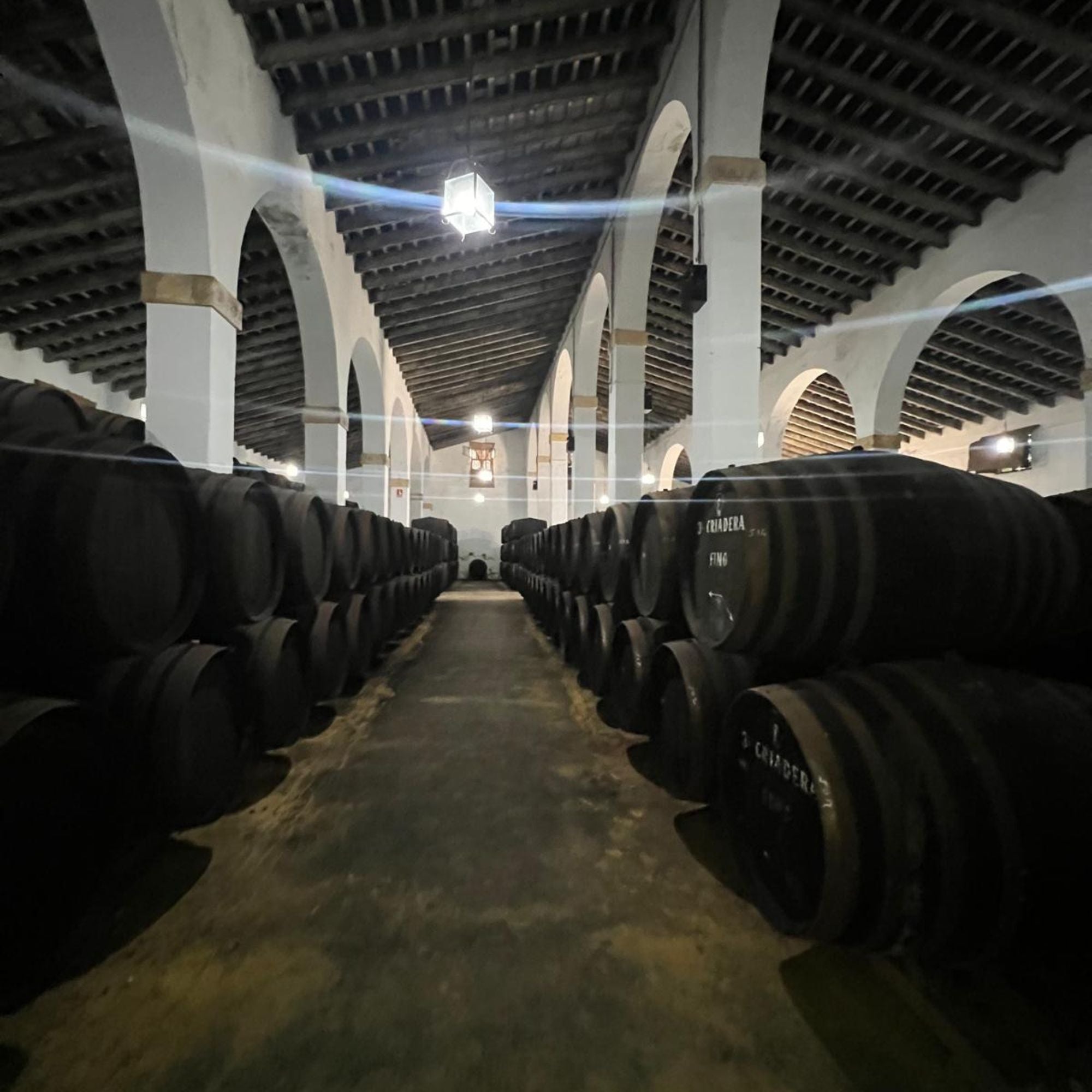
We were standing in the middle of the "cathedral," the enormous bodega where Manzanilla Solear matures. Montse explained that the left side is more influenced by the Levante, which gives the wine bitter notes, while the right side is more influenced by the Poniente, which gives it more salty notes. The barrels in the center are the most balanced.

This is where you realize just how complex it actually is. A picture of a solera always seems so neatly stacked in your textbook, but in reality, it's often quite different. A corridor often forms a single criadera, not a row.
The Solear solera is even located in a separate building. From there, the wine is bottled, or sent on to the pastora-solera (manzanilla pasada), or to the amontillado area, where the flor eventually dies off naturally due to different climatic conditions and the wine continues to age oxidatively.
Day 3: exam, wine and Beltrán Domecq
We started with a lesson on maturation by César Saldaña, a foretaste of what was to come: a VOS & VORS tasting led by Beltrán Domecq – the sherry king of Jerez.
VOS and VORS are special designations in the sherry world for the oldest and most complex wines. VOS stands for Vinum Optimum Signatum or Very Old Sherry , meaning the wine has aged for at least 20 years. VORS takes it a step further: Vinum Optimum Rare Signatum or Very Old Rare Sherry , which refers to sherries aged for at least 30 years. These titles are awarded only after rigorous testing. In short: bottled history.
Luckily, the exam was scheduled first, so we could then fully immerse ourselves in the aged wines (and, of course, take the exam feeling fresh and fruity). A few nervous faces here and there, but in the end, it turned out to be perfectly doable. A few nervous faces here and there, but in the end, it turned out to be perfectly doable. Want to practice yourself? Check out the advanced course from the Sherry Academy , that will save you some stress.

And then it was time for the VOS & VORS tasting with Beltrán. For those who don't know him yet: his father was a Domecq, his mother a Williams, and he himself is a kind of Dumbledore of the sherry world. He literally grew up with sherry and, at the age of eight, was already reciting Shakespeare's sherry poems for English guests. This man is Sherry. And even though he's long retired, he returns every year to host this tasting for new students on the Sherry Educator Course. Wonderful, isn't it?
Below are some highlights from the tasting:
-
González Byass – Matusalem Cream VORS
130g/l sugar, yet beautifully balanced. Raisins, apple syrup, maple syrup, dates, and coffee. Sweet, but not at sweet. -
Grupo Estevez – Oloroso Don Gonzalo VOS
Dry with less than 9g/l of sugar, yet round and smooth in flavor. Coffee, cocoa, raisins, and after 15 minutes, orange and apricot also emerged. -
Tradición – Oloroso VORS
Only 6.5g/l of sugar, yet so complex. Salty, orange peel, dried apricot. More fruit than the previous oloroso. Old, elegant, and endlessly complex. -
Williams & Humbert – Palo Cortado Dos Cortados VOS
“Have dos cortados and you'll do the right thing,” Beltrán's father always said. Orange peel, salted caramel, delicate and clean. Less than 6g/l of sugar, but so smooth! -
Álvaro Domecq – Palo Cortado 1730 VORS
Extremely complex and deep. Salted caramel, with a velvety texture. This is truly next-level sherry. -
Hidalgo La Gitana – Amontillado Napoleon VORS
This started out as a manzanilla and has evolved into a powerful amontillado. Toffee, caramel, orange, and mango, with a touch of volatile acidity. -
Diez Merito – Amontillado Fino Imperial VORS
Once a fino, now a richer amontillado. A full nose of toffee and dried fruit. Less pungent than the Napoleon, but rounder and softer.
After this special tasting we were still waiting for Sherry & Food Experience waiting. In case you didn't know: sherry is the most gastronomic wine on the planet. It can complement so many different dishes. This workshop demonstrated that.

Then it was time for the highlight: lunch at Bodegas Tradición. It feels like coming home now. First, a tour of the bodega, where the history and traditional methods of this relatively new bodega, built on centuries-old soleras, were explained.

Afterwards it was time for a delicious lunch on the patio, with unlimited fino, oloroso, amontillado, cream and PX from Tradición – what immense happiness.
Sherry Educator Course
I look back on a fantastic week in Sanlúcar and Jerez. I gained more knowledge about sherry, tasted over 45 sherries, and made new friends. The course was perfectly organized, with contributions from people from various bodegas and, of course, César Saldaña, the president of the DO Jerez-Xérès-Sherry – as you might expect, a huge sherry expert.

Would you like to become a sherry educator? You can. First, delve into sherry and make sure you have the advanced course from the Sherry Academy Have you completed your application? Then send your motivation to the Consejo Regulador, and who knows, you might be selected to come to Jerez. They usually only have one spot per country and give preference to people who work in wine.
Also fun: join our sherry course! Since I became a Sherry Educator, I've been organizing Le Club's Sherry Course. We meet once or twice a year. Find all the information here .




Share:
Dr Loosen and the Riesling Show
Chenin at its best: Savennières and Vouvray