
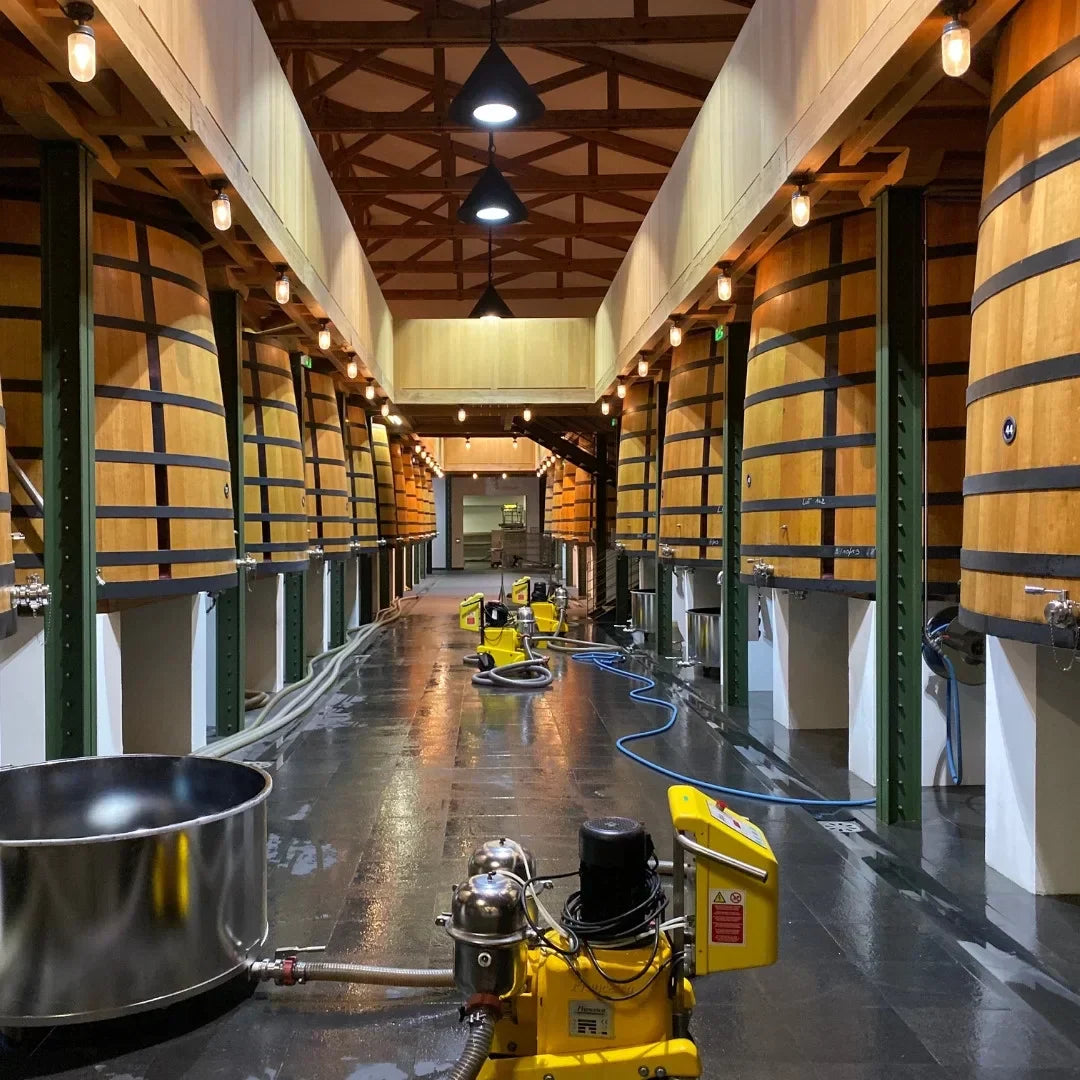
After the questions and answers about sulfites and malolactic fermentation, today's article is about alcoholic fermentation. I can't believe I never thought of that before. It's an essential step in winemaking.
How does alcoholic fermentation work?
During alcoholic fermentation, sugar is converted into alcohol. So far, so good. There's more to it, including CO2 and heat. CO2 protects the wine; it blocks oxygen. The energy not used by the yeast is converted into heat. The warmer, the faster the fermentation. Until it reaches about 35 degrees Celsius, then the yeast stops. Too warm.
White wine ferments at temperatures between 12 and 22 degrees Celsius. The cooler it is, the fruitier the aromas. Oak-aged white wines are usually fermented at a higher temperature (18-22 degrees Celsius).
If white wine is fermented too cool, it can produce isoamyl acetate . This gives it an aroma of pear licorice (which is what these candies are) and banana.
Red wine ferments at temperatures between 20 and 32 degrees Celsius. This is higher because more heat is needed to extract phenols—color, flavor, and tannin, etc. The higher the temperature, the greater the extraction.
Stopping the alcoholic fermentation
Fermentation stops automatically when the yeast has converted all the sugars into alcohol. There's nothing left to harvest, so the yeast dies. The result is a dry wine.
Sometimes it's desirable to stop fermentation early, before all the sugars have fermented, to create a semi-sweet or sweet wine. How does that work?
Lower temperature
Yeast is a diva and loves comfortable temperatures. For a fruity Pinot Grigio, that might be around 12 degrees Celsius, but lower is not desirable.
A low temperature (around 4-5 degrees Celsius) slows or halts alcoholic fermentation. This is seen, for example, in the Asti Method, but also in most Rieslings with residual sweetness. The wine is usually (lightly) filtered afterward to prevent fermentation from restarting.
Addition of SO2 and/or filtering
The above method can optionally be combined with the addition of SO2 to eliminate any risk of re-fermentation. In addition, the wine can be filtered to ensure it is free of yeast.
Addition of alcohol
Another option is to intoxicate the yeast by adding alcohol. Yeast can handle an alcohol content of 15% to 18%, depending on the yeast strain used. Grape distillate is usually added to increase the alcohol content. For sherry, a 95% grape distillate is added (though no longer required ), and for port, it's 77%.
Cooling the fermentation tank is the most common method for making sweet wine. It's a way to kill the yeast. These techniques, such as temperature-controlled vats and extensive filtration options, didn't exist in the past.
In the case of Recioto della Valpolicella, the outcome was a surprise. The intention was to produce a sweet wine, so fermentation was stopped early by transferring the wine from one barrel to another, hoping to leave the yeast behind.
Sometimes, some yeast did get carried over, and the wine ended up bitter ("amaro" in Italian), becoming an Amarone. And sometimes, this only became apparent in the bottle – resulting in a sparkling Recioto – once quite common!
Source: Veronissima.com
Spontaneous fermentation
Then there are a handful of winemakers who want to interfere as little as possible with the wine. It happens as it happens. One year it might be a sweet wine, the next a semi-dry, and the next a bone-dry wine. You often see this in the Loire.
The wine is fermented spontaneously, using yeasts native to the grapes. These yeasts don't always cooperate as well as commercial yeasts. Sometimes they're too slow (and time is money) or they suddenly stop. In the latter case—if the winemaker decides not to intervene—you're left with a (slightly) sweet wine.





Share:
Easy or not? Which cheese goes with which port?
Questions and Answers about Acids (Part 1)