
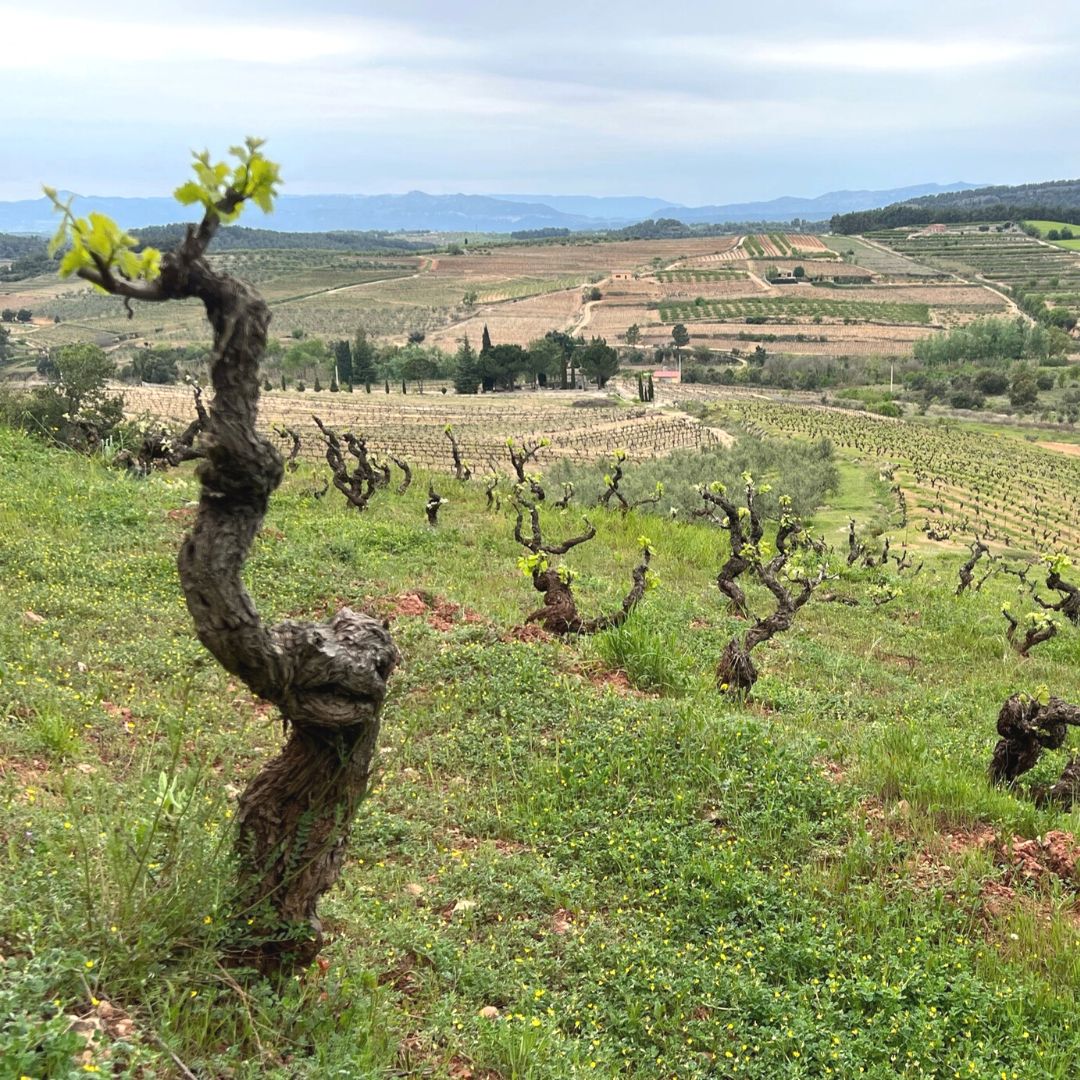
From conversations leading up to this trip, it became clear that few people know the Priorat. You can really only mention this region to wine enthusiasts. For everyone else, it's best to just say "a little bit south of Barcelona" when describing where you're going. That's not surprising, since besides wine, there's not much happening there. No problem, though, because there's plenty to tell about wine! In this blog post, I'll tell you more about the unique character of the Priorat and the wines that come from there.
Unique features
Besides the much better-known Rioja, the Priorat is the only Spanish wine region with the highest quality label, DOQ (Denominació d'Origen Qualificada in Catalan, DOCa in Spanish). For comparison, the Priorat has approximately 2,000 hectares of vineyards, while the Rioja has 65,000. It's no wonder the Rioja is so much better known.
The Priorat is a small region consisting of 12 villages, almost entirely surrounded by the DO Montsant. Montsant is not only the name of a wine region, but also of a mountain range: Sierra de Montsant. This mountain range has a significant influence on the Priorat's climate. It blocks the cool northerly wind, meaning it can remain incredibly hot and dry for extended periods in the summer. There are also significant elevation changes. Everything is very steep, and the landscape creates all sorts of microclimates.

There's one final aspect that makes the Priorat special: the soil. It consists of weathered slate and small particles of mica (a group of minerals that gives the stone a crystalline sheen). This soil, called llicorella , is incredibly poor. It contains almost no nutrients, forcing the grapevines to work hard and producing low yields.
God's stairs
Priorat is Catalan, meaning priory (monastery) in Dutch. We owe the vineyards in that area to the Carthusian monks. They built a monastery there because, so the story goes, a shepherd had a vision. He saw angels walking up the mountain, as if they were ascending a staircase to heaven. The monks therefore built a monastery on that spot in the 12th century and named it Scala Dei (God's Staircase). The prior (the highest-ranking monk) had his monks plant and maintain vineyards in the area surrounding the monastery.
That lasted until 1835, when the monks were dispossessed of their land by the state. Then, phylloxera threw a wrench in the works, and the quality of the wine plummeted. Until three prominent Rioja winemakers (Carles Pastrana, René Barbier, and Álvaro Palacios) became convinced of the potential of the Priorat. They breathed new life (and quality) into the region, which ultimately led to a DOQ (Declaration of Authenticity).
Grape varieties
The main grape varieties in the Priorat are Cariñena (Carignan) and Garnacha Tinta (Grenache Noir). Cariñena, in particular, is a rather robust grape. It produces abundant color, acidity, and tannin. Fortunately, they blend it with Garnacha, resulting in wines that are not only powerful but also have a fine fruitiness. My expectation of the Priorat was for those true knife-and-fork wines: robust tannins, incredibly high alcohol, and a bit bulky. I think my biggest discovery was that I was pleasantly surprised. Of the dozens of wines I tasted there, only a few were truly unbalanced and bulky. By creating the right blend, choosing regions (or plots) with the right microclimate, and aging them properly, the wines were almost always exceptionally drinkable and sometimes even truly smooth and fruity.
Wineries to visit
If you're heading that way, I have two wineries you absolutely must visit. Or actually, three: it would be fantastic if you could get into Alvaro Palacios , but unfortunately, they rarely welcome it. We managed it because we came with a group of wine professionals. Truly fantastic; we even got to taste the L'Ermita, a wine whose bottle definitely exceeds €1,000. Expect delicious depth: deep dark fruit, pepper, spices, and beautiful tannins. Very special, but not easily available.
So where should you go? To Albert Jané ! He's a passionate winemaker who works organically (or is transitioning to organic farming for some plots) and makes truly magnificent wines. He does this both in Montsant (under the Acústic Celler label) and in the Priorat (Ritme Celler). We were very impressed with virtually all his wines; every single one was top-notch. When Albert invited us for lunch and not only pans of paella appeared, but also an impressive number of magnums were opened, we were completely captivated. We decided to invite him for dinner, and I can assure you, we sampled his selection to the fullest.

A second tip is Genium Celler . This winery was founded by six families from Poboleda who collaborated to produce top-quality wine. We tasted their wines right on the street. No problem, as Poboleda is completely deserted, so the tapas table could easily be moved outside. I ended up holding a tasting in Walsjérôt with various wines from the Priorat and Montsant regions, and Genium Celler won the Priorat. Let's call it the People's Choice Award. So now, it's on tap at Walsjérôt.
One of the most famous villages in the Priorat is Gratallops. It's tiny, but it's home to some 20 to 25 wine cellars, from Alvaro Palacios to Mas Martinet. A great base for a stay during your trip to the Priorat is Trossos del Priorat , a beautiful hotel with stunning views over the vineyards. With Transavia, you can fly to Barcelona in just a few hours . From Barcelona, it's a short two-hour drive to Gratallops, the heart of the Priorat.
Walsjérôt offsets the CO₂ emissions from air travel.
Guest blogger: Jelle Stelpstra
Jelle Stelpstra started his career as a tax advisor but after 12 years switched to something even more interesting than taxes: wine. Jelle owns the Walsjérôt wine bar in Rotterdam and is a vinologist. At Walsjérôt, you can pour your own wine from over 70 wines.


Share:
2022: Nadien de Visser's top 5
Wine from Savoie, France