
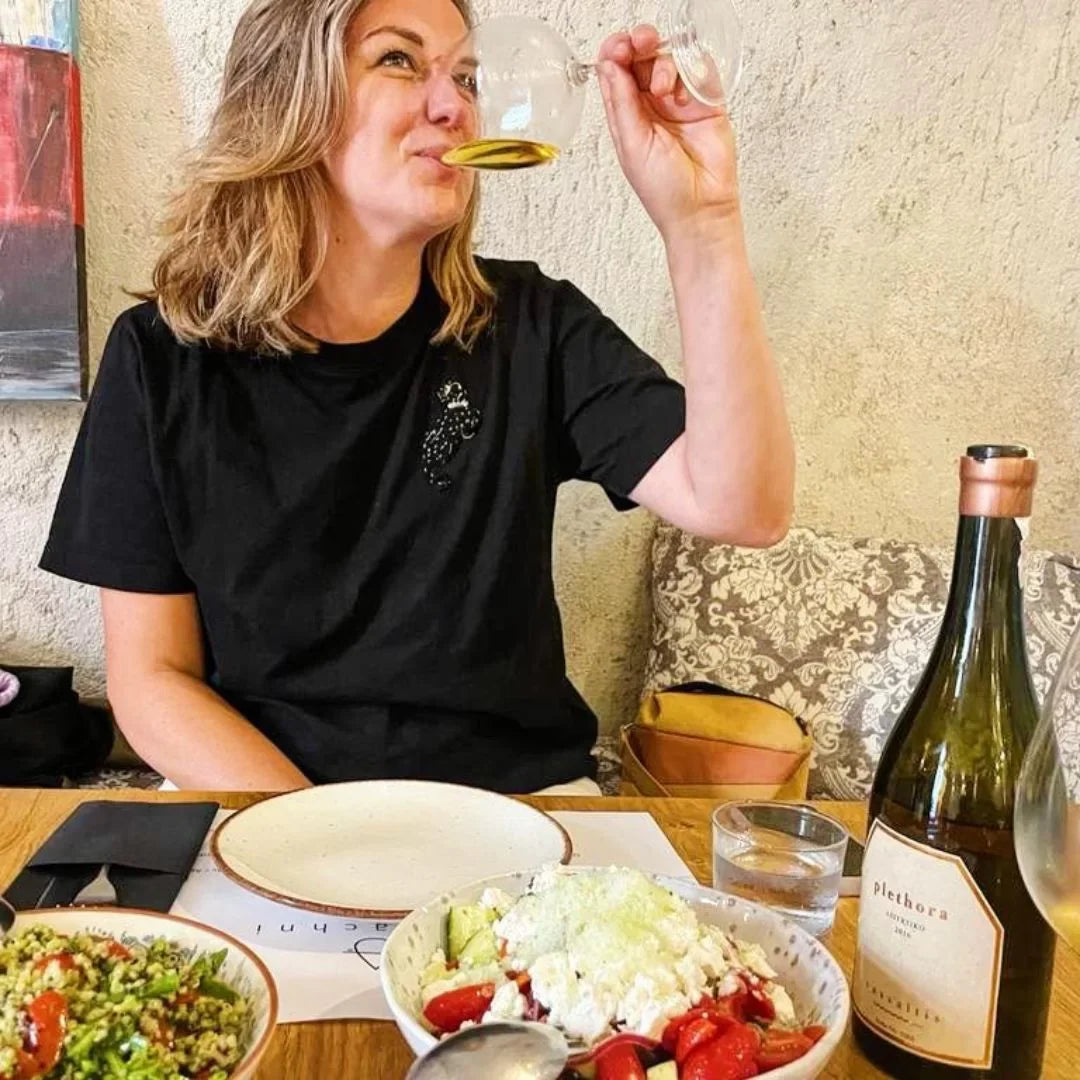
New column in December. Le Club asked wine enthusiasts for their top 3 or 5 of the past year. In this edition: Nadien de Visser, owner of Le Club des Vins.
It's always fun to make a list of favorites because it brings back those memories. In 2022, I traveled extensively. From Jerez to Santorini and from Madrid to South Africa. It was a dream come true. I tasted tons of wine, made new friends, and filled notebooks with writing. I still have many stories to compile into a blog post on Le Club des Vins, but I'll get started on that after the December rush. The first one has already been published, by the way: Douro .
For now: a list of favorites.
Burlotto, Barolo Monvigliero, 2018
I've never tasted such a refined Barolo. I think it was only with this Barolo that I truly grasped the essence of Nebbiolo. I visited in November and was given a tour by Fabio Alessandria, the fifth generation of the winery, who, along with his father, is responsible for the wines. The winery exudes tradition: 60-day skin maceration, fermentation in large wooden barrels, and the grapes for this Barolo are even stomped by foot. You expect a rustic Barolo, but nothing could be further from the truth. This Barolo is light as a feather and yet simultaneously blows you away. A-ma-zing.
It's a pricey wine and sold out in many places, but feel free to try it verduno pelaverga From the same estate. The Pelaverga Piccolo grape grows only around the Barolo village of Verduno, where Burlotto is located. Not as powerful as its big brother, Nebbiolo, but wonderfully juicy and easy to drink.
Bodegas Tamaran, Marmajuelo, Gran Canaria 2020
I understand it's a new addition to the Anfors collection. It was bound to happen, as the wines are made by Jonathan García, the winemaker of Suertes del Marqués in Tenerife. Bodegas Tamaran was founded in 2019 by David Silva, a former Manchester City footballer. I ordered this wine from Spain especially for the volcanic wine tasting. It's made from 100% Marmajuelo, a white grape variety native to Gran Canaria that I'd never heard of before. The wine is aged for ten months on its lees in neutral 2500-liter oak barrels. A captivating glass. Savory, creamy, and salty, all in a lively balance with the citrus peel.
The current edition is sold out, but the next one will soon be available for sale at Anfors .
Vassaltis, Plethora Assyrtiko, 2016
Discovered on Santorini, where I flew at the invitation of Volcanic Agriculture Europe. On the last day, we still had a few hours left, which we decided to put to good use: more tasting. It had to be the Plethora, which we'd heard about earlier from a friendly sommelier on a terrace in Oia. It was the most expensive wine on the menu, and we asked her if she could tell us anything about it. She was spot on, as she had interned at Vassaltis and told us that this wine ages under a thin layer of flor. You had me at flor .
The precise details of the winemaking process are unfortunately not easy to determine. What I do know is that the wine is aged for about 8-9 months in used oak (partly under flor, partly oxidatively – the barrels are not topped up) and then matures for another two years in the bottle before being sold. What happens in the glass is unique. Very layered. Roasted hazelnuts, toast, mandarin and grapefruit, flint, and that delicate, shimmering salty note so characteristic of Santorini and Assyrtiko. It's made from late-harvest Assyrtiko, a grape that naturally has a good alcohol content. Apparently, it also has a slight residual sweetness, but I can't recall that. I was too caught up in the moment – it was, after all, the last day of a 14-day press trip 😉
L'Anglore, Véjade, Vin de France, 2020
Life can be full of surprises. I'm not so quick to grab a Grenache or Mourvèdre wine from the shelf. Sure, a Priorat or Bandol might be quite appealing, but I'm happier with a slightly lighter wine, one in the energetic, fresh, exciting category. Generally speaking, that is, because sometimes the evening, the company, or the dinner calls for something heavier. Anyway, Véjade is a wine you don't see coming from the Rhône. It's a Natural wine , the winemaker in question isn't a fan of sulfites. I usually don't like wines without sulfites, but there are certainly exceptions. And you'll find them in this wine (and in other L'Anglore wines as well). The light ruby red color doesn't immediately bring to mind the Rhône, although: the wine has about the same color as many rosés from Tavel. It's very pure, not at all heavy (13%), extremely easy to drink, with delicate aromas of small red fruit, almost cherry candy, but from a health food store, plus some green herbs and earthy notes.
Make sherry great again
Of course, a sherry is a must. Now, I'm a big fan of the generally affordable sherries from big boy Valdespino , are the unfortified sherry and vinos de pastos of Luis Perez not to be sneezed at, but this year I also fell head over heels for the sherries of Bodegas Tradicíon . And actually also for the wines, the baby sherries that I was allowed to taste straight from the barrel, but then again, they don't come on the market. If you're ready for next level sherry , then I can highly recommend Bodegas Tradicion Amontillado! Although that Cream still, yes...
happy new year!
Share:
Douro, the most beautiful wine region in the world?
A wine lover in Priorat