
In the Netherlands, Savoie is primarily known as a winter sports destination, but anyone who's ever skied here as a wine enthusiast knows that they produce some fantastic wines. Sparkling wines, white wines, and red wines: you'll find everything here, almost always characterized by a delicate, mountainous freshness. Time to get to know this region better.
Savoie is located in eastern France, bordering Lake Geneva and Switzerland. The French Alps, including, of course, Mont Blanc, tower over everything, making the region incredibly fragmented. Most wine regions are located near Lake Geneva, around Lake Bourget, or along the banks of the Rhône River. See the map below from Winefolly.

Grape varieties of Savoie
Altesse, Jacquère for white and Mondeuse, Pinot Noir, and Gamay for red. These are the most important grape varieties to remember.
Savoie also boasts some obscure grapes. Verdesse and Étraire de la Duie are grape varieties you might never have heard of. That's because they're found nowhere else but in Savoie. And then there's not always Vin de Savoie on the label, because some of these grapes aren't included in the AOC Savoie. Oh, wine law, it can never be easy.
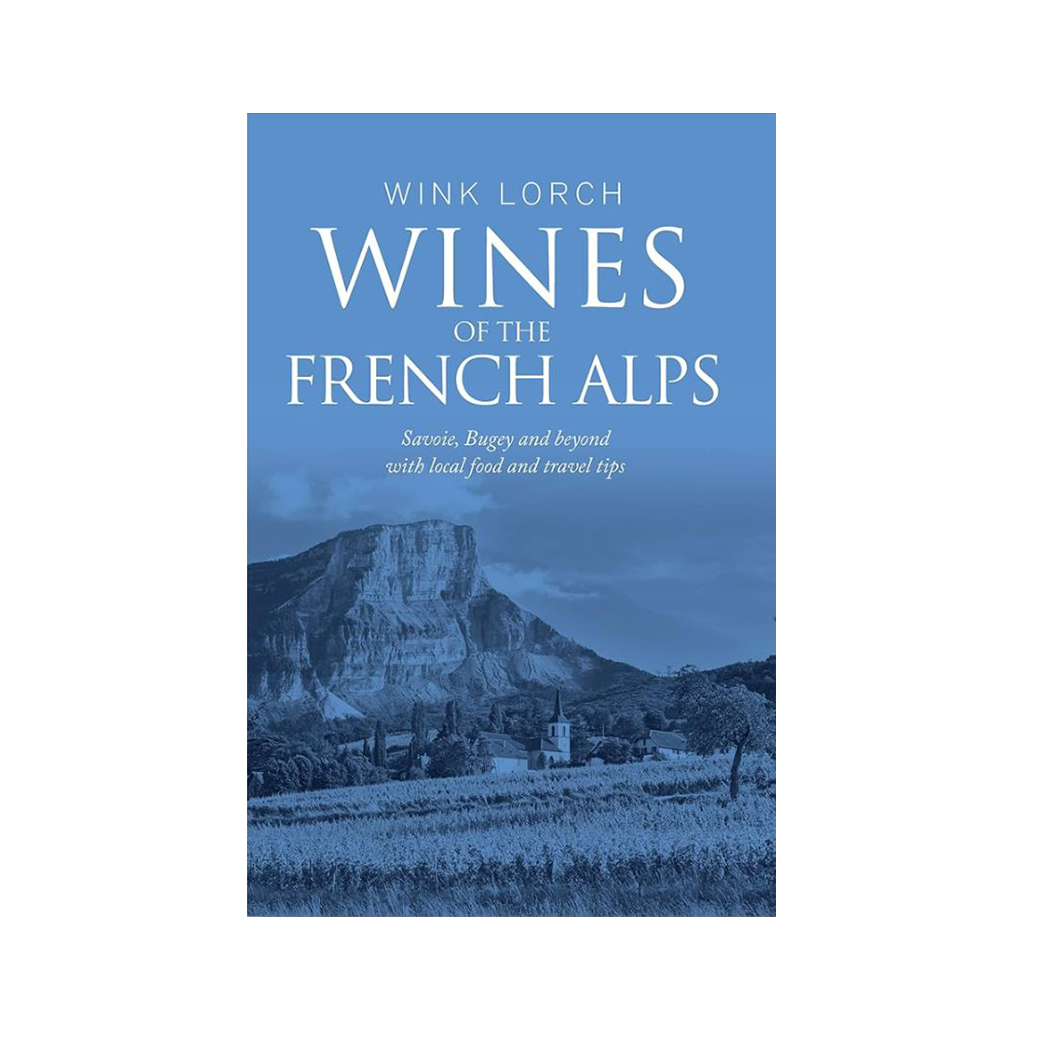
Not easy, but very nice: Wines of the French Alps . This book tells you more about wines from the Savoie region and beyond. It's a great book to take with you if you're planning a winter sports holiday in this area.
White grapes
Aligoté, altesse, chardonnay, chasselas, jacquère, mondeuse blance, velteliner rouge précoce, roussette d'ayze, gringet (Marsanne, Verdesse in Isère)
Blue grapes
Pinot noir, gamay, mondeuse, cabernet franc, cabernet sauvignon (persan, etraire de la dui, servanin, joubertin in Isère)
The wine regions
The area covers approximately 2,000 hectares and is divided into four AOCs:
- AOC Savoie
- AOC Roussette de Savoie
- AOC Seyssel
- AOC Crémant de Savoie
AOC Savoie
AOC Savoie is the largest appellation in the region and has numerous sub-appellations. The grape varieties used for red wines are usually listed on the label. Mondeuse, Pinot Noir, and Gamay are the most common red wine varieties.
- Chignin , Jongieux , Chautagne , red and rosé made from 90% Mondeuse, Pinot Noir and Gamay
- Arbin and Saint-Jean-de-la-Porte , exclusively red from Mondeuse
If these wines are made according to the regulations, they may display the sub-appellation on the bottle. Otherwise, they are labeled AOC Savoie (provided the wine is made from authorized grape varieties).
For white it is more cryptic, the grape variety is not always stated on the label.
Apremont, Abymes, St-Jeoire-Prieuré, Chignin, Cruet, Jongieux, Chautagne
Here, Jacquère is at the helm. It is the most widely planted grape variety in Savoie, with a total area of approximately 900 hectares. It is a grape that rarely achieves high sugar levels and often requires chaptalization (especially with high yields).
Chignin – Bergeron
Chignin-Bergeron is made from 100% Bergeron, better known as roussanne.
Ayze
Does it say Ayze on the bottle? Then the wine must be 50% gringet. A grape no one has ever heard of, it grows near Ayze, between Geneva and Chamonix. It's almost extinct; only 20 hectares are cultivated. The grape is likely related to molette (from Seyssel) and gouais (an important ancestral grape, to which many grapes we know today are related). We drank one, Crocus Alpines, from Domaine Famille Montessuit and it tasted very good (mountainous freshness, texture, slightly salty). One of the best-known producers is, by the way, Domaine Belluard . Sparkling wine is also produced in Ayze.
Crépy, Marin, Marignan and Ripaille
Chasselas originated in Switzerland, so it's not surprising that it's primarily grown near Lake Geneva. It was once an important grape variety, but plantings now total no more than 100 hectares. In the Swiss Valais region, Chasselas is grown as fendant Through life – who knew? Until 2008, you could consult the AOC Crépy for a glass of Chasselas, but that appellation has been discontinued. For the sub-appellations Crépy, Marin, Marignan, and Ripaille – all close to the Swiss border – the wine must be at least 80% Chasselas.
AOC Roussette de Savoie
This appellation was created in 1973 and is specifically intended for wines made from 100% Roussette de Savoie – or altesse . Can it be more complicated? No.
Within Roussette de Savoie there are four sub-areas:
- Frangy (Haute-Savoie)
- Marestel and Monthoux (west of Lake Bourget)
- Monterminod (near Chambéry)
AOC Seyssel
Seysel's vineyards are located near the town of the same name, partly in Haute-Savoie and partly on the west side of the Rhône River. Most white wines are made from Altesse, but here and there you'll also find Molette, an obscure grape variety that has almost disappeared. Sparkling wine is also permitted. Oddly enough, since the arrival of AOC Crémant de Savoie, it must be made of 70% Molette—much to the frustration of producers.
AOC Crémant de Savoie
A relatively young AOC, Crémant de Savoie was launched in 2015. The 2014 harvest was the first to be used and, after at least 12 months of maturation, it was released onto the market in December 2015.
Like all other crémants, Crémant de Savoie must also be prepared according to the traditional method It must be aged on the lees for at least nine months, followed by a three-month maturation period after disgorgement.
The permitted grape varieties are the same as those used in the region for still wines. This is convenient in Savoie, as they also plant Chardonnay and Pinot Noir, just like Champagne. But it's not that simple. There are more regulations regarding grape varieties. Typicity is important, and besides, we're making Crémant de Savoie, not Champagne, so the law stipulates the following:
- The blend must contain at least 40% jacquère;
- The blend must contain at least 60% jacquère and altesse (but it may also be only jacquère, as in this bubble from Quénard;
- The remaining 40% may be supplemented with other grape varieties from Savoie, but the red grape varieties may never comprise more than 20% of the blend.
Also worth mentioning: IGP Vin des Allobroges
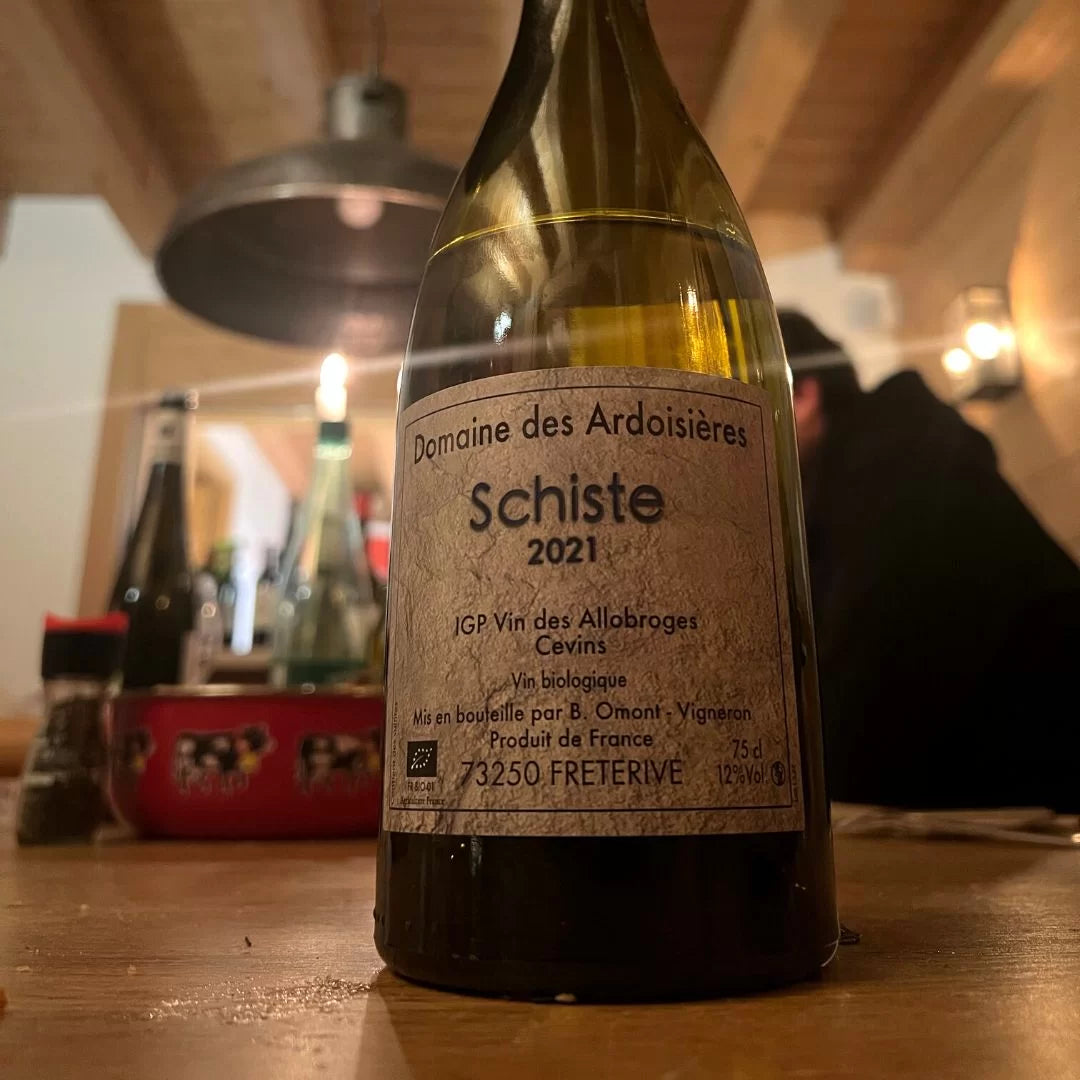
If you walk into any wine shop in Chamonix—for a small village, they have a surprising number—you can't miss Vin des Allobroges. While it is an IGP, it's an interesting one. In a nutshell: the area is larger than AOC Savoie and many more grape varieties are permitted. Sparkling wines have been banned under this IGP since 2016. Try the schist from Domaine des Ardoisières. It's excellent, and the added bonus is its low alcohol content (11-12%).

Want to know more?
Then I recommend you the book by Wink Lorch called Wines of the French Alps I also wrote a blog about the wine from Adrian Berlioz from Chignin.
Share:
A wine lover in Priorat
Santorini, kouloura & assyrtiko