
Imagine this happening to you: you're invited on a press trip to Santorini. The moment I stepped off the plane, a wave of excitement coursed through me. The blue sea, the white houses, the rock formations, and the vines in the distance. It does something to you.
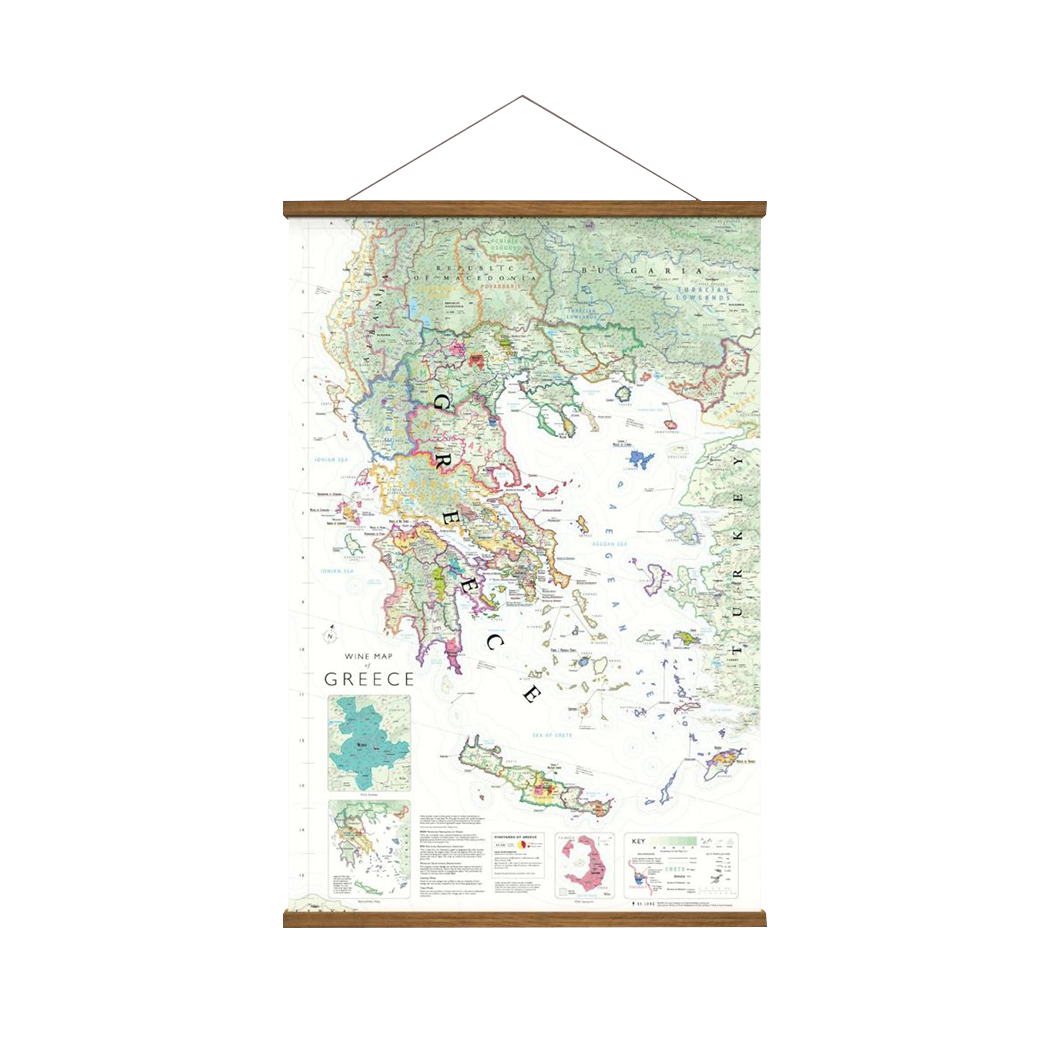
Santorini is located in the Aegean Sea, about 100 kilometers north of Crete. The archipelago was formed by several volcanic eruptions, from 2 million years ago to a massive volcanic eruption about 3,700 years ago. This last one destroyed the city of Akrotiri, which was buried under meters of pumice. Some of it has been recovered and can be visited.
Santorini is shaped like a donut, with a few bites taken out. It's a beautiful sight when you look at the caldera (the inside of the donut, so to speak) and looking out over the water and the black rocks that together form the archipelago. Before you know it, an hour has passed and you have a hundred seemingly identical photos in your camera roll.
It is those volcanic soils that do something special to the wines.
Black lava soils
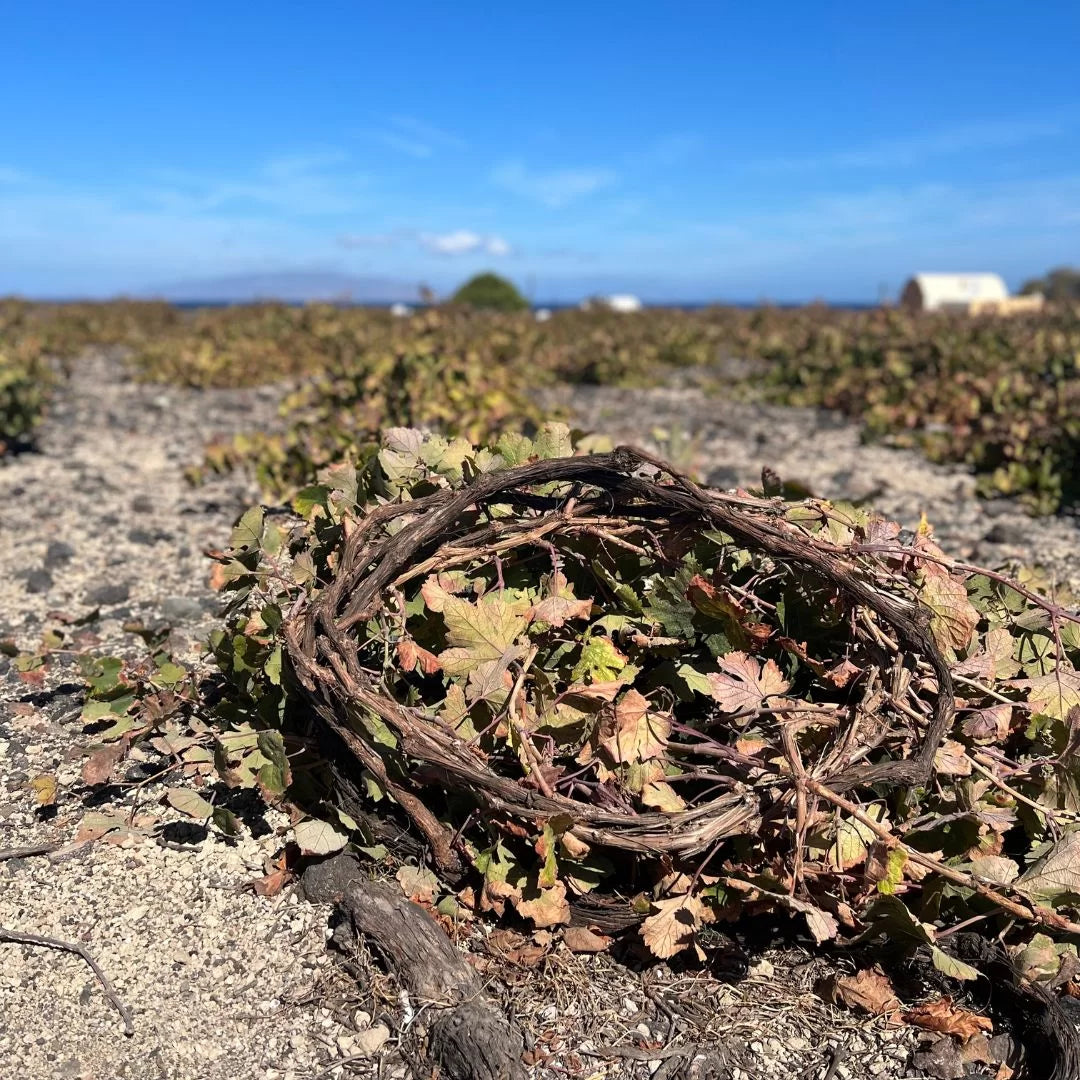
It looks like a lunar landscape, those baskets on the black lava soil. A vineyard on Santorini looks quite different from one in the Mosel or Burgundy. The farmers use a centuries-old pruning technique, kouloura The vines are woven into baskets. This is not without reason. It has everything to do with the island's rugged terroir. Strong sea winds rage on Santorini, which can damage the vines and/or grapes. The grapes grow inside the basket, protecting them from the wind. In addition, the leaves drape over them, which in turn provides protection from the bright sunlight. Finally, the vines grow close to the ground, allowing them to easily reach the (limited) moisture.

The volcanic soil, aspa called, is rich in minerals, but lacks potassium. Potassium is necessary For photosynthesis and helps neutralize acids and raise the pH. A potassium deficiency lowers the pH and produces that fine acidity in the wine. Is that the key to minerality?
Not quite. The age of the vines is at least as important. Some vines are over 200 years old. Phylloxera has never been a threat here. Other plant diseases are also rare, so there's no reason to use herbicides or pesticides. These agents kill microorganisms that form the bridge between minerals and the roots.

In addition, the wind, which rages wildly across the island, leaves salt on leaves and grapes. This can be found in the wine. Also measurable, see The results published by SevenFiftyDaily . Assyrtiko, and especially Assyrtiko from Santorini, is known for that salty freshness, which I'd venture to call minerality—but who am I...
Assyrtiko
Assyrtiko is the most important grape variety of Santorini, and perhaps even of Greece. Not so much in terms of plantings, as there are only 2,000 hectares of Assyrtiko planted in Greece (for comparison: there are 35,000 hectares of Chardonnay in France), but in terms of popularity.
Greece is a small wine country compared to major players like France and Italy. As a small player, you only get one chance to make your mark. You see that with Austria (Gruner) and Germany (Riesling). For Greece, that's Assyrtiko. tells Yiannis Paraskevopoulos of Gaia Wines in the I'll drink to that podcast.
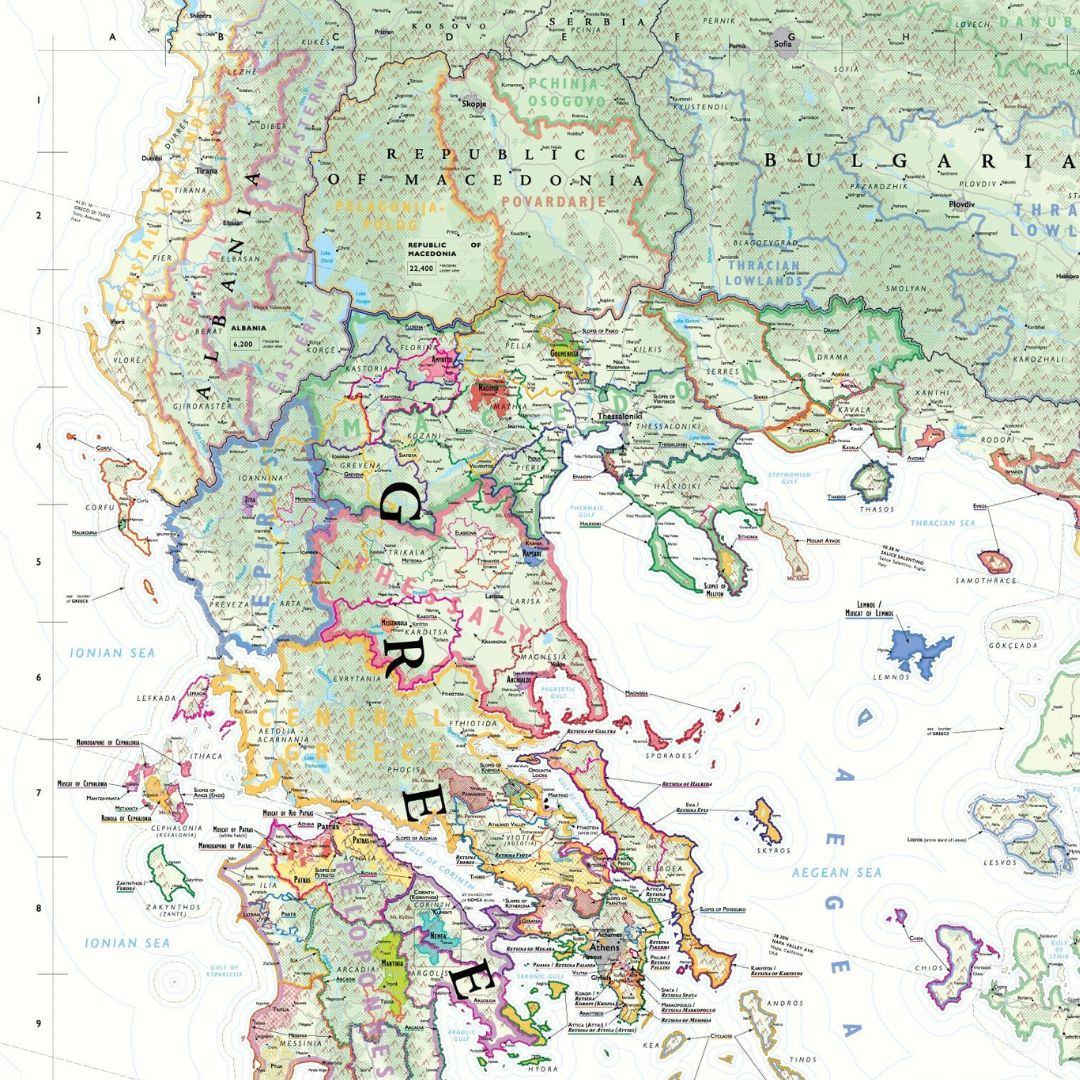
Assyrtiko has put Greece on the map. According to JancisRobinson.com About 60% of all Greek assyrtiko are located on Santorini and Therasia (small volcanic island northwest of Santorini).
Despite the intense sun on Santorini, Assyrtiko retains its acidity. This is also the reason why the grape has become increasingly popular in recent years. Chris Mullineux and Eben Sadie, two top growers from South Africa, planted Assyrtiko as an experiment and are both surprised by the results. In these uncertain times of climate chaos assyrtiko might just be the answer.
Assyrtiko is a phenolic grape variety. Phenolic compounds comprise several hundred chemical compounds that influence flavor, color, and mouthfeel. Surprisingly (at least to me), Assyrtiko is rich in tannins. These compounds react strongly with oxygen. Oxygen management during winemaking, as well as for bottle aging (cork vs. screw cap), is therefore important. Oddly enough, bottling with screw caps is prohibited under the Santorini PDO.
Besides acidity, Assyrtiko is naturally high in alcohol. It's up to the winemaker whether they express this in the wine. Sometimes they're picked earlier or blended in a specific way to keep the alcohol content within limits. While Yiannis Paraskevopoulos, founder of Gaia Wines, pursued a French style of Assyrtiko, his daughter Leto doesn't shy away from alcohol and instead harks back to tradition. There's something to be said for both. The question is which trend is stronger: wines with less alcohol or a yearning for tradition and authenticity?
Styles
Assyrtiko offers endless possibilities. The PDO Santorini label includes both dry Assyrtiko and Vino Santo, the island's sweet wine. The wines must contain 75% Assyrtiko and may be supplemented with, among other things, Athiri and Aidani.
The style of dry wines depends on the producer. In short: Argyros is known for its tight, mineral style, while the wines of Sigalas and Gaia generally have a slightly fuller and rounder flavor profile. Then there's Santorini Nykteri, where nykteri literally translates to "product of the night": the grapes were pressed on the same day they were harvested, usually in the evening. It must contain 13.5% alcohol (usually more) and is aged in oak for at least three months. Most nykteri are rich, full-bodied, and generous.
Producers
During the press trip, we visited four houses and tasted many wines. You can find the highlights below.
Argyros Estate
Founded in 1903 and renovated in 2014, Argyros is now a state-of-the-art estate nestled amidst the koulouras overlooking the sea. Argyros is run by the fourth generation, Yiannis Argyros. They own approximately 130 hectares of vineyards, the largest privately owned vineyard in Santorini. The average age of the vines is 70 years, with the oldest over 200 years old.
Do you love wines with a truly undeniable minerality? Then try the wines from Argyros Estate. Mineral, salty, and exciting.
Estate Argyros 2021
High acidity, citrus aromas, structure through fine bitters, salty, smoky.
Cuvée Monsignori Santorini 2019
Made from 220+ year old vines, 11 months sur lie, savoury, bitters, lemon peel, creamy, salty, crunchy acidity, unprecedented length.
Cuvée Evdemon 2019
Biodynamically grown on 180-year-old vines, 25% aged in second- and third-year French oak for 12 months, 75% aged on lie in stainless steel for 30 months. A beautiful balance between the creamy mouthfeel and razor-sharp acidity.
Fun fact: there are few old vintages on Santorini. Argyros is taking that to heart and has built a wine cellar with space for 150,000 bottles. Assyrtiko has a knack for aging, and Argyros wants to show it off.

Domaine Sigalas
Much younger than Argyros is Domaine Sigalas, which was founded in 1991. Domaine Sigalas was founded by Paris Sigalas, who in 2020 owned just over half (60%) of the estate. sold to Thanasis Martinos for a hefty sum. The wine estate has 37 hectares spread across the island. In the book Santorini by Yiannis Karakasis (yes, everyone is called Yiannis in Greece) states that in 2015, Paris Sigalas separately fermented grapes from seven different villages on Santorini, a series he called " The 7 Villages ." The idea was to showcase Santorini's diverse terroirs side by side.
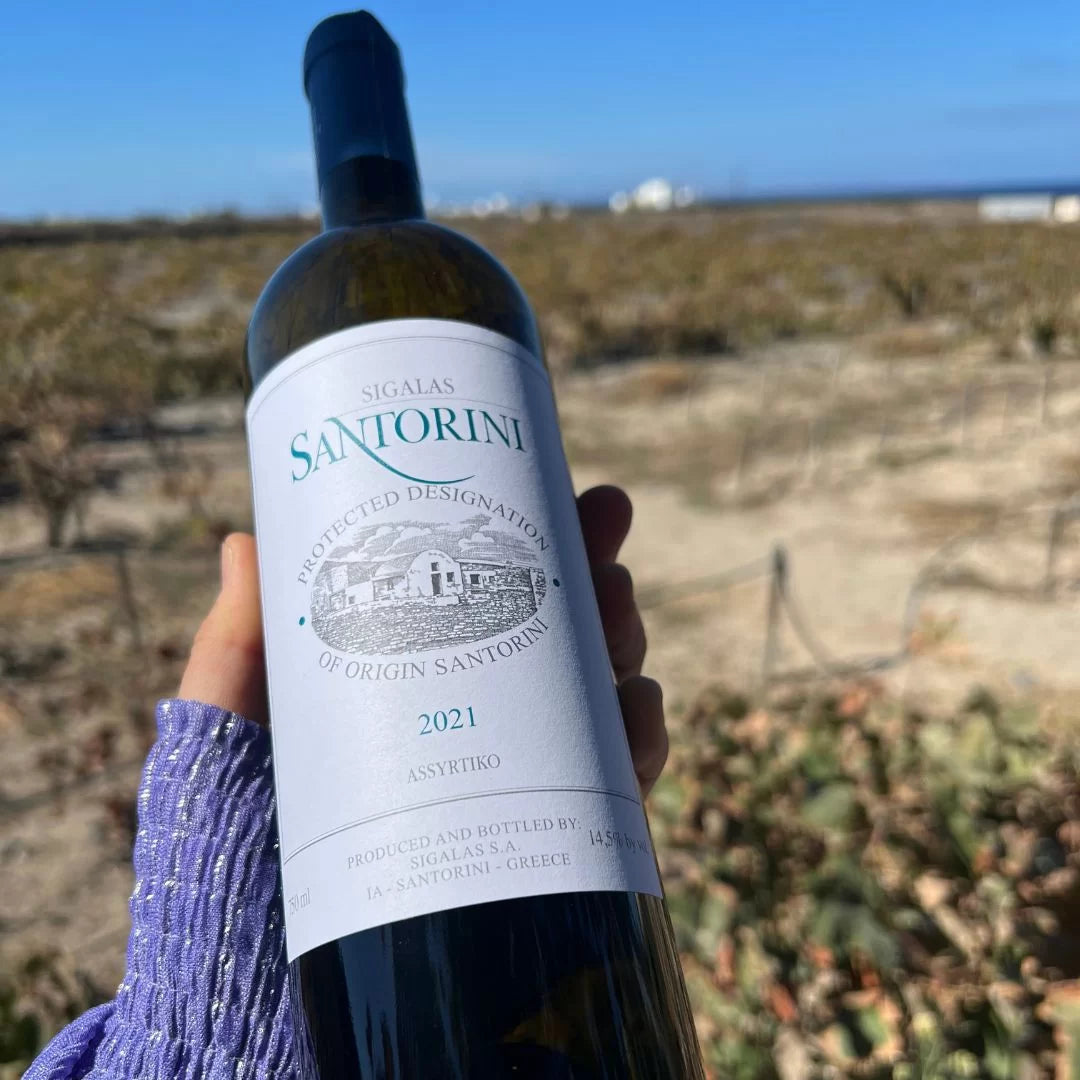
At Sigalas, in addition to tasting, you can also have an excellent lunch with a view over the vineyards.
Sigalas Aidani 2021
Aida—who? Aidani, Santorini's second grape variety. Only 30 hectares are planted on Santorini. It is more aromatic and expressive than Assyrtiko. White flowers, pear, melon, lychee, a bit salty, and the acidity is milder than Assyrtiko .
Sigalas Santorini 2021
Savory, lemon peel, energetic acidity, creamy coat of lie-maturation, bitters.
Sigalas Kavalieros 2020
The first single vineyard wine from Santorini, a high-altitude vineyard in Imerovigli. Fermented and aged in stainless steel for 18 months. Oyster shells, maximum salinity, wet stone, concentrated.

Santo Wines
Santo Wines is the island's cooperative. They have no fewer than 1,200 members. A remarkable story, because every winegrower on the island is automatically a member of the cooperative, whether or not they supply grapes. Due to the popularity of assyrtiko and rising demand, the price per kilo has risen considerably over the past 10 years. Where farmers previously received 75 cents per kilo, that has increased. in 2018 About five euros. Those are champagne prices. So, owning a plot of vines on the island is quite lucrative. And the problem is: no one sells it. The cooperative is the largest producer, with a total volume of 500,000 bottles per year.
They get it at Santo Wines: there's a terrace with spectacular views over the caldera and the sunset.

Santo Wines Assyrtiko 2021
This was the first glass I received on Santorini, and it was exactly what I needed and expected from Assyrtiko. Good acidity, a subtle saltiness, and plenty of citrus (grapefruit). It might lack a bit of concentration, but I didn't really care about that at the time.
Gaia Wines
The Gaia wine estate is located a few meters from the sea. It is owned by the aforementioned Yiannis Paraskevopoulos and Leo Karatsalos, although Yiannis' daughter Lito is now in charge.
Gaia Thalassitis 2021
Thalassites is Gaia's entry-level wine, but that sounds irreverent. Expressive, open, creamy, grapefruity, and salty. Typical of Santorini.
Gaia Thalassitis 2015 (cellar-aged)
Assyrtiko can oxidize quickly, so reductive action is important. This can be done in two ways: with sulfites, as in this Thalassitis 2015, which remained in the cellar for an additional five years. Or by aging the wine at sea. According to Leto, however, five years proved too long – the wine was too reductive, so now they're aiming for four years of aging at sea. We tasted the cellar-aged 2015: creamy, salty acidity, grapefruit peel, candied citrus, nutty, and slightly smoky.
The Greek made a wine also known as “ thalassites ”, by placing vessels full of must in the sea, a method which quickly imparts to the wine all the qualities of old age. Read more >
Gaia Wild Ferment 2021
Fermented with wild yeasts. Partly in stainless steel, partly in wood (American oak, French oak, and French acacia), and a small portion in amphora. The oak is noticeable in its youth, so if you don't like it, wait a few years . It's also called "a Burgundian expression of Assyrtiko." It's rich, generous, and full of yellow apple, lemon peel, hazelnuts, vanilla, and almonds, all without losing that vibrant acidity and salty undertone.
Gaia Ammonite 2020
The showpiece. From the Thalassina vineyard, made from 300-year-old vines. Matured largely in tank, with 8% in second-year oak. Aged for 15 months on lees, this contributes to the wine's texture. This texture, combined with the intense freshness, is truly breathtaking.
Also nice to visit or try
Our flight wasn't until late afternoon, so we had some spare time on the last day We decided to put some free time to good use at Alisachni Art & Wine Gallery in Megalochori. Earlier that week, we'd discovered Vassaltis Plethora, an Assyrtiko wine aged under flor. It was on the menu at Alisachni, and it's a great lunch spot, so the decision was easy. From the hotel, Impressive One Hotel , you can walk to Megalochori in about half an hour. Don't expect a scenic route: there are no sidewalks on Santorini, so you'll walk along the road. Eyes on the prize. On the way, we passed the Venetsanos winery. Well, since you're there anyway. Unsuspectingly, we walked inside and settled down on a terrace with another spectacular view of the caldera. That never gets old. Also nice: Venetsanos makes an orange wine from Assyrtiko here.
Tasting note Vassaltis Plethora 2016
Nykteri-style, overripe grapes, 12 months of oak with floral influence, 1,110 bottles produced. Full-bodied and savory, grilled peach with salt, roasted hazelnuts, and lemon zest—impressive.

On to Santorini
Be warned: it gets crowded during peak season. Only 15,000 people live permanently on Santorini, but the island welcomes 2 million tourists a year. And they mostly come in the height of summer. I went in October, and it was wonderful. Few tourists and a perfect temperature. Transavia you can fly there directly in about 4.5 hours.
We slept in the Impressive One Hotel And that was fine, just outside the towns, but you can walk (although along the highway) to Megalochori. On to Santorini!
Thanks to Volcanic Agriculture of Europe (HEVA) for this press trip .


Share:
Wine from Savoie, France
10 Grape Varieties You Need to Know as the World's Best Sommelier