
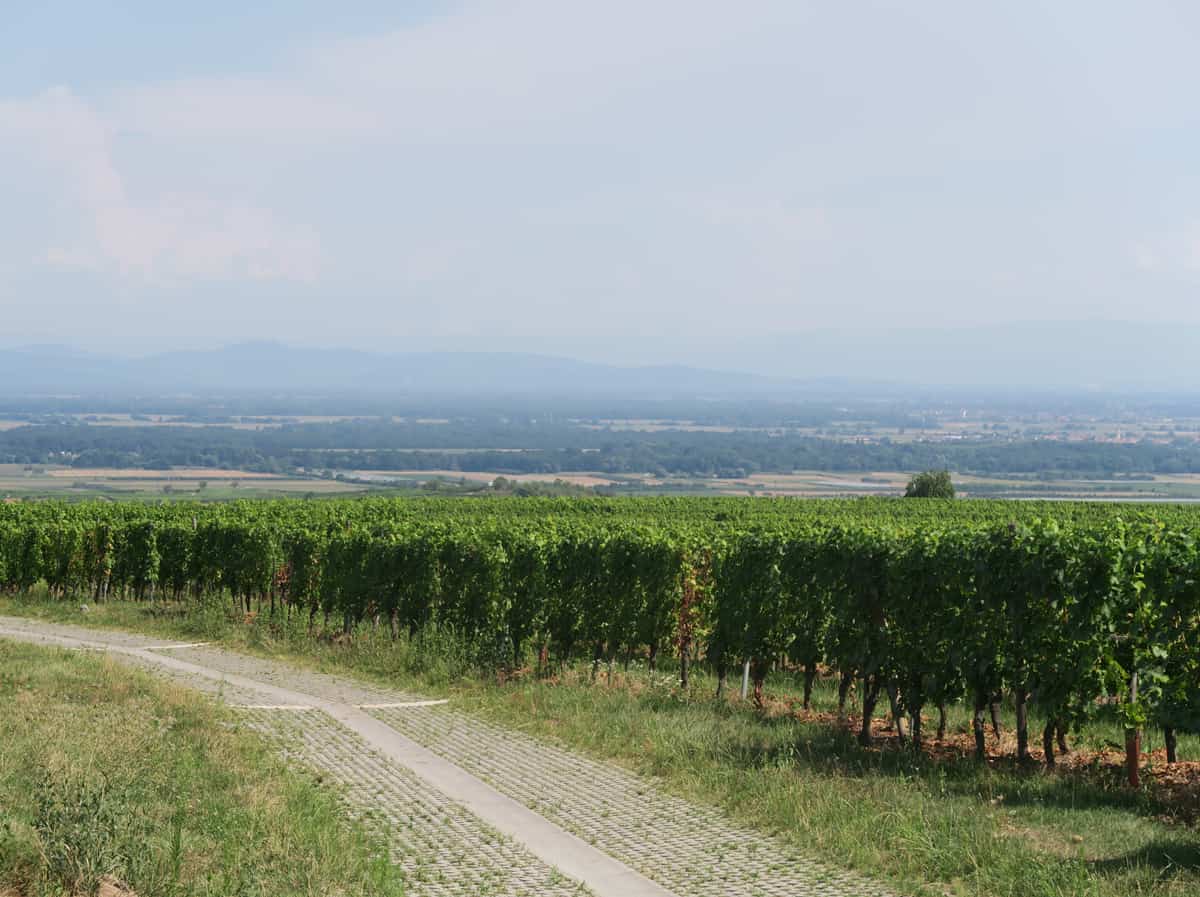
This year, 2017, I was first introduced to Marcel Deiss . I'd heard about him, but never really delved into him. When I did, it turned my world upside down for a moment.
Marcel Deiss (or rather, grandson Jean-Michel Deiss and great-grandson Mathieu Deiss (also known from Vignoble du Reveur ) are now at the helm of the Deiss winery) is a bit The enfant terrible of Alsace . The wines are as idiosyncratic as the man himself.
While Alsace is all about specific grape varieties and mono-varietals, Deiss is all about one thing: Terroir . The grapes are secondary. He does the unthinkable: his wine is a blend of different grapes from a single vineyard. Say what? People thought he was crazy, but Deiss persisted. The fact that he also threw in Riesling tainted with noble rot was a real death blow for some. For others, it was a case of world upside down in a positive way.
Wine is bottled poetry
Not only does he plant the grapes together, he also harvests them simultaneously. What happens with early- and late-ripening grapes? Deiss claims it's possible, and he even ferments the grapes together—something you rarely, if ever, see. Why, you might ask? But Deiss thinks: why not? According to him, making wine from a single grape is like writing poetry with a single syllable. Beautiful. So, we're getting very close to the expression "wine is bottled poetry."
By the way, don't think it's easy, just randomly planting a set of vines in a vineyard, harvesting the grapes, mixing them together, and making wine. There's a five-hundred-year-old theory behind it, which seeks the right soil for the right grape. This is what we call Complantation , the art of planting different grape varieties on a specific type of soil.
Yet these blends aren't entirely unfounded. Blends are indeed made in Alsace. Take Edelzwicker and Gentil, for example. Gentil consists of at least 50% Riesling, Muscat, and/or Gewürztraminer and may be supplemented with Sylvaner, Chasselas, and/or Pinot Blanc. Unlike Deiss, the grapes must be fermented separately. Edelzwicker is no longer subject to any requirements. The term has existed since 1644 but was abandoned in 1970. Edelzwicker is still produced, but no longer regulated by the AOC law.
It's hard work, prioritizing quality over quantity. The planting density is incredibly high. The vines are so close together that they have to compete for nutrients. The one with the best fruit (grapes) advances to the next round. Yields are low. While four bottles per vine is normal in Alsace, Deiss calculates less than one per vine.
Tasted
Marcel Deiss, Alsace Blanc, 2014
A truly exceptional wine. While his approach deviates from the norm, his wine—the final result—is emblematic of Alsace. A richness and complexity that is truly remarkable. Fresh, ripe, and dried fruit intertwine. And this is just the entry-level wine… Anyway, the fairy tale is over. The bottle is empty.


Share:
A wine fan in Lisbon: 24 hours!
Savage: Simplicity is rarely simple