
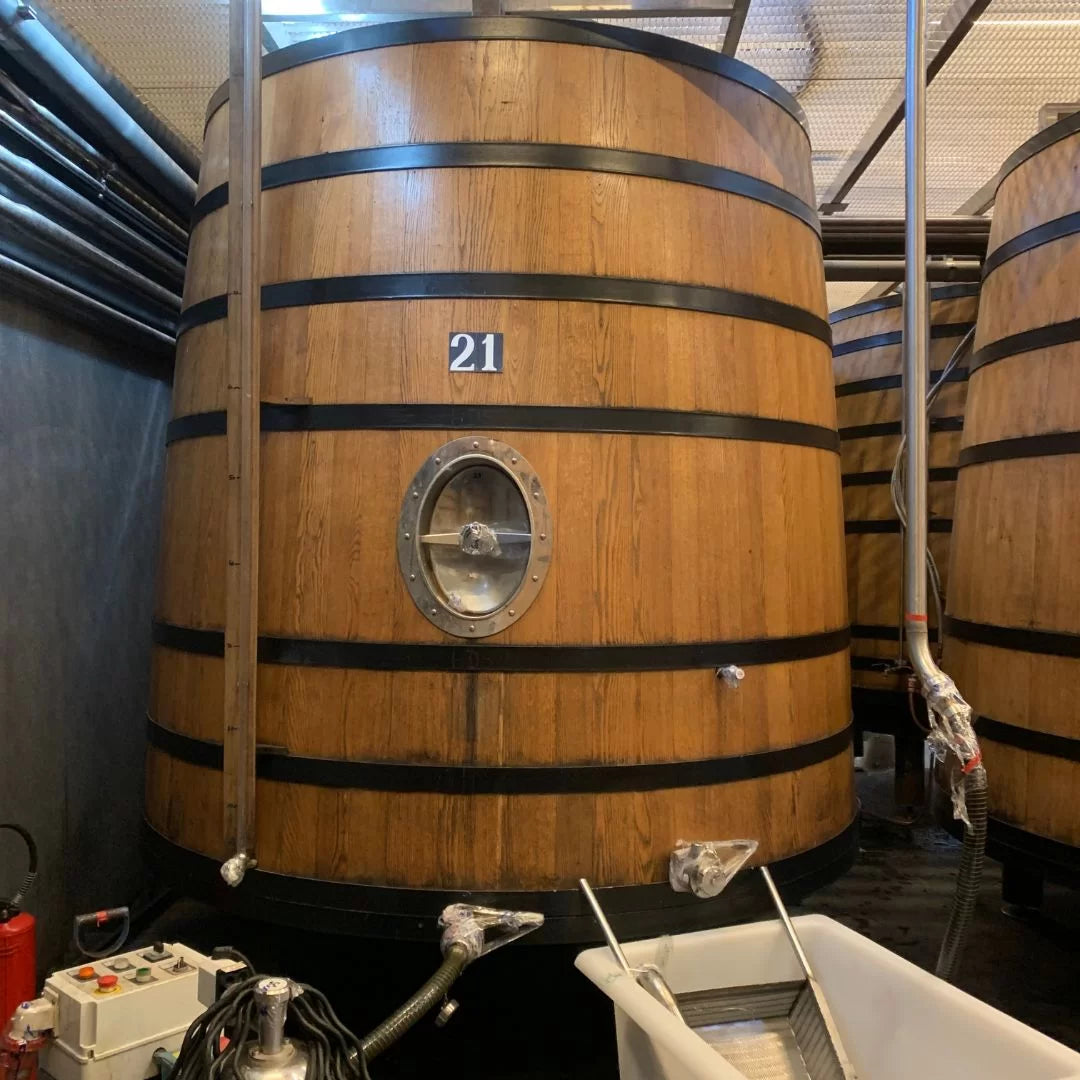
Last month I interned at Chateau Smith Haut Lafitte (SHL) . In the winery, there was a single barrel completely cordoned off with tape. No one was allowed to touch it, and it was quite hysterical. That certainly piqued one's curiosity. Two men came daily to oversee the wine's fermentation process. What did I find out? This was a rabbi and another from the Jewish community. What were they making? Kosher wine .
What is kosher wine?
Kosher wine is wine made by members of the Orthodox Jewish community. It's an important part of celebrations and ceremonies. They maintain strict rules when it comes to food and drink. The word "kosher" comes from Hebrew and actually means "suitable," as in: suitable for consumption. Grapes are one of the seven sacred fruits in the Jewish Bible. There's even a quote dedicated to it: "Blessed are you, Lord our God, who creates the fruit of the vine." And we, of course, completely agree with them.
How do you make kosher wine?
Kosher wine can be as good or bad as other wines, because it's made in exactly the same way. Kosher wine used to have a bad reputation, but today, top quality is also available. Jewish winemakers are scarce, so you're increasingly seeing collaborations with existing "regular" producers. It was strange to see grapes from the exact same vineyard going into both regular and kosher tanks.
The kosher tanks were filled a day later, as the preparation is quite an undertaking. Early in the morning, all the machines, hoses, and pumps were thoroughly cleaned by the rabbi and his colleague. From that moment on, no one was allowed to touch anything. The rabbi, after detailed instructions and under the supervision of Yann (SHL's winemaker), managed the entire process. The grapes are naturally holy, and from the moment they pass through the sorter through to bottling, they only come into contact with Jewish people. If I had touched the hose, tank, or any other part at any point, it would all have been for nothing. The wine would no longer be kosher-certified, and it would have cost SHL a fortune. It was awful!
Filtration, additives and mevushal
There are a few additional caveats to making kosher wine. Yeasts, vitamins, or fining agents are sometimes added or used during the winemaking process. Here too, if it's not kosher, it's not allowed. Even the wooden barrels must be kosher. Fining agents such as gelatin (derived from animals) or casein (extracted from milk) are not permitted. Egg whites are permitted. And bentonite may be used for filtration.
Another way to stabilize wine is through flash pasteurization . The wine is heated to around 72°C (165°F) for 20-30 seconds to eliminate any bacteria and yeast. A major drawback is that this process significantly reduces the wine's character, sometimes even transforming its fresh, fruity character into cooked fruit.
Yet there's an important—and especially practical—reason for flash-pasteurization. This is when "mevushal" appears on the label. This literally means "boiled." Normally, a bottle of kosher wine cannot be opened or served by anyone outside the Jewish community. This can be quite a nuisance during parties, but mevushal is the solution. A mevushal kosher wine can be served by anyone. A bit more practical, after all. With top-quality kosher wines, this is almost never the case. I think Yann would rather eat his shoe than have "his" wine boiled.

Are only kosher wines Israeli and are all Israeli wines kosher?
No, and no. Kosher wine is made all over the world. Here in Bordeaux, for example, it's made at SHL, but also at the famous Lafite Rothschild and the Dutch Château Giscours . Prefer Champagne? No problem, Laurent-Perrier and Drappier are also available. Wine, both kosher and non-koosher, has been made in Israel for thousands of years.
How do I recognize a kosher wine?
Recognizing a kosher wine isn't always easy. The new wave of Jewish producers wants to demonstrate that their wine is suitable for everyone, not just those from the Jewish community. All kosher wines have a symbol on the front or back label, some larger than others. Perhaps you've even unknowingly consumed kosher wine yourself. Who knows?
Clumsy as I am, I had to concentrate hard not to accidentally trip over one of the pipes. So you can drink the SHL 2022 kosher wine with peace of mind!
Sources
- Kosherwine.com – What is kosher wine?
- Wine-searcher – The big deal about kosher wine?
- Decanter – Kosher Wines
- Jancis Robinson – Oxford companion to wine
Share:
A look inside Smith Haut Lafitte
A look inside Isole e Olena