
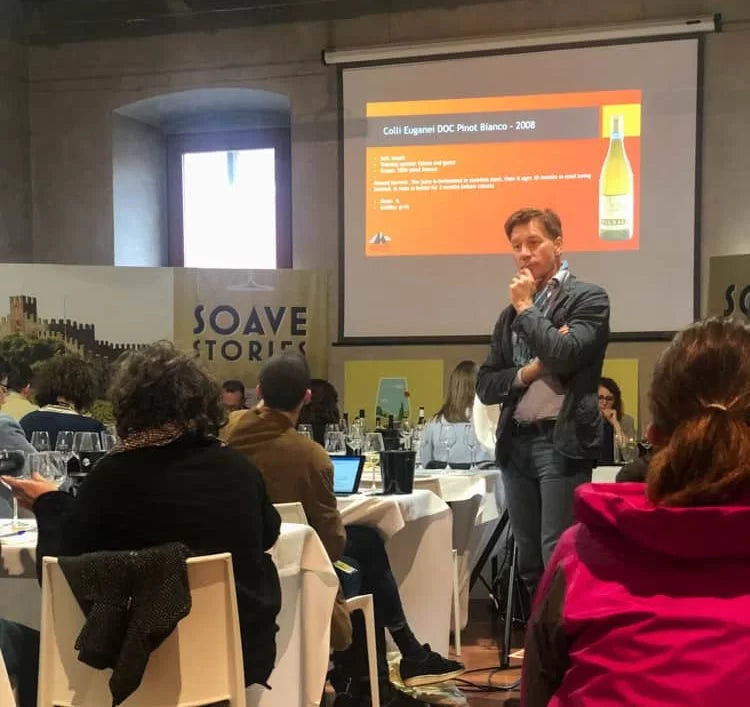
Oh, wonderful, we're going to talk about volcanic soils and minerality for a few hours. I can't wait. A wonderful topic. Mind you, minerality is a contentious issue in the wine world, as we can't seem to find a consensus. We do seem to agree that it goes hand in hand with volcanic soils. John Szabo, author of the book Volcanic Wines , he certainly can't stop talking about it. In Soave, he's giving a masterclass on volcanic soils, and Le Club des Vins was there.
What do they have in common?
" Talking about volcanic soils is as descriptive as talking about cheese ," explains John Szabo. Nice statement, John. We all understand plain language. He means to say that there are many types of cheese, so it doesn't really say much if you talk about cheese in general. Some people don't like cheese, but they do like melted cheese. They don't like Gouda, but they do like mozzarella. You can't tar them all with the same brush. The same goes for volcanic soils. Yes, the volcano is central, but we're talking about geology with an age that ranges from a few days to millions of years old. This means that the soil types and compositions can vary endlessly. There are areas that are clearly formed by a volcano, think of Etna and Santorini. But there are also areas where this is much less clear, such as the Rangen vineyard in Alsace. In short, it varies considerably, and that makes it difficult to arrive at a definition. volcanic wines .
There are a few properties that wine from volcanic soils all seem to possess, and that makes it so intensely interesting:
- Mineral salts (including magnesium and calcium) usually combined with high acidity. A characteristic that makes your mouth water. Gimme more.
- More savory than fruity . The fruit is accompanied or even dominated by savory aromas, such as spice or earthy notes. According to John Szabo, this has to do with the iron content, which is generally higher in volcanic soils. Am I going too far when I say that we colloquially call this minerality?
- More minerality means more ' electric' conductivity ' or electrical conductivity, but that doesn't make it any less complicated. I prefer to call it tension You'll find this in the wine's texture, often drier due to the higher acidity and tannins. The absence of an aromatic fireworks display also makes the texture more prominent.
How do those salts get into the wine? What role do acids play in this? Susan Gordon – also present at Soave Stories – has an opinion on this. extended article written on Forbes.
Tasting notes 'Wine from volcanic soil'
During the masterclass, we get to blind taste twelve wines. It's not easy to stay focused, as we already have a busy program (and wines) to choose from. Yet, I detect a common thread of saltiness here and there—I'll say it cautiously—because there are also wines where the fruit clearly dominates. This could, of course, very well be due to the winemaking process and the (commercial) mindset of the winemaker. Moreover, there's a fine line between "what am I really tasting?" and "what do I want to taste?"
Contrada Cavalieri Etna Bianca, 2017
Bingo. This hits the nail on the head: more savory than fruity. A very pure style, salty with crisp acidity.
Davide Vignato 'Col Moenia' Gambellara Classico 2016
It's sulfite-free, and you can tell by the bitterness, which feels like tannins in the mouth. It smells of bruised apple.
Suavia 'Monte Carbonare' Soave Classico 2016
Very pure and linear. A textbook example of minerality, if you ask me.
Roccolo del Durlo 'Le Battistelle' Soave Classico 2014
Golden yellow color. Many more aromas. Primarily tropical fruit (apricots, mango, honey), but also a salty flavor.
Tenuta La Pazzaglia 'Poggio Triale' Lazio 2011
A wine that's aging. There's a lot going on here. Bread, toast, roasted nuts, honey, dried apricots, salted caramel. Lively acidity, or is it the bitters that take over the acidity?
Giovanni Fattori 'Motto Piano' Soave 2011
Golden yellow color. More honey and ripe yellow fruit such as mango and peach.
Corte Moschina 'I Tarai' Soave 2011
Here, the flowers come to the fore. Combined with butter, peach yogurt, and a bit of marzipan. Not a favorite.
Vignalta Pinot Bianco Colli Euganei 2008
Dried apple and almonds. Dry, salty flavor combined with bitterness (almost tannic).
Sassotondo 'Isolina' Bianco di Pitigliano 2008
Um. Agave? Very vegetarian. Weird.
Sandro de Bruno 'Monte San Piero' Soave Superiore 2011
Toast, honey, nectarine, orange peel. Less acidity than you'd expect. Creamier mouthfeel.
Domaine Sigalas Santorini 2010
Ripe and dried yellow fruit, roasted almonds, acacia, and honey. Salty flavor. Pleasant bitterness. A strong flavor.
Filippi Castelcerino Soave 2012
A unique Soave, which, oddly enough, reminds me of sherry. In this case—the period varies by vintage—the wine is aged on its lees for 56 months. The aroma is overflowing with yeast, followed by notes of nuts and bruised apple. Lovely bitterness from the skin contact. A superb wine.
On the bucket list
If you're new to the wine world, this—minerality included—is incredibly boring. In the early stages of your wine hobby, you crave a fireworks display of aromas. Give me peach. Give me oak aging. Then you understand what's meant and can explain why you smell what you smell. Wines where minerality takes center stage are harder to explain. In fact, wine enthusiasts like John Szabo still go to great lengths to explain them. It goes a step further and might take some convincing, but I find it truly fascinating to follow.
I haven't finished tasting yet. After some research, I now have a very long list of wines I still want to try. Number one by far is Magma, the cuvée from natural wine hero Frank Cornelissen . How could it be otherwise with a name like that? Made from vines over a hundred years old, planted on Mount Etna. Very limited edition and a bit pricey, but definitely on my bucket list.
Also Inama It's listed here because: one of the best producers of Soave Classico . It comes from Monte Foscarino, a cru with basalt-volcanic soil.
Volcanic soils and Tenerife are often mentioned in the same breath. They've done a clever job, because otherwise, the island is only known as a tourist attraction for Dutch people who prefer to keep eating frikadellen even when they're abroad. That was reason enough for me to avoid it, but I know better now. They make fantastic wines, including those from Suertes del Marqués are appearing more and more often.

Share:
What the f*ck is Matassa?
Do I have a favorite wine after all?