
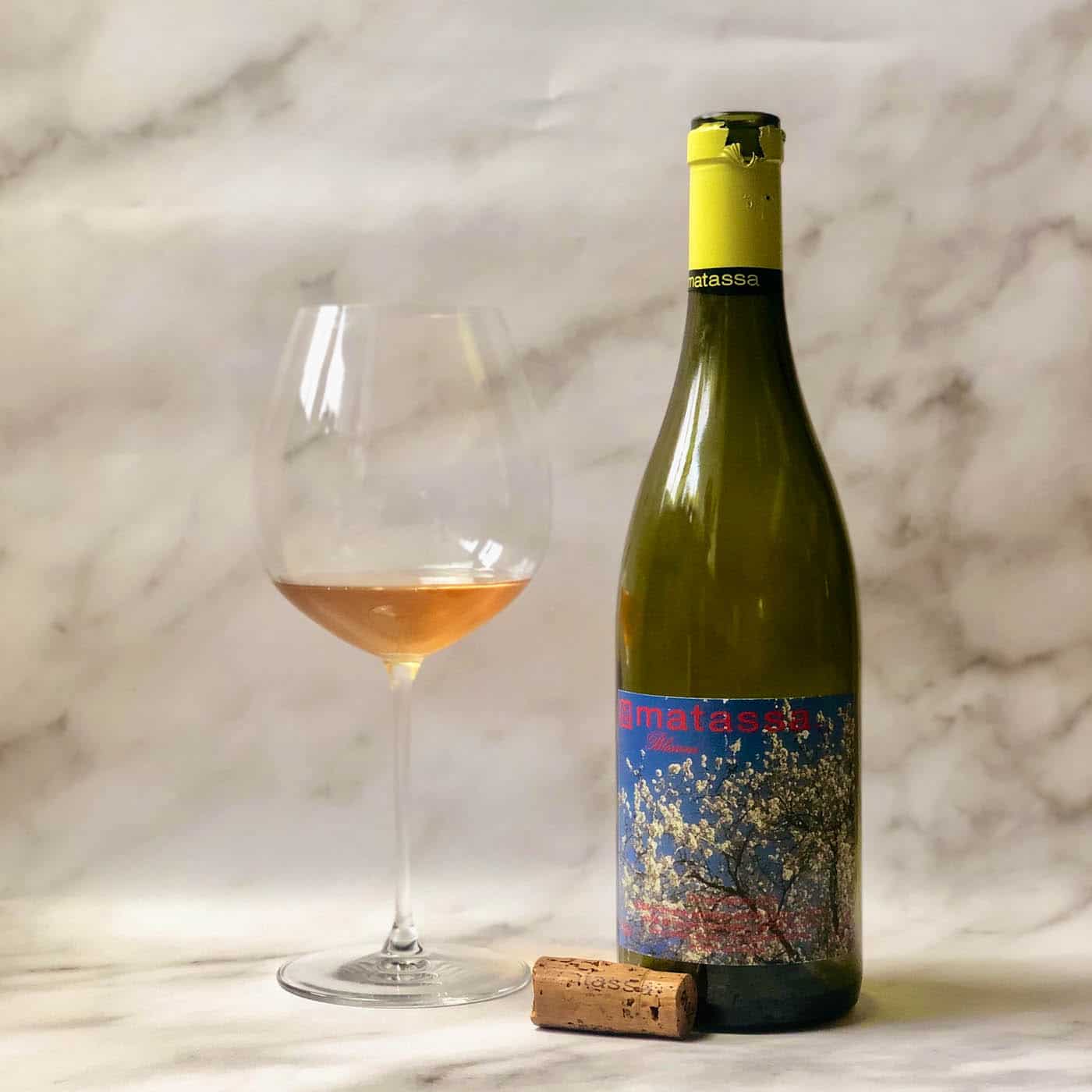
Pardon my French, but I couldn't think of a better title. This wine is très bizarre. The label has white flowers on it, and that's exactly What I smell in this wine. Like standing in a field of fragrant flowers with a bunch of chamomile in your hand.
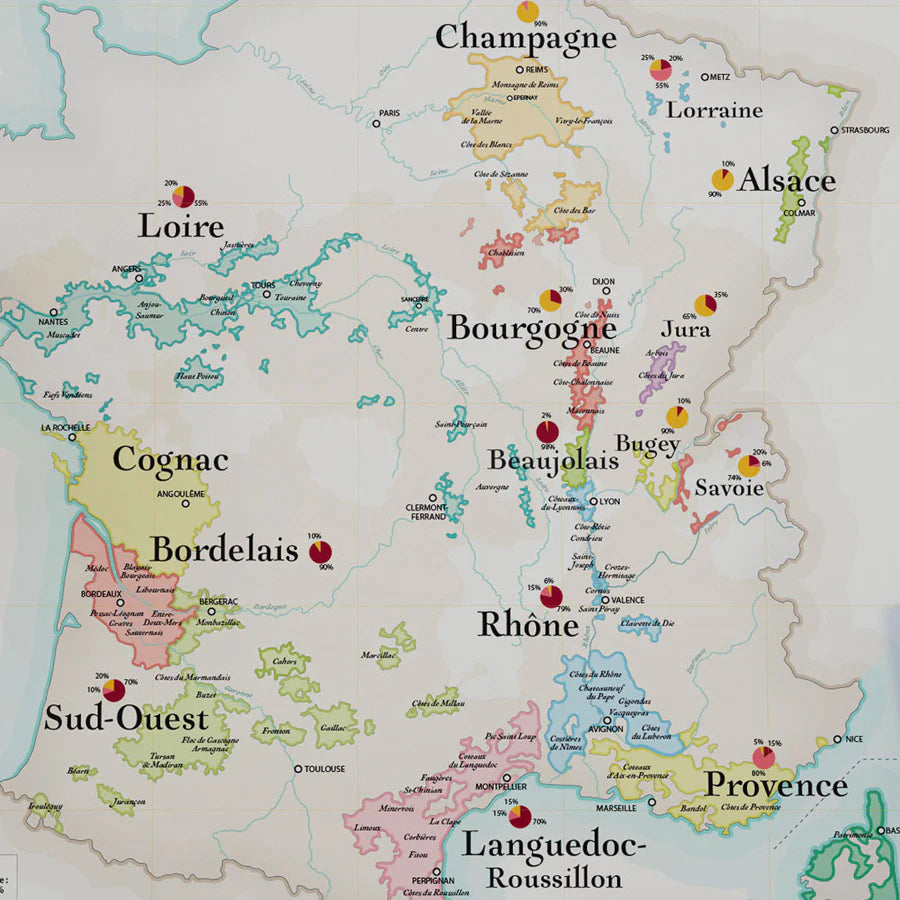
In my glass is Blossom , an orange-colored wine, 100% Muscat, made by Domaine Matassa. Domaine Matassa is located in the Languedoc-Roussillon region, in the Côtes de Catalanes, to be precise (yes, close to Spain). Here, Tom Lubbe and his wife Nathalie Gauby, along with Sam Harrop, make exceptional wines that raise many questions and generate a bit of hysteria.
“Is it even wine?” *5 minutes later* "Wow, smell it again! The scent has completely changed!" "How is this made then?" “It tastes like an IPA”. Some are instantly enthusiastic, while others think, "WTF?" We're all impressed by the deep orange color and the intense aroma of white blossom, orange peel, grapefruit (peel), chamomile, and white tea. After the first sip, we can also add the tannins. Wow!
Domaine Matassa
The winery owns a total of fifteen hectares of vineyards planted with native grape varieties, including Grenache Gris, Macabeo, Muscat d'Alexandrie, Lladonner Pelut (Catalan Grenache), Carignan, and Mourvedre. They operate biodynamically in the vineyard and extend this natural approach to the winery.
“Real wine is made from grapes. Right now, I think around 180 additives are legal in the European Union. Real wine is taken those additives out of the equation and putting grapes to the front.” (Quote from Tom Lubbe, Youtube )
They're letting nature take its course. This also means the vines aren't neatly arranged in rows by variety and/or color. They're all jumbled together – just like they used to be (before phylloxera, that is). There are even vines over 115 years old.
In the cellar, the process is as simple as possible. The white grapes are pressed whole, with the first half pressed old-school by foot. Sulphur is only used after malolactic fermentation. Matassa Blanc (aged Grenache Gris and Macabeo) spends 18 months in used demi-muid (600-liter barrels). The red wines are fermented whole and undergo a single fermentation. piggeage Initially—naturally, by foot. This is done to extract the juice from the grapes and initiate natural fermentation. The juice is pressed halfway through fermentation and then moved to the demi-muid, where fermentation is completed and malo begins. The red wines are aged for 18 to 24 months. Some wines are filtered; none are fined.
Rather than making a purely white wine or a purely red wine, we make orange wine where we macerate the skins of the white grapes and our red wines are actually pink wines because they are fermented with both white and red grapes. (Quote from Tom Lubbe, Youtube )
Beautiful love story
Tom Lubbe was born in New Zealand but grew up in South Africa, where he interned with Louise Hofmeyer at Welgemeend Winery. Louise worked exclusively with low yields, spontaneous fermentation, and little to no new oak. Tom was eager to work with Mediterranean grape varieties and, through Louise, ended up with Gérard Gauby of Domaine Gauby in Calce. After his internship, he stayed in the cellar for another three years and met his wife, Nathalie Gauby – Gérard's sister. How wonderful, isn't it?
I can only say I'm a fan of Domaine Matassa. And that after just one bottle. Mind you, you have to be a fan. This is truly funky stuff, and the quality likely varies from year to year (and perhaps even from bottle to bottle?). I find it fascinating and want another bottle, because I'm incredibly curious to see how this wine will taste after a few years. And I haven't even tried the red wines yet!
Curious? Wine merchant La Bordelaise sells Blossom from Domaine Matassa in the store.
Sources:
- Louis Dressner – Domaine Matassa
- WineAnorak – Producer Profile: Matassa


Share:
A wine fan in Rome: La Fiaschetta, Il Goccetto and Verso Sera
Wine from volcanic soils