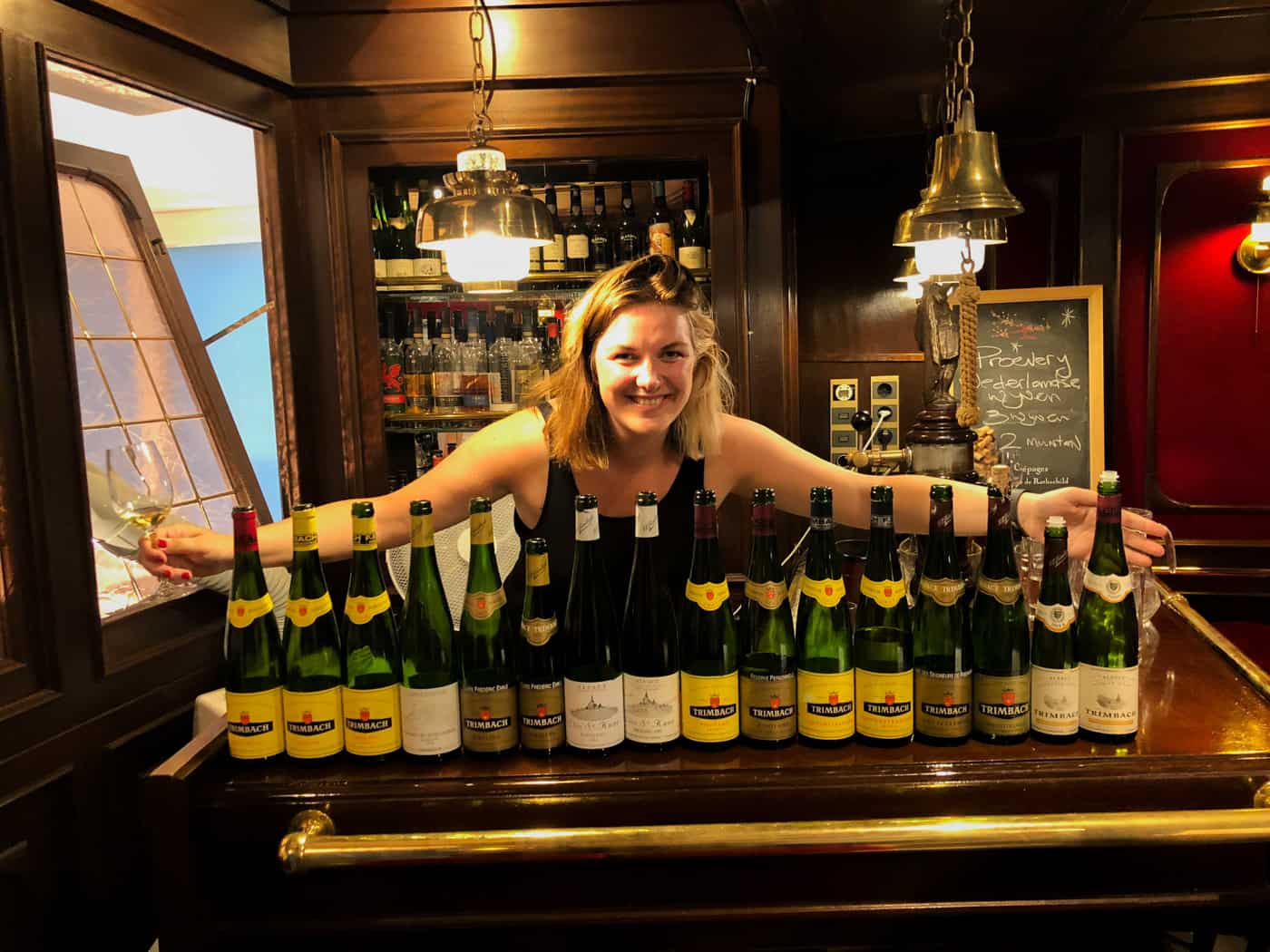
None other than Jean Trimbach came to Rotterdam for a masterclass at Wijnhandel Peeters. Together with his brother Pierre, he runs Domaine FE Trimbach, one of Alsace's most famous wineries. The family is passionate about Riesling. A whopping 45% of their annual production (1.2 million bottles) comes from this grape. The clear number one is, of course, Clos Ste Hune, considered by wine enthusiasts to be the best Riesling in the world.
In 2016, Trimbach celebrated its 390th anniversary. The company was founded in 1626 in Riquewihr by Jean Trimbach. The winery as we know it today was created by Frédéric Emile Trimbach. He received the highest award at the International Wine Fair in 1898, putting Trimbach on the map. His initials are still used in the company's official name, and one of the finest Riesling cuvées bears his name.
Using the tasting notes below, I will tell you more about the Trimbach winery, the wines, and Alsace.
Tasting notes Trimbach
Trimbach Pinot Blanc 2016
Floral, pear, and soft white fruit. A friendly wine.
Trimbach Riesling 2015
Soft, stone fruit, nectarine, and a touch of lemon. Despite a scorching hot and dry year in 2015, the acidity miraculously held up. A mystery. However, they did lose about 30% of the harvest due to the weather. A shame, but also a plus: this makes the wine even more concentrated in flavor.
Trimbach Riesling Reserve 2014
Yes, heart. Lime, lemon, pineapple, a touch of petrol, honey, and stone. Reserve in this case refers to the vines, which must be at least 45 years old. I'll be opening this again soon with a plate of sauerkraut.
Trimbach Grand Cru Schlossberg 2014
Sourced from 30- to 35-year-old vines of the Grand Cru Schlossberg near Ribeauvillé. The soil is primarily granite, which gives it a so-called "vertical" mouthfeel, Trimbach explains. I've never heard this flavor description before, but listen carefully. Vertical indicates a dry wine, high in acidity, while horizontal refers to a somewhat creamy texture; the flavor extends across the entire palate. It's spot on; the Schlossberg is bone dry.
'It's not difficult, but complex and super exciting'
– Jean Trimbach about wines from Alsace. Touché, Jean, touché.
Alsace Grand Cru
With 50 hectares, Trimbach is the fourth-largest winery in Alsace in terms of vineyard ownership, not production. A full 30% of the vineyards are Grand Cru. Yet, it's only in recent years that they've used the Grand Cru classification. For a long time, they found it undesirable to label Alsace Grand Cru on bottles. Their main criticism of the system was that the boundaries are too broad and therefore don't accurately reflect the region's diverse terroirs.
For convenience, let's compare Alsace with Burgundy, the region of classifications and terroir. Burgundy has 60 soil types and 635 appellations with Premier Cru status and 33 with Grand Cru status. Alsace has 800 soil types, and "only" 51 vineyards are classified as Grand Cru – that's 4% of the total. So Trimbach has a point. Alsace Grand Cru is a broad term. Yet, due to external pressure and the fact that more and more wine enthusiasts can easily lap up those 51 Grand Crus, they've changed their minds. In 2016, they released the Grand Cru Geisberg 2009. Grand Cru Schlossberg 2014 followed in 2017. Thus, they are slowly building a small Grand Cru collection.
Trimbach Cuvée Frederic Emile 2008 and 2011
In the 1960s, the family decided it was time for a second, great Riesling alongside Clos Ste Hune and created Cuvée Frédéric Emile. Unlike Clos Ste Hune, the FE comes from two Grand Cru locations: Geisberg and Osterberg. Both plots have soils of clay and limestone over sandstone. This creates intense minerality and powerful acidity.
We tasted two vintages, 2008 and 2011. This tasting session showed that this cuvée also has great aging potential. The 2011 is still a bit closed, though the aromas of nectarine, ripe apple, and coriander are promising. In the 2008, the aromas are more pronounced, and toasted bread also emerges. What wines!

Trimbach Clos Ste Hune 2012
" Arguably the single most admired dry Riesling made anywhere," says Jancis Robinson. Clos Ste Hune is a 1.67-hectare walled vineyard in Hunawihr. It's part of the Rosacker Grand Cru. But no, it's not on the bottle here. Why?
"This label was designed in the early 20th century, some 70 years before the Grand Cru system was created in Alsace," says Anne Trimbach in Wine Masters. Of course, such a label can be changed in a flash, but why bother? It's a cult wine; every wine fan knows this wine.
At Clos Ste Hune, only Riesling is planted; most vines are 50 years or older. Its success is due to the pure limestone soils, the southeastern location, and the low yields. Words fail to describe this wine. Minerality, complexity, concentration. And that's just the beginning, because we're actually drinking this wine far too young. The older, the better.
'Clos Ste-Hune does not seek to charm, and the initial impression given by a young vintage is often one of ruthless austerity. It's a wine that demands bottle age and should not be broached until it is at least seven years old.' – Decanter.
About 8,000 bottles are produced annually, depending on the vintage. So, it's scarce. A bottle (2009) starts at €159.95.
'I love the wine, I love it' – Jean Trimbach on Clos St Hune. It's wonderful to see how enthusiastic Jean Trimbach (still) is about this wine.
Trimbach Clos Ste Hune Vendange Tardives Hors Choix 1989
This wine requires some explanation, as Vendange Tardives from Clos Ste Hune doesn't come along every day. When the weather permits and botrytis develops, Trimbach lets the grapes hang longer to make a Vendange Tardives from Clos Ste Hune. The last time this happened was in 1989. Botrytis no longer shows up.
The main reason: there's no river nearby. A river brings morning dew, which, combined with bright afternoon sunshine, creates the perfect conditions for noble rot. In 1989, there was something even more special. The grapes from the oldest vines were vinified separately as hors choix, or top choice.
Wine tasting was also a treat for Jean, as he doesn't have a single bottle left in his cellar. Moritz had received two bottles for the shop's 90th anniversary. How fortunate we were to be able to taste them.
Caramel, orange marmalade, crème brûlée, burnt sugar, peach, and baked peach. Phew.
Viewing tip: WineMasters
Dutchman Klaas de Jong visited top wineries in France, including Trimbach, and created a series of documentaries. Available for rent or purchase through Winemasters.tv – here's a sneak peek:
Trimbach Pinot Gris Reserve 2015
Pinot Gris in a nutshell: lower in acidity than Riesling, not as hysterical as Gewürztraminer.
Trimbach Pinot Gris Reserve Personelle 2013
This Pinot Gris comes from six different vineyards, including Grand Cru Osterberg. The Reserve Personelle is only made in exceptional years. A full-bodied and voluptuous Pinot Gris. Pairing? "Give me some lobster," says Trimbach.
Trimbach Pinot Gris Vendange Tardives 2000
The grapes come from the Grand Cru vineyards of Kirschberg and Osterberg. A full-bodied wine with plenty of power. "Smoky, botrytis, apricot, honey, and marzipan," I note in my notebook. This is heavenly with strong (blue) cheeses.
Trimbach Gewurztraminer 2015 and Reserve 2013
Both are typical Gewürztraminer. Lychee, rose petals, cinnamon, full-bodied. Bring on the Munster. The reserve is aged in the bottle for three years before being sold, making it more powerful with a good balance between sweet fruit and freshness.
Trimbach Cuvée des Seigneurs de Ribeaupierre 2011 and 1985
This wine is made from 40-year-old vines of the Osterberg Grand Cru. This plot was formerly owned by the former estate of Les Seigneurs de la Ribeaupierre. Typical Gewürztraminer. Very rich, full-bodied, and spicy (with a hint of pepper?). According to the website, the wine can definitely be aged for up to twenty years. We tasted one from 1985 and can only say it was fantastic. So, add a few more years to that.
Trimbach Gewurztraminer Vendange Tardives 2014
There's nothing more beautiful than a Gewürztraminer Vendange Tardives. So rich, so aromatic, and so full-bodied. The grapes are usually affected by noble rot and are selected from the finest vineyards. The wine is only made in exceptional years.
Only the noble grape varieties of Alsace may be used to make Vendange Tardives (i.e. Riesling, Gewürztraminer, Pinot Gris and Muscat).
Trimbach our bottle to me!
At the end of the Masterclass, Jean suddenly starts his life song: "Trimbach oh Trimbach, Trimbach my bottle to me." With a glass of Cuvée des Seigneurs de Ribeaupierre 1985 still left over, I happily sing along.
I realize how special it is that one family has been in the business for almost four hundred years. And also how passionately Jean Trimbach talks about the wines, and that he, like us, was thrilled when we tasted the old vintages.
The Trimbach family are true purists. They don't pay attention to trends or ratings; no, the terroir defines the wine. Isn't that wonderful?
The end.
Trimbach wines are available at Wijnhandel Peeters in Rotterdam.
More Alsace?
" A wine enthusiast in Alsace " is waiting for you. A wonderful wine region for relaxing, hiking, and enjoying good wine.
Share:
Governo, the Ripasso of Tuscany (but better)
Inside Billecart-Salmon - the traditional method up close