
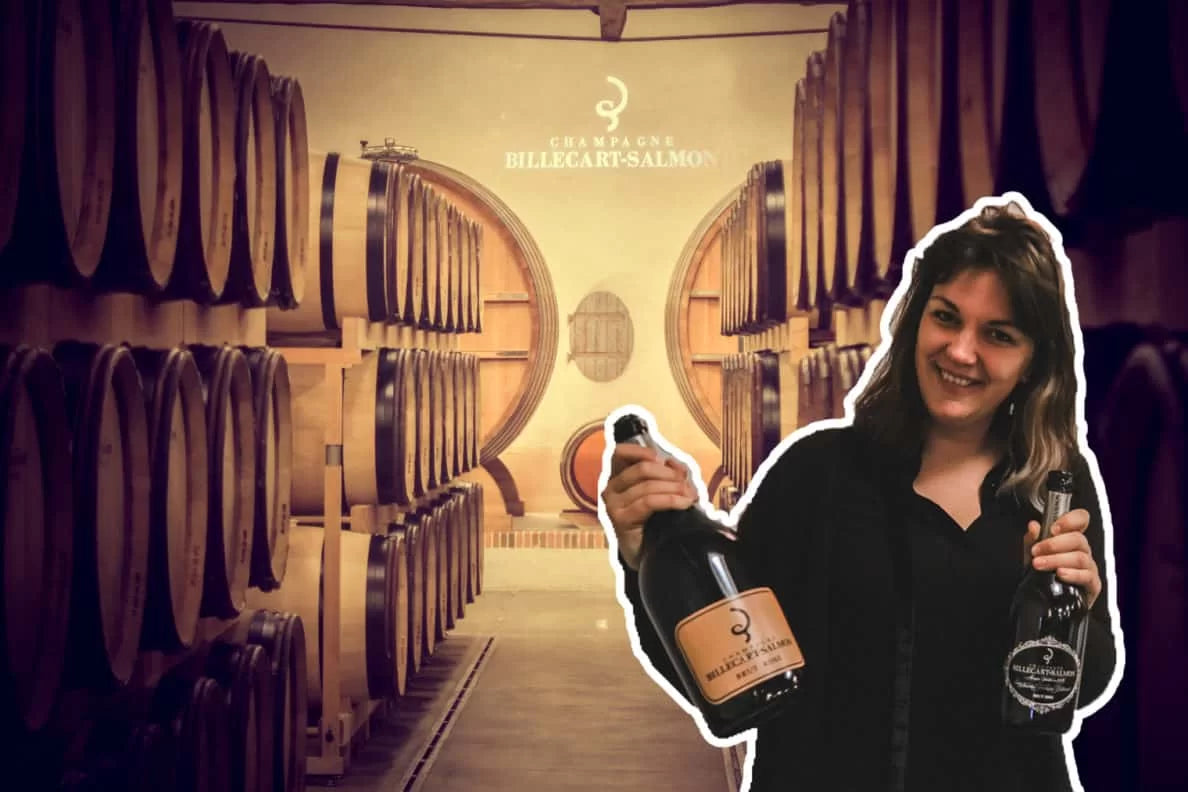
Billecart-Salmon, Mareuil-sur-Ay – March 2, 2018
Today I'm taking you—pour yourself a nice glass—to Billecart-Salmon. Loyal fans know Billecart-Salmon from their striking Champagne Rosé, which incidentally contains a surprisingly high percentage (50%) of Chardonnay. Others may know Billecart-Salmon from The Millennium Tasting in Stockholm. In 1999, the 1959 Nicolas François Billecart Champagne won the prestigious title of "Champagne of the Millennium," the 1961 came in second, beating the likes of Dom Pérignon, Taittinger, and Krug.
And now I'm standing on their doorstep.
Billecart-Salmon has been around since 1818. What would life have been like back then? Long coats, horse and carriage, a glass of bubbly—I can just imagine. Type "How was the year 1818" into Google and you'll find the interesting fact that Frankenstein was published that year. The first science fiction book. A milestone. Another milestone is that this year, 2018, marks not only Frankenstein's bicentennial, but also Billecart-Salmon's.
The Champagne house was founded by Nicolas François Billecart and his wife Elisabeth Salmon. Billecart-Salmon is one of the few houses in Champagne that remains family-owned. The eighth generation is now at the helm, but they are no longer entirely independent. Since 1987, the company has also invested in outside capital.
With their 2 million bottles per year, they can be considered medium-sized. That's a lot, but it's a pittance compared to the powerhouse Moet & Chandon, which produces 2 million bottles per year. 30 million bottles Sold. How does Billecart source its grapes? Billecart-Salmon has 15 hectares of its own vineyard, cultivates 100 hectares, and buys grapes for another 100 hectares from contracted growers.
Billecart-Salmon's traditional method
Each Champagne house has its own perspective on production methods, on how they make champagne. That sounds logical, but it was quite a revelation for me. I visited Heucq, Bollinger, Charles Heidsieck, Roger Manceaux, and Leclerc-Briant, among others – and with each visit, I learned something new. Some steer clear of oak aging, while others age exclusively in oak. Lots of reserve wine, little reserve wine. Vin de taille, no vin de taille. And so on.
The vineyards of Billecart-Salmon
Our tour of Billecart-Salmon starts at the Clos Saint Hillaire vineyard, which is just a stone's throw from La maison. A clos is a walled vineyard, and there are only 31 of them in Champagne. From such a clos, a single-vineyard champagne is usually made—in good years—a wine. This is actually diametrically opposed to the centuries-old tradition of Champagne: assemblage, or "the art of blending." Sometimes as many as 100 different base wines (plots, grape varieties, oaked/woodless, reserve wines, etc.) are used to create the perfect blend. The goal is to release the same champagne year after year, regardless of the quality of the vintage.
Just think of Moet & Chandon. Whether you buy it today or next year, the style and flavor are always the same, year after year. That's the great trick and challenge of Champagne.
In recent years, we've seen an increasing number of terroir-driven Champagnes, including Clos Saint Hillaire. These are usually vintages, as these special Champagnes are only produced in good years.

The walled vineyard Clos Saint Hilaire
At Clos Saint Hilaire, you'll find Pinot Noir vines pruned according to a special method. It got a bit technical, but the bottom line is that the vines produce less, but what is produced is of higher quality (higher concentration, more aromas, etc.). The vines have only vertical starters, which results in fewer leaves and the grapes receive more sun and air. Going a bit far, huh? But really, it's the little things that make the difference.

Vertical starters
Another nice thing: they work organically as much as possible, but without certification. This is quite common in Champagne. Chemical pesticides are only used when absolutely necessary. They let nature take its course as much as possible. This also means that after the harvest, four sheep are put in the vineyard, where they can graze freely until Christmas.
To the basement
Manual harvesting is legally required in Champagne. 100,000 seasonal workers are needed annually. At Billecart-Salmon, the grapes never travel longer than thirty minutes. They have presses in other villages if needed.
Pressing involves numerous regulations (what else is new?). Billecart-Salmon adds a few more. In Champagne, the grapes are pressed three times. Add to that the fact that juice already flows from the press before pressing even begins. Billecart-Salmon doesn't use the first 10% because it often still contains impurities (from the skins).
From 4,000 kilograms of grapes, a total of 2,550 liters can be pressed. The vin de cuvée and the taille are pressed in three stages ('serres'). After each serre, the grapes are turned. This turning process is called 'retrousse'. Nowadays, some pressing facilities also do this automatically. Billecart-Salmon needs 1.4 kilos of grapes for one bottle of brut champagne.
- 2050 liters of cuvée wine
The 2050 liters seems like a rather arbitrary figure, but it isn't. It corresponds to 10 pièces champenoises, the traditional wooden barrels used in the region before World War II, which hold exactly 205 liters of wine.
Oh yeah, funny story: you can lie down in a press in Champagne without getting your clothes ripped. That's how gently they press. Essentially, the grapes are gently caressed, and the juice that comes out is used to make Champagne. Isn't it wonderful?
- 500 liters of waist wine
After the cuvée, the vin de taille is pressed. The pressing is stronger, bringing out the skins and pips. The resulting juice is therefore more bitter and less acidic than the vin de cuvée. Billecart-Salmon does not use this.
- 50 liters of rebeche wine
Then a final press, the rebèche, must be done. This is not allowed to be used to make Champagne, but Marc de Champagne—a distillate—is. The rebèche is usually combined with the first juice and sold to a distillery.
Disguise (be careful, technical story)
Before fermentation can begin, the juice must be filtered. It may still contain some bourbes—residues of the skins and stems—and these must be removed. This is done through débourbage. After pressing, the grape juice rests for about 20 hours (sometimes shorter, sometimes longer) at a temperature of around 15 degrees Celsius. Any impurities sink to the bottom of the barrel. The juice is then transferred to a clean barrel to obtain clear, pure grape juice. An improvement on this technique, though not yet widely used in Champagne, is débourbage à froid. It's the same idea, but at a much lower temperature, 5 degrees Celsius. This enhances freshness and vibrancy. Billecart-Salmon is one of the few Champagne houses to use this method.
Alcoholic fermentation
Finally, we're making wine. Alcoholic fermentation in Champagne typically takes twelve to fifteen days, but not at Billecart-Salmon – they take three to five weeks. That's thanks to beer. Yes, beer.
The father-in-law of the previous CEO used to make beer, and that gave him the idea to ferment the must cold – just like beer. Cold, in this case, means at about 13 degrees Celsius. This makes the yeast a bit lethargic, which makes the whole process take a lot longer, but once again The concentration of the aromas increases. Billecart-Salmon was the first to start this in 1957. Other Champagne houses have since done this, but Billecart-Salmon is still the only one to do it for all their Champagnes. Patience is a virtue.

This is where it all happens. Ultra-modern cellar.
The best plots are fermented in oak barrels, the rest go into tanks. Malolactic fermentation is avoided whenever possible, but it depends on the vintage. In 2014, it was necessary, and BS allowed it. In 2015, it wasn't necessary (because warmer weather equals riper grapes), and 80% of the process was blocked.
For about ten years now, Billecart-Salmon has been releasing a cuvée, a non-vintage, fermented entirely in oak. It's the Sous Bois Brut , and I'm glad I brought one home to savor again in peace. About 20,000 bottles are produced annually.

Some wines are aged in oak barrels. These are used barrels from Burgundy.
From basic wine to champagne
Once all the base wines are ready, the art of blending can begin. At Billecart-Salmon, a team of six, including the CEO, handles this process. Their job is to ensure that the Brut Reserve maintains the same consistent quality and style as in previous years. This team also determines which wines should be kept as reserve wines. Reserve wines account for approximately thirty percent of production.

Nice material.
In February, they'll meet again to see if the blends are truly the same as in previous years. They'll need about two months to reach an agreement. If that doesn't work, they'll bring in the mother (true story).
Once they are removed, the wine can be filtered and prepared for the second fermentation. Meanwhile, the liqueur de tirage is also made, which consists of a mixture of yeast, blended wine, and sugar. 24 grams of sugar are needed to reach a pressure of 6 bar in the bottle. The bottles are sealed with a bidule and a crown cap. The second fermentation can begin.
I don't need to explain how long that takes, do I? Okay, Billecart-Salmon does deviate from the minimum requirements for AOC Champagne. The Brut Réserve is aged on the lees for at least three years, the vintages for at least eight years.
Let's turn: le remuage
Then my favorite part: the remuage. At some point, the yeast sediment has to be removed. Eighty percent of this is done mechanically using the large gyropalettes, which hold 500 bottles and manage to move the yeast to the neck of the bottle within a few days. The remaining bottles are turned manually. All small production runs, including the large bottles, the unusually shaped bottles, and older vintages, are done by hand. If bottles have been on the lees for more than 10 years, they are also turned manually, because "they are supposedly too delicate." It sounds plausible. Besides that, remuage is, of course, a beautiful tradition that shouldn't be lost.

Les pupitres.
And now: disgorgement ! The bottles go to the bottling line, where robots take over. I didn't see it, but that's what they told me seriously. Traditions are still alive, but otherwise, they're pretty high-tech here. The machine/robot tilts the bottle and freezes the neck, causing the yeast to splash out. The bottle is filled with liqueur d'expedition and sealed with the original champagne cork.
In his book "Champagne," Gert Crum quotes a champagne maker who compares this process to open-heart surgery. The young wine, which has aged for at least 15 months, comes into contact with oxygen for the first time. This is intense and must happen as quickly as possible. There's no right or wrong. Some houses don't shy away from a little oxidation, while others do everything they can to prevent it.
Back to the liqueur d'expedition. This is a blend of the same wine, reserve wine, and cane or grape sugar. The amount of sugar added, the dosage, depends on the style of champagne the house wants to produce. At Billecart-Salmon, they've created a dedicated space in the cellar for this purpose. It's incredibly impressive. Here, they can create a beautiful blend from 72 (!) different reserve wines. With the liqueur d'expedition, the champagnes are essentially ready to be sold, but Billecart-Salmon is holding on to them for a while longer. They let a non-vintage wine rest for six months, a vintage wine for twelve months.
I repeat: patience is a virtue in Champagne…

Fortunately, we can also taste them 🙂
Thanks, Billecart-Salmon
Gotta love Billecart-Salmon. After this visit, I'm an even bigger fan of this champagne house. Sure, you learn how champagne is made in books, but it's so much more rewarding to see it with your own eyes and discover that it's impossible to explain. Our tour was more like a private lesson; we were told all the ins and outs.
We were able to taste several wines. The one that stood out for me was Nicolas François Billecart, the cuvée that won The Millennium Tasting—but the 2002 version. Next-level champagne—served in a wide glass. It's reminiscent of a grand Burgundy, with so many aromas. The champagne has been aged on the lees for almost ten years and offers aromas of butter, brioche, and croissants. It's a-ma-zing.
And with that thought, I end my ode to Billecart-Salmon. Thank you very much.
Want to know more?
Want to try Billecart-Salmon? You don't have to travel all the way to Champagne. Résidence Wijnen imports the wines to the Netherlands. They are available at, among other places: Wine merchant De Gouden Ton .
Sources:
- Visiting Billecart-Salmon (March 7, 2018)
- Gert Crum – Champagne
- Bubblegek.com – Pressing, the key to quality
- The Finest Wines of Champagne: A Guide to the Best Cuvées, Houses, and Growers


Share:
Trimbach my bottle to me!
Champagne: 3 days, 7 houses