
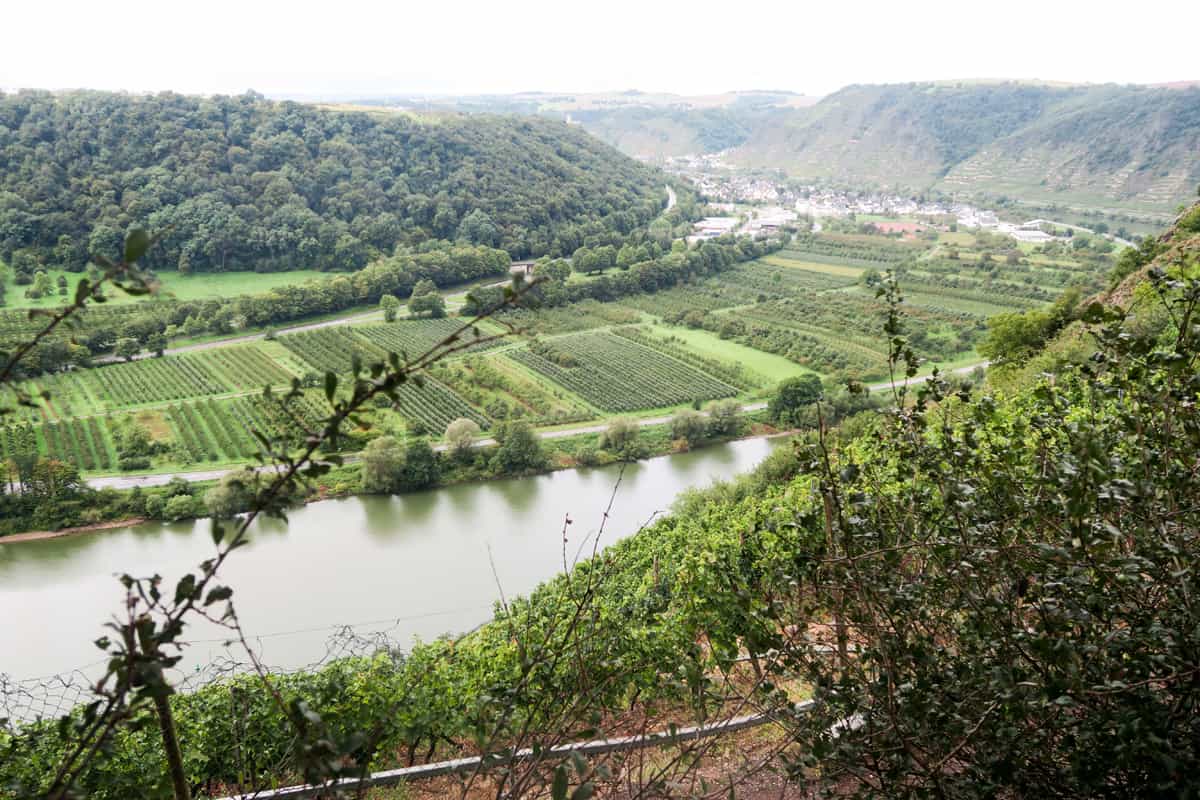
Germany is a top white wine region. Everyone knows Riesling, of course. It's fun to see how Riesling is slowly winning over wine enthusiasts. The exact same thing happened to me. At first, you're not interested in it, because "those days are over." No more sweet white wine. But then you discover that Riesling is capable of great things. That it might just make the most beautiful white wine in the world.
Egon Muller's Riesling from the 'Schartzhoffberger' vineyard is in the top 3 most expensive wines in the world. Just saying.
Riesling is plentiful in Germany, but there's more… Take Sylvaner, for example, another white grape variety that, like Riesling, produces strong wines. While Sylvaner may be considerably less aromatic, it's certainly not boring. Pinot Noir is also (spatburgunder) from Germany is a success – we are seeing more and more of that in the Netherlands.
The climate
Germany has a cold continental climate, which means hot summers, cold winters, and (the risk of) rain year-round. The latter poses the greatest risk for winegrowers. Cool nights combined with dew or heavy rain showers increase the risk of powdery mildew, a grape disease. With a bit of luck, the rain stops in autumn, allowing the grapes to ripen fully and undisturbed (developing flavors). The harvest usually doesn't take place until October; by then, the grapes are sufficiently ripe and contain sufficient flavor and sugar. Winegrowers want to leave the grapes on the vine as long as possible, but this also entails the risk of rain. This is a constant balancing act for winegrowers. Weather conditions directly influence the quality, quantity, and style of the wine.
So it's not all that easy. The winegrower is extremely dependent on Mother Nature, so every little advantage you can get counts. Most of the sun shines on the southern Slopes , so a plus if you have a vineyard there. A downside is that the slopes are so steep (sometimes as steep as 60%) that no machine can reach them: everything is done by hand.

Extra points if your vineyard is also included a river The reflection of sunlight in the river creates more heat, thus increasing the chance of riper grapes. The flowing water also offers protection against freezing temperatures in winter. The soil is also important. The Mosel is famous for its Dark slate soil . It has the property of retaining moisture and heat. Another plus, since every ray of sunshine counts here.
All of this together, plus the decisions of the wine grower himself (such as the pruning method, the time of harvest, etc.) is what we call the terroir .
The harvest
Because the ripeness of the grapes is so important, it's also a central theme in German wine law. Here, we consider not only the wine's origin, but also the grape's sugar content at the time of harvest.
German grape varieties
White grapes:
- Riesling
- Muller-Thurgau (rivaner)
- Silvaner
- Weissburgunder (pinot blanc)
- Grauburgunder (pinot gris)
Blue grapes:
- Spatburgunder (pinot noir)
- Dornfelder
The regions
Wow, just when you think you've got all the French wine regulations figured out, it's a different story in Germany. There's a whole swathe of Deutscher Wein and Landwein, the simple table wines you can pick up two bottles of for three euros at a German supermarket. Quality wines are identified by the "Qualitätswein" or "Prädikatswein" labels on the label.
Qualitätswein must come from one of the 13 Anbaugebieten (wine regions), and the grapes must have reached a certain ripeness. Several terms are used to determine which style is in the bottle:
- Trocken: A dry wine with 9 grams of residual sugar per liter, or less.
- Selection: The same as Trocken, but specifically for wines from the Rheingau. The grapes are always hand-picked.
- Halbtrocken: This is semi-dry, so slightly sweet. It may contain up to 12 grams of residual sugar.
- Classic: The same as halbtrocken, but may contain slightly more residual sugar – up to 15 grams per litre.
- Feinherb: Not official, but often used as an alternative to Halbtrocken.
- Liebliche: A sweet wine with up to 45 grams of residual sugar per liter.
- Suß: A sweet wine with more than 45 grams of residual sugar per liter
The 13 wine regions of Germany
Germany has a total of approximately 100,000 hectares of vineyards. That sounds like a lot, but it's still smaller than Bordeaux. These include the Ahr, Moselle, Middle Rhine, Nahe, Rheingau, Rheingessen, Palatinate, Hessian Mountain Road, Saale-Unstrut, Saxony, Franconia, Württemberg, and Baden.
I will explain the most important ones below.
-
Moselle
For a long time, I was under the impression that the Mosel was just a random sweet wine region. As a wine lover, that sounds incredibly foolish, because nothing could be further from the truth. The Mosel is one of the most beautiful wine regions in the world. The best vineyards are located on the steep slopes along the banks of the Mosel. The Rieslings here are generally lighter in body and alcohol, with higher acidity than the Rieslings in the Rheingau, Rheinhessen, and Palatinate. -
Nahe
The Nahe lies between the Mosel and Rheinhessen. The best vineyards are again found on the steep slopes, this time not on the Mosel, but on the Nahe. Riesling is also the most widely planted grape variety here. In terms of style, it falls between the light Mosel variety and the fuller Rheingau/Rheinhessen/Pfalz variety. It is generally slightly warmer here than the Mosel, so sometimes slightly riper fruit aromas are present. -
Rheingau
Small but mighty. And prestigious. The best vineyards are also found on the steep slopes along the Rhine, but here another natural wonder comes into play: the Taunus Mountains. They protect the grapes from the elements and ensure optimal ripening conditions. The Riesling here is somewhat fuller, with a distinctive peachy character. Besides Riesling, excellent Pinot Noir is also produced here. -
Rhine Hesse
Germany's largest region. All grape varieties are planted here, and all styles of wine are produced. The slopes near the village of Nierstein are famous for their full-bodied Rieslings. A very different style than the clean-lined wines from the Mosel. In recent years, the focus here has shifted from quantity to quality. Hear, hear. -
Palatinate
Second-largest area. Much of the region is comparable to Alsace. Like Alsace, it is dry because it is protected by the Haardt Mountains (as opposed to the Vosges Mountains in Alsace). All grape varieties are grown here, but Riesling and Muller-Thurgau are the most common. -
Bathing
The warmest and southernmost region. This also produces the most full-bodied wines with the highest alcohol content. The best vineyards are located on the southern slope of the Kaiserstuhl. Too warm for Riesling, but perfect for Spatburgunder. -
Franks
This is the area where Silvaner comes into its own. Silvaner is sensitive to frost, so the grape is planted on the warmest, southernmost slopes.
Prädikatswein
Pradikätswein goes a step further and is actually easier to describe as Qualitätswein with a Pradikät. That term was used in the past. The wine must, in any case, be a Qualitätswein wine; it must originate from one of the 13 wine regions and meet certain requirements regarding sugar content at the time of harvest. This is precisely what determines the Pradikät the wine receives.
Sugar content is measured in Oechsle and ranges from 67-82 Oechsle for Kabinett to 150-154 Oechsle for Trockenbeerenauslese. These minimum amounts are legally set by region and grape variety. Fun fact: one degree Oechsle corresponds to approximately 2.5 grams of sugar.
| Prädikat | Harvest information | Style |
|---|---|---|
| (No) Qualitätswein | dry to semi-sweet | |
| Cabinet | Ripe grapes | dry to semi-sweet |
| Spätlese | Harvest just after the regular harvest, so slightly riper. | dry to semi-sweet |
| Auslese | Late harvest (whole bunches) | dry to sweet |
| Beerenauslese | Late harvest (grape by grape selected) mainly but not exclusively noble rot. | sweet |
| Trockenbeerenauslese | Only grapes with noble rot. | sweet |
| Ice wine | Picked in a frozen state | sweet |
The wine's category is indicated on the label, along with the region where it originates. The specific village with the specific vineyard is also often mentioned on the label. It becomes more difficult if you're looking for an indication of quality. The law doesn't specify a premier cru or grand cru to guarantee you're holding a fine bottle.
It can make a big difference which region you are from Prädikatswein It all comes down to this. One will taste sweet, the other not so sweet at all. This has to do with acidity. If a wine is high in acidity, it needs more sugar to compensate. So, it's very enjoyable and interesting to do a wine tasting with Rieslings from different regions or categories. Want to know more about the categories? Check out this article .
Grosses Gewächs
Knowing nothing, or almost nothing, about a wine's terroir isn't helpful. The producers agreed. An independent group of approximately 200 wine producers therefore founded the Verband Deutscher Prädikats (VDP). They classified Germany's vineyards like Burgundy. By terroir, that is. The top of the scale, the Grand Cru, is called Grosses Gewächs (GG) here. If it's on the bottle, you know you're holding one of Germany's finest wines. A small caveat: this title may only be used by VDP members. It's a trademark, but it's generally recognized as a reliable quality mark.
Below you see the vineyards on the Kaiserstuhl in Baden ( copyright – Vinous.com ).

This club determines which grape variety may be used to make a GG in which region:
- Moselle only riesling ( how much longer? )
- Nahe alleen riesling
- Rheingau of Riesling and Spätburgunder
- Rheinhessen of Riesling and Spätburgunder
- Palatinate of Riesling, Weissburgunder and Spätburgunder
- Baths of different grape varieties
- Francs of silvaner, riesling, weissburgunder, grauburgunder, spätburgunder
For this blog post I consulted the following sources:
- Passion for Hospitality – Wine region Germany
- Winefolly – Understanding German Riesling by the label
- Jancis Robinson – The Oxford Companion to Wine
Share:
Whole bunch fermentation: the fermentation of whole bunches
Wine and food pairing: Lasagne with chorizo, pear and blue cheese