
How is Champagne made? What is the traditional method, or "methode traditionnelle"? How do bubbles get into wine? So many questions, so many answers. Sparkling wines like Champagne, Cava, and Franciacorta are made using the traditional method. In short, this means that the second fermentation takes place in the bottle instead of in a large tank (as with Prosecco). Below, I'll tell you more about the complete Champagne production process.
Don't feel like reading? Then watch this video. You'll immediately understand how champagne is made.
Starting with the base wine of champagne
Before we have sparkling wine, a still wine must first be made. This is the first step in making Champagne. After harvest, the grapes must be pressed, preferably as quickly as possible to prevent oxidation. In Champagne, this process must adhere to a thousand rules, see My blog post about Billecart-Salmon provides a detailed explanation. After pressing, the juice is filtered to remove impurities. Then it's ready for fermentation. This can take place in oak barrels or stainless steel tanks. Don't think, however, that all the grapes are mixed together. The grapes—usually Chardonnay, Pinot Noir, and Pinot Meunier—are fermented separately. During fermentation, the grape sugars convert into alcohol. Usually, even the different vineyards are fermented separately. It might be just a little warmer in vineyard B than in vineyard A, which can result in a very different base wine. This can be very useful during blending .
Say what? Yes, Champagne is all about the blend. Ever wondered why your bottle of Moet & Chandon always tastes the same? That's the Champagne region's greatest trick: delivering the same, consistent quality year after year. It sounds easier than it is. Was it very warm that year? Then the grapes are riper and therefore sweeter, which then has to be compensated for by years with perhaps cooler weather – to achieve the same quality.
Nearly all Champagne houses also use reserve wines in their non-vintage brut. These are wines from previous years. Bollinger's cellars even hold 700,000 magnums of reserve wine!
Once the winemakers are satisfied with the blend, the bottle is prepared for the next round.

How is champagne made? Here come the bubbles!
The answer to the question "How is champagne made?" can be found here: bubbles! They are created during the second fermentation. This time, not in a tank, but in the bottle. The wine is bottled, and a little yeast and sugar are added. The sugar doesn't affect the sweetness of the champagne; it simply feeds the yeast. Because: sugar + yeast = alcohol! The wine is usually sealed with a crown cork, like your everyday bottle of beer. Yes, sugar + yeast = alcohol, but not just alcohol; a natural byproduct of alcoholic fermentation is carbon dioxide. This can't escape through the crown cork, so it creates bubbles! Isn't that beautiful?
Now we have to wait…
The wine must be left to mature on the yeast cells. This is called aging "sur lie." This imparts so-called "secondary" aromas to the wine, such as bread, bread dough, toast, brioche, etc.
A non-vintage Champagne must be aged for at least 15 months in the Champagne AOC. Champagnes that are only aged briefly on the lees primarily have primary aromas, such as green apple and citrus. These are quite easy to recognize, so it's a nice way to impress the next time you pour a champagne.
The longer the wine ages, the more complex the flavors become and the more refined the mousse. A vintage Champagne has a minimum bottle aging of 36 months, but most Champagnes age longer.
The second fermentation in the bottle is actually the essence of Champagne. The longer, the better. A vintage champagne, for example Bollinger Vieilles Vignes Françaises is a top-notch champagne. Its aromas will leave you completely ecstatic. It's not just a green apple and a touch of citrus; the scent of apple cake with cinnamon wafts through you. Brilliant.
Going round in circles
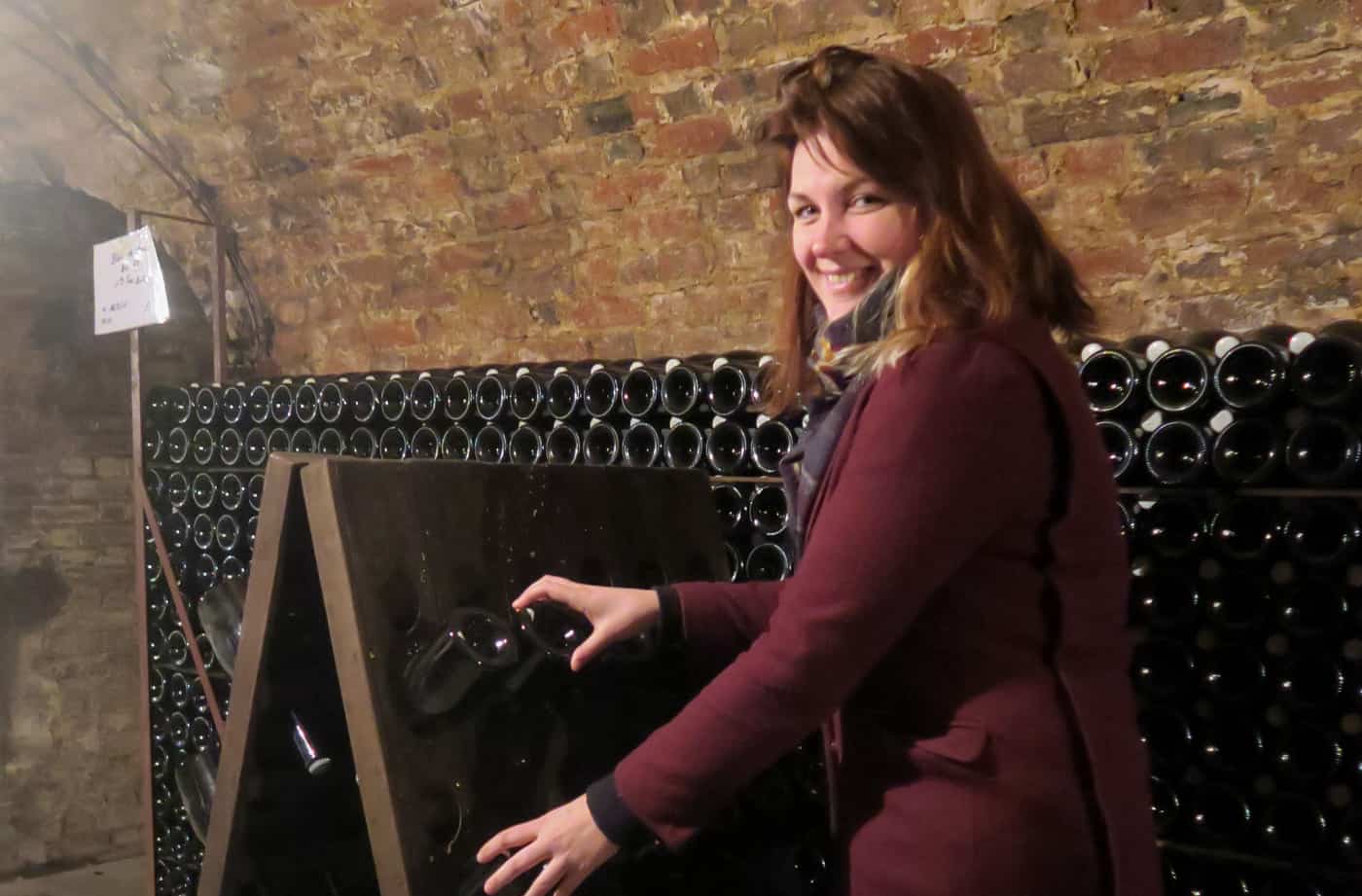
We're not there yet, mind you. After the maturation period, something essential still needs to happen. The yeast sediment needs to be removed from the bottle and transferred to the neck of the bottle. According to the specifications, the bottle then lies neck-down in special racks for about 60 days. The lucky person gets to turn the bottles a little each day, so that by the end of the process, the sediment has settled. We call this person the "rémueur." This is now done mechanically at most Champagne houses, but back in the day, there were people who turned 30,000 bottles a day. Gotta love Champagne.
Ready for departure
When it's all finally settled at the neck, it has to come out. It's handy that the crown cap is on. The neck is frozen, the crown cap is removed, the frozen sediment shoots out, voila! The bottle is filled with a Liquor d'expédition , a liqueur made with wine and possibly sugar. This does determine the sweetness of the champagne. Of course, there are rules and labels for this, so you can identify your favorite champagne by the term on the bottle.
- Zero Dosage of Brut Nature: 0 grams of added sugars, resulting in a dry, almost bone-dry champagne. Global warming is making this increasingly possible. The grapes are riper, so there's simply no need to add as much sugar.
- Extra Brut: less than 6 grams of sugar, which is sometimes confusing, because 6 grams is so little that it could also be residual sugars, making Champagne effectively a zero dosage.
- Brut: between 6 and 15 grams, the most common style of Champagne, a dry Champagne.
- Extra Dry: Between 12 and 20 grams of sugar, a slightly off-dry Champagne. Especially popular in America.
- Sec: Between 17 and 32 grams of sugar, which is rather confusing, as sec is the French word for dry, but if it says sec on the bottle, expect a medium-sweet bubble.
- Demi-Sec: between 32 and 50 grams of sugar, which is certainly sweet, but combines deliciously with fresh fruit desserts.
- Doux: more than 50 grams of sugar, the sweetest Champagne of all.
Alternatives
Champagne may only be labeled on the bottle if the wine originates from the Champagne region. This doesn't mean that no one outside France (or even within France) knows this trick. There are numerous alternatives, recognizable by the term " methode traditionelle " on the bottle, as even the term "methode champenoise" has been banned for sparkling wines outside the region since 1994.
Do your research, though, because not every bubbly can simply call itself a champagne alternative. I've already done some preliminary research for you. You can read it here:
Share:
Who understands Burgundy?
Wine FAQ: What is phylloxera?