
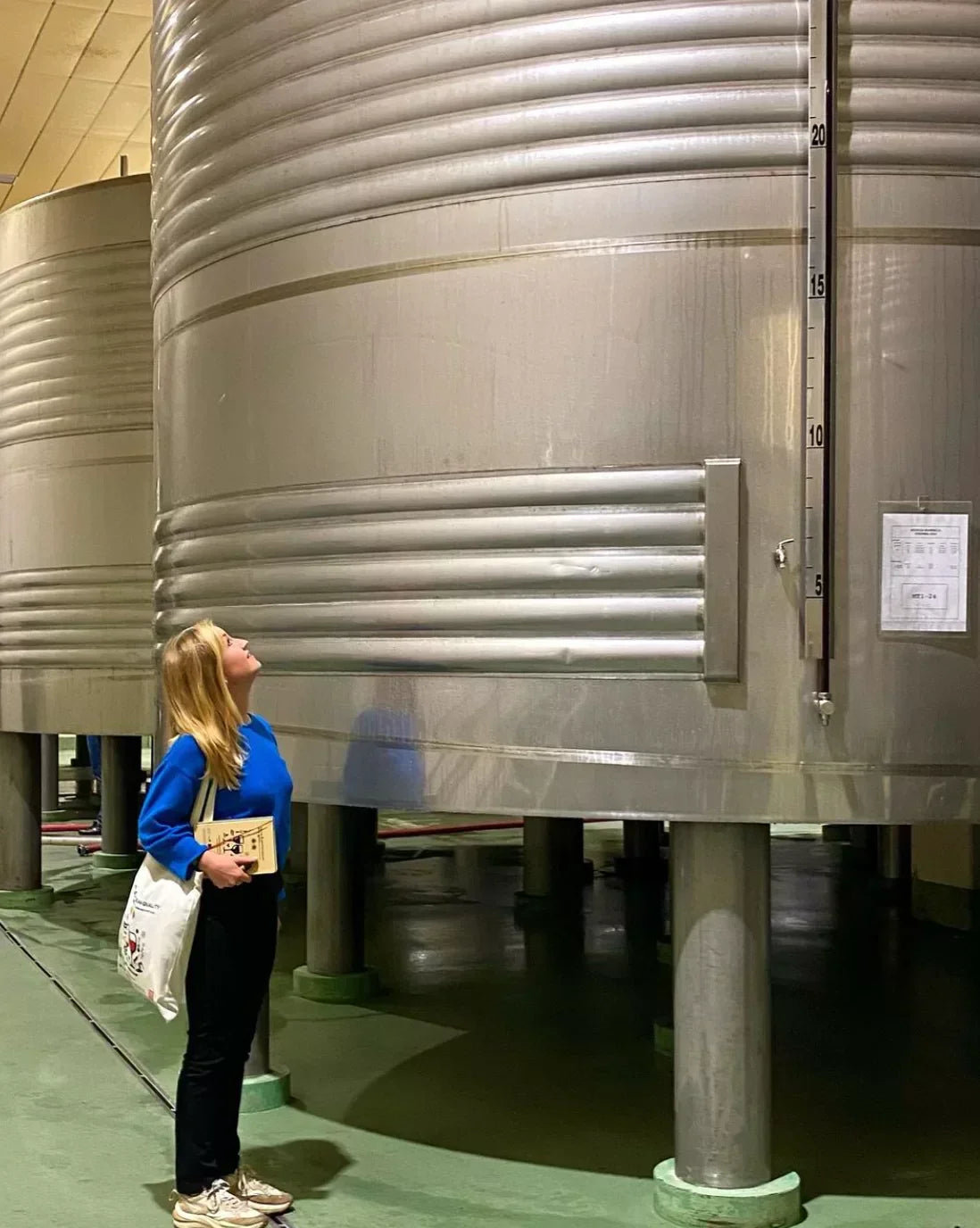
Olé! I was recently in Spain for Le Club. When you think of Spain, you probably immediately think of tapas, jamón ibérico, and famous wine regions like Rioja, Galicia, and Andalusia. With approximately 1 million hectares of vineyards, Spain is the world's largest wine country. In terms of production, it ranks a respectable third, mainly due to lower yields per hectare compared to neighboring countries France and Italy.
There are no fewer than 102 recognized DOs (Denominación de Origen) and 42 VdlTs (Vino de la Tierra). Spain is working hard to promote lesser-known wine regions. So let's go: explore DO Navarra and DO Somontano. In this blog post, I'll tell you more about the former, and you can read more about Somontano here .
Introduction to Navarra
DO Navarra is located in northern Spain, wedged between Rioja and France. It boasts the country's northernmost vineyards, influenced by an Atlantic and Mediterranean climate.
We distinguish five distinct regions within the DO, each with its own unique character: Tierra Estella, Baja Montaña, Valdizarbe, Ribera Baja, and Ribera Alta. Navarra generally experiences colder winters (around 5 degrees Celsius) with average rainfall. Summers are warmer (around 26 degrees Celsius) and drier, allowing irrigation throughout the region.
Over the past 25 years, there has been a major shift in quality and wine tourism. Today, the region produces approximately 90% red grape varieties and 10% white. Grenache and Tempranillo are the main red varieties, and Chardonnay is the most important white. This hasn't always been the case, however. In the past, up to 90 different grape varieties were found in the region, with indigenous varieties playing a significant role.
There are two reasons for the shift from native to more classic grape varieties: phylloxera and, consequently, the arrival of the French. The phylloxera louse arrived in Navarre much later than in the rest of Europe, thanks to the natural barrier of the Pyrenees. Naturally, the French winegrowers, driven from their own vineyards by this devastating pest, saw a silver lining. They therefore played a key role in replanting the region and brought with them more classic grape varieties like Chardonnay, Cabernet Sauvignon, and Merlot. Today, you'll find a mix of classic and authentic Spanish grape varieties in the region.
The place for rosado
DO Navarra's specialty? Surprise: rosé! This is made exclusively using the saignée method, resulting in relatively low yields. A costly undertaking, as a bottle requires twice the amount of grapes compared to direct pressing. With global warming, achieving the desired light, fruity style is also becoming increasingly difficult. As a result, the traditional saignée method is under increasing pressure. The possibility of permitting pressed wine in the future is even being explored to safeguard rosé production.
Nerd alert at Bodegas Ochoa
Of the wineries we visited in Navarra, Bodegas Ochoa and Bodega Otazu were the most memorable. Ochoa is run by two sisters who took over the winery from their father a few years ago. They have approximately 145 hectares of vineyards, and all their red wines are now certified organic. Ochoa is Basque for "wolf," and you'll find it everywhere. Since Adriana arrived in 2005, in addition to her father's classic wines, she has also developed her own eight (ocho) wines under the name 8A.
A key characteristic of this winery's wines is their desire to keep alcohol levels as low as possible. They achieve this, among other things, by selecting naturally occurring yeasts that promote slower fermentation. These yeasts are then propagated and used for alcoholic fermentation. Nerd alert: for the diehards among us, the yeasts Ochoa primarily uses are saccharomyces, rhodotorula, metschinikowia , and kluyveromyces . Metschinikowia plays a special role in this because it has a stronger antiseptic effect, which can reduce sulfite use: a win-win!
The grape varieties Ochoa uses are Tempranillo, Grenache, Graciano, Merlot, and Cabernet Sauvignon for reds, and Moscatel, Chardonnay, Viura, and Viognier for whites. Overall, I found the wines here to be very well-balanced, with plenty of fruit and minimal fuss.

Personally, I was more impressed with the 8A wines than the classic wines from this bodega, but that is of course also due to my fragile Burgundy palette ;-).

Bodega Otazu: museum or winery?
Bodega Otazu: honestly, I'm not sure whether to call this a museum or a winery. Art is central to the family that runs this winery. Everywhere you look, there's art. From the garden to deep in the cellars: everything has been carefully considered and there's a philosophy behind it. Interestingly, this winery produces "vino de pago," the highest classification for vineyards in Spain (though not every region has or uses this classification). It's one of only 23 (!) bodegas in all of Spain with this classification.
The wines were good, but not exceptional. So why is a visit to Otazu truly worthwhile? The art, the cellar, the experience… it was a true delight to explore here, with every detail perfectly executed.
The visit was part of the EU campaign “A Shared Passion”.
Guest blogger: Jette van Bergen
I'm Jette van Bergen (@kleinmaarwijn), a huge Francophile and a true wine lover. In 2022, I decided to work at a wine estate in Burgundy for a few months. Purely for the experience and to satisfy my hunger for France. The opposite happened, and I soon decided to pack my bags and emigrate to Burgundy to further immerse myself in the world of winemaking. I'm currently studying Viticulture and Oenology at Viti in Beaune. Next step? Making more wine, tasting more wine, and above all: sharing more wine with other wine lovers.





Share:
A day in the life of a vineyard girl
Palo cortado: mystery unraveled