
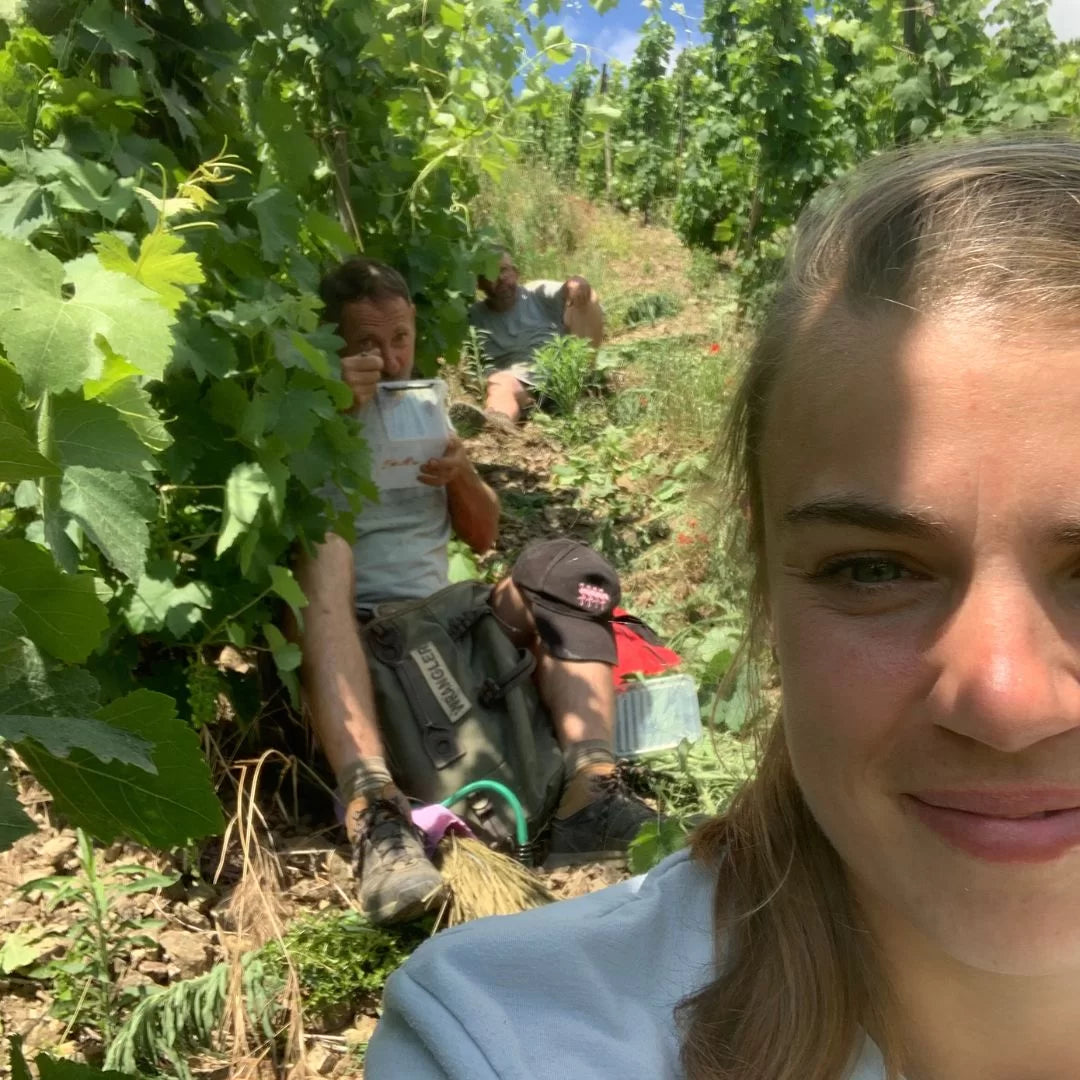
The final stages of harvest - 6:45 a.m., the sun has barely risen. We're ready with our equipment to tackle La Landonne. La Landonne is one of the famous "la-las" vineyards in the Côte-Rôtie, Northern Rhône. This season I worked for Domaine Xavier Gérard, and this is his most prestigious vineyard. With a 45-degree slope and no typical terraces, working here is nothing short of hellish.
It is the end of August, and the grapes have gradually changed color from green to deep blue –
We call it "véraison" (veraison), the moment the vines are in their final sprint toward harvest. Today, we're removing the foliage around the grapes on the east side. The morning sun is still mild and won't cause the grapes to wither. After a wet spring, we're dealing with a lot of leaves and high moisture levels in the fruiting zone; a perfect playground for botrytis fungus. By defoliating, we ensure that the grapes dry faster and that mold has less of a chance.
A ride to the steep slopes of La Landonne
We navigate our pickup truck up the steep slope toward our rows in La Landonne. Our mini-team of four passes legions of majestic Guigal grapes. We gaze enviously at their brand-new equipment as we head to our modest plot. Gérard's 0.2 hectares are a blip in the otherwise unbroken 2.3 hectares of Guigal. As you can imagine, our vines are in better shape, and our grapes are naturally more flavorful than theirs. Call it the "Calimero effect."

Getting started: tackling the canopy
Once we arrive, we don't waste a minute. At Domaine Gérard, efficiency is everything. We carefully slide our way down – as if we're descending a black run. Half-hanging from pole to pole (called echallas), we hope not to break anything. The task is clear: 75% of the blade has to be removed, and that in just 20 seconds per pole, if it's up to Xavier. The unspoken competition can begin. Competition? Yes, competition, unintentional, of course, but that's what happens when you put a bunch of men together who are eager to prove themselves.
Rats, rats, rats, 75%? Don't think, just go, Rianne, you don't want to be last. The leaves fly around and before you know it, you suddenly pull off a bunch. MAD . A quick calculation runs through my head. We can make a maximum of 500 bottles from the yield from this plot. On average, we need about seven bunches for a bottle. A bottle costs 140 euros. That makes each bunch twenty euros. Seven mistakes like this and we're one bottle short. A small moment of realization, oelala.
Côte-Rôtie and the roasted Rianne
The sun has begun to burn. For those who don't know, Côte-Rôtie literally means "roasted slope." It feels like a toasted Rianne. During our break, we huddled against a vine for a little shade. Our trembling calves and aching backs could certainly use a break. Picnic-style, we devour our lunch and greedily drink our water. I pull my cap over my sunburned nose. Time for a quick nap before we have to get going again.
On to the harvest
In a few weeks, we'll hopefully be able to harvest perfectly ripe grapes. I'm feeling a sense of responsibility and pride. La Landonne 2024, I can't wait!
More Rianne?
Listen to the podcast about Condrieu where she talks about her life in the Northern Rhône.
Guest blogger: Rianne Ogink
I'm Rianne Ogink. From sports manager in Deventer, to sommelier at Zoldering in Amsterdam, to student of viticulture & enology in Bordeaux, France. You could say I've turned my hobby into my job. Spending whole days chatting with people about beautiful wines, regularly popping corks, and spending days learning how wine is made. I'd love to share my adventures on (digital) paper for you! Enjoy!
Share:
Golden combination: Manchego ice cream with cream sherry
Jette in Navarra: a journey to the north of the south