
It's one of Italy's most famous wines, but how is Amarone della Valpolicella actually made? Le Club investigates and reports.
The hills of Valpolicella lie north of the charming city of Verona, near the hills of Soave – Italy's famous white wine region.
The grape varieties
The main grape used in Amarone production is Corvina. It's an indigenous grape variety that has been grown in the Verona area for decades.
According to DOCG rules, an Amarone must be a blend of the following grape varieties:
- 45 - 95% corvina
- 5 - 50% rondinella
- 0 - 50% corvinone
- Supplemented with up to 15% of other local grape varieties from the province of Verona, of which molinara is the most commonly used
Oseleta is one of the local grape varieties that has been gaining popularity in recent years . It produces small bunches of small, thick-skinned grapes. It is ideally suited to adding structure, color, and aromas to the Amarone blend.
It's not allowed in Valpolicella, but that doesn't stop producer Allegrini from making a 100% Corvina under IGT Veronese. Curious? Check out the tasting notes from WineAnorak.com here >
How is Amarone della Valpolicella made?
What makes Amarone della Valpolicella different from other red wines? It's the unique production method, appassimento. The wine is made from dried grapes.
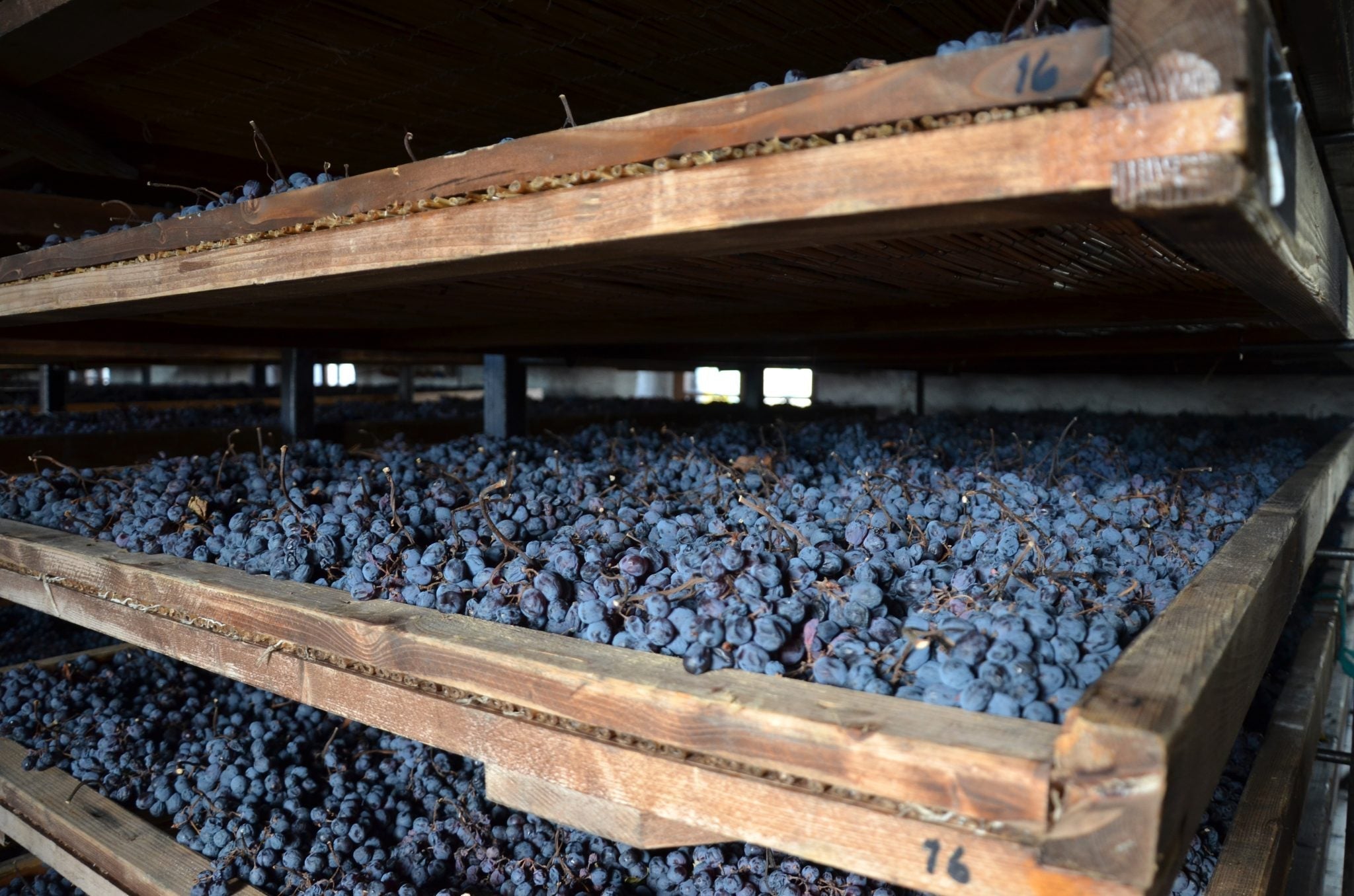
When selecting the grapes, it's important that the bunches aren't too large and that the grapes have enough space. Compact bunches increase the risk of mold. The grapes are then moved to the fruttai in the cellar. These are large rooms where the grapes are laid out to dry for about three months. Some producers still use arele , special mats made of river reeds, to lay the grapes on, while others have high-tech drying rooms where everything (temperature, humidity, and ventilation) is meticulously controlled.


The grapes are regularly inspected to ensure they are still healthy. Any moldy grapes are immediately removed to reduce the risk of spreading the disease.
After three months, the grapes' water content has decreased by 30% to 40%. The sugars concentrate, as do the aromas. They have become raisins. Winter has arrived in Valpolicella, and the grapes—or rather, raisins—can be fermented. The must is loaded with sugar, so fermentation is slow. It usually takes 40 to 60 days (compared to about two weeks for a typical red wine).
After fermentation, a wine must age for two years before it can be released. A Riserva must age for at least four years. There are no regulations regarding the wood or size of the barrel. Most use oak, but chestnut wood was also used in the past.
Trying something new? In Valtellina, they also make a dry red wine from dried grapes, in this case Nebbiolo. Not Amarone, but Sforzato della Valtellina.
Small difference with Recioto della Valpolicella
According to our friend Jancis Robinson's The Oxford Companion to Wine, Amarone is a recioto scapata , a recioto that "escaped" and was fermented completely dry, when it was actually intended to be a sweet wine .
Recioto and Amarone are practically the same wines. They're made using the same process from dried grapes , but a recioto retains some residual sweetness (more than 50 grams per liter), while an Amarone may contain a maximum of 12 grams per liter. Most Amarones contain 5 to 7 grams per liter.
Does recioto have a much lower alcohol content? Not so bad. We're still dealing with raisins that are fermented. They contain a huge amount of sugar . It's not like a sweet Riesling, which sometimes has an alcohol content of 8%. The sugar content of the grapes for Amarone and Recioto is much higher. By law, a Recioto must contain at least 12% alcohol. An Amarone has a minimum alcohol content of 14%, but most these days are at 15% or even 16%.
Cooling the fermentation tank is the most common method for making a sweet wine. It's a way to kill the yeast. These techniques, such as temperature-controlled vats and extensive filtration, didn't exist in the past. In the case of Recioto della Valpolicella, the outcome was a surprise .
The intention was to make a sweet wine, so fermentation was stopped early by transferring the wine from one barrel to another, hoping to leave the yeasts behind. Sometimes, some yeast was carried over, and the wine ended up bitter ("amaro" in Italian), becoming an Amarone. And sometimes, this only became apparent in the bottle – resulting in a sparkling Recioto – once quite common!
Source: Veronissima.com
What a success
Since the 1980s, Amarone has been a hit. Production continues to grow, rising from 8.5 million in 2005 to 14 million bottles in 2013. Producers are allowed to use 70% of their grapes for Amarone production, regardless of the quality or origin of the grapes (as long as they come from the Valpolicella region). This creates a huge difference in quality. In 2021, production reached around 18 million bottles.
More Wine Masters? Check the website for all the documentaries >
Finally
One of the finest Amarones I've ever tasted was from Quintarelli. My tasting notes read:
An incredible wine, I'm starting to wax lyrical. One sip and all the Amarones are swept away. It's like your palate is being reset. Not thick at all, but very elegant. Still, at 16.5% alcohol, we can't call it light. Complex, though. Plums, cherries, tobacco, and chocolate make their appearance. Cardamom and a touch of mint reappear on the palate. The tannins are velvety smooth. After five minutes, I can still taste the wine.
Share:
2021 in 12 wines
Bordeaux to love