
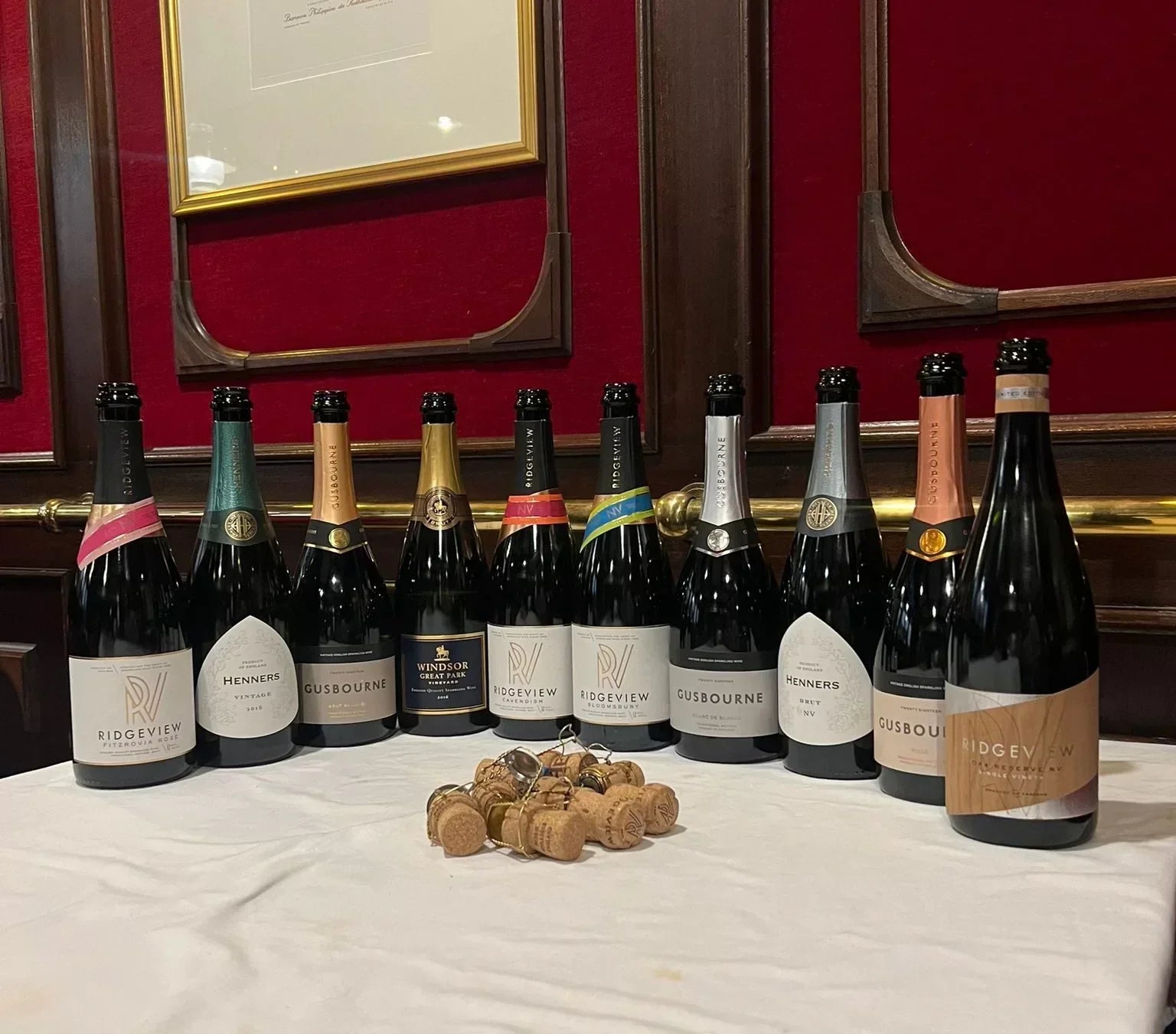
In early 2023, we recorded a podcast about English Sparkling Wine and were deeply impressed by these bubbles from across the Channel. England's vineyards, particularly those for sparkling wine, are located in the southeast, in Kent, Sussex, and Hampshire—at the 51st and 52nd parallels of latitude, the northern limits of viticulture.
Britain's vineyard area now totals almost 3,800 hectares and has doubled in the last 10-15 years. Since 2000, it's even quadrupled. In short, it's hip and happening.
There are several reasons for this.
What has contributed to this is that English Sparkling Wine has dethroned Champagne on a number of occasions. various blind tastings . Nyetimber was the first English fizz to introduce the World Sparkling Wine Championships won, beating Champagne.
It also helps that Champagne itself admits that the quality is good: some producers have already purchased land in England. Champagne Taittinger was the first to cross the Channel.
And that's not without reason. Champagne and southern England are climatically similar. It's said that England has roughly the same climate as Champagne. 30 years ago . Generally, the climate is cool, although you wouldn't say so looking at the summer of 2022. "Sometimes it feels continental, sometimes distinctly Atlantic, sometimes even a bit Scandinavian," writes Tom Stevenson for Tim Atkin (Special Report, England 2022). When we think of England, we often think of rain. That falls mainly in Scotland; on the southern English coasts, it's noticeably dry. Except in 2012, a disastrous year in English wine history.
Besides climate, the soil also plays a role. Remember the chalk cliffs of Dover? That's right, chalk. This characteristic soil of the Champagne region extends and reappears in southern England. The vineyards of Hambledon Vineyards Hampshire has a chalk bottom. Nyetimber has soils with chalk, but also with greensand (the layer beneath the chalk, which becomes visible when the chalk has eroded). Gusbourne has chalk and flint near Sussex and clay soils near Kent .
More about soils
I can imagine you'd have a head start in communication if you had a chalk base. After all, it's the same base as Champagne, so you can shout it from the rooftops.
However, it's not all chalk that's prevalent in England. There are various soil types, each with their own advantages and disadvantages. World of Fine Wine website the geology of southern England is explained in detail.
- Greensand , which can perhaps be translated as green limestone, is known for its good drainage.
- Stony soils They have the gift of reflecting light, extra sunlight, and extra warmth. This can contribute to growth. They often have hard soil, which can be detrimental to the use of machinery.
- Clay soils They can retain nutrients and water well. This can be both an advantage and a disadvantage. A slope can help improve water drainage.
- Chalk soils They are a kind of sponge: they can retain water and allow it to move through the soil. This results in "fitter" vines, because they have to work harder for water. The iron deficiency is the biggest drawback, which can lead to chlorosis (yellowing of the leaves).
Grape varieties
The main grape varieties are the classics from Champagne: Chardonnay and Pinot Noir in the lead with both around 1100 hectares, followed by mincer with over 300 hectares. About 68% of the production is sparkling and in terms of plantings, England is now equal to one eighth of Champagne.
Right after that comes Bacchus , England's signature grape. It's well-suited to the English climate because it ripens early. Bacchus is a cross between Scheurebe (also a cross between Riesling and Silvaner) and Müller-Thurgau. While rarely used in sparkling wine production, it is an important grape for still white wines.
Low yields
The combination of climate, soil, and grape varieties keeps yields low. Lower than Champagne. The best vineyards in England have a yield of 8 tons per hectare. That's a lot for England, but corresponds to a bad year for France. Champagne . In 2021, the yield was 7,272 kg per hectare in Champagne, which was the smallest harvest in 40 years. The following year, 2022, was much better, with 12,000 kg per hectare. We're not there yet in England.
For more information about harvest years in England, read the Harvest Report by Stephen Skelton MW about 2018.

English sparkling wine: the favorites
RIDGEVIEW
Ridgeview is located in the South Downs National Park in Sussex and was founded in 1995. When they started, production was 20,000 bottles. They now produce 250,000 bottles annually, allowing them to retain some of the harvest to release non-vintage sparkling wines. Ridgeview has been producing these since 2017.
Ridgeview Cavendish NV
36% Pinot Noir, 32% Chardonnay, 32% Meunier (18 months lie, 8 gram dosage)
A fairly typical Champagne blend. Everything is fermented in stainless steel, so freshness is paramount.
Ridgeview Bloomsbury NV
60% chardonnay, 25% pinot noir, 15% meunier (18 months lie, 9.2 gram dosage)
Zesty is the magic word. Very refreshing with aromas of lime, apple, and fine mousse.
Ridgeview Oak Reserve NV
100% Chardonnay (24 months lye, 8 gram dosage)
This one leaves us speechless. Vinous. Matured in French oak. Decadent, buttery, ripe apples, hazelnuts, flint, and matchstick. Impressive. Curious how this tastes next to Bollinger.
Ridgeview is available at Wine merchant Peeters .
GUSBOURNE
Gusbourne was founded in 2004 in Kent. They now have 90 hectares of vineyards, including 60 hectares in Appledore, Kent, and 30 hectares in West Sussex. They use only their own grapes and do not buy any grapes in-house.
Gusbourne Brut Reserve 2019
62% chardonnay, 28% pinot noir, 10% meunier (24 months lie, 9 gram dosage)
About 11% of the wine has new oak, which you can taste. It makes the wine more interesting and gives it more body. Nice toasted notes of freshly squeezed citrus.
Fun fact: we also served this bubbly during The Bubble Battle at Walsjerot in a flight with a Fattori 60 from Lessini Durello (Veneto) and Agrapart Les 7 Crus from Champagne. Most tasters thought Gusbourne was the champagne.
Gusbourne Blanc de Blancs 2018
100% Chardonnay (33 months aging, 11.6 gram dosage)
The favorite of the English royal family. Served when Queen Elizabeth turned 80 and also at Charles's first state banquet. It's unmistakably a Blanc de Blancs: lime zest, lemon, freshly toasted bread, brioche, and lime. Can you tell it apart from a Côte de Blancs?
Gusbourne Blanc de Noir 2018
100% Pinot Noir (31 months lie, 10 gram dosage)
A clear difference from the Blanc de Blancs. More filling thanks to Pinot Noir. Small red fruit, richness, good and lively acidity, tangerine peel, cinnamon.
Gusbourne is available at Peeters Wine Merchant and at other stores that work with importer Vinites.
HENNERS
Henners, founded in 2007, is located in the Pevensey Levels nature reserve, a stone's throw from the English coast. The area is dry and sunny, with a pleasant sea breeze that lends a salty note to the wines. They own a total of 3 hectares of their own vineyards (clay soil) and purchase grapes from contracted growers.
Henners 2016
70% Chardonnay, 30% Pinot Noir (48 months lie, 7.5 gram dosage)
It needs a little time, or perhaps a larger glass. But afterward: fascinating! Very refined with delicious aromas of biscuit and brioche, a touch of flint, apple, saltiness, and delicate citrus acidity.
Henners is available (on request) at Peeters Wine Merchant and at other stores that work with importer Pallas.
NYE TIMBER
Nyetimber is probably the most famous English winery. The first vines were planted in 1988 and have been owned since 2006 by Eric Heerema, a scion of a wealthy offshore family. In 1991, his brother bought him out of the family business for a quarter of a billion euros. With that money, he bought Nyetimber, among other things, and declared his ambition to make the best sparkling wine in the world. So far so good, as Nyetimber beat Bollie to the Champion of Worldwide Sparkling Wines . Nyetimber owns 170 hectares of vineyards, mainly located in greensand and produces between 1.5 and 2 million bottles per year. The daily management has now been taken over by Richard Carter , former CEO of Rolls Royce.
Nyetimber Brut NV
55-65% Chardonnay, 30-40% Pinot Noir, 5-15% Meunier (36 months lie, 8-10 gram dosage)
Baked biscuits with lemon zest on the nose. Roasted nuts, yeast, lemon, apple. Crispy acidity, as befits the English. I'm immediately craving fish and chips.
Nyetimber Tillington 2013
76% Chardonnay, 24% Pinot Noir (48 months lie, 9.7 gram dosage)
Tillington is a single vineyard in West Sussex with a greensand soil and a southerly exposure.
Nyetimber is available (on request) from Peeters Wine Merchant and at De Bruijn Wine Buyers.
Podcast
In early 2023 we recorded a podcast about English bubbles and this one is here to listen to.



Share:
The best podcasts about wine
A wine fan in Bilbao and San Sebastian