
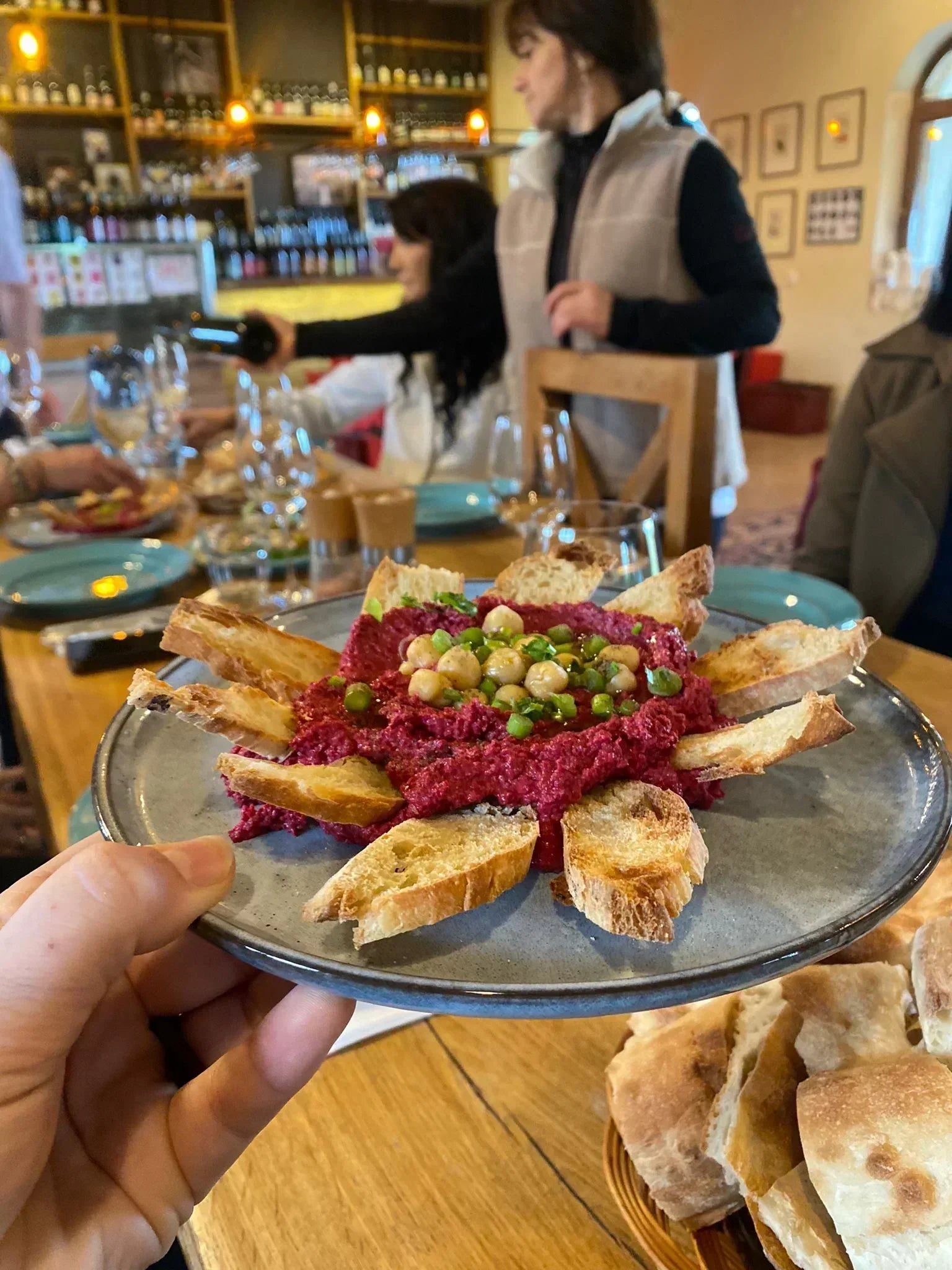
Fun, but exciting, I thought, when I received the invitation to go on a press trip to Georgia. It might not be the first country you think of when you think of wine. Which is strange, really, because Georgia is beautiful and the oldest wine country in the world. Remains have been discovered dating back 8,000 (!) years. As a wine enthusiast, you simply have to visit at least once.
Before I delve into the country and its wine culture, I'll share some background information for those who don't quite have Georgia's history and current political situation top of mind.
Georgia has a population of approximately 5 million, over a million of whom live in the capital, Tbilisi. It shares a 1,771-kilometer border with Russia and, like Ukraine, was part of the former Soviet Union. Modern-day Georgia came into being when it declared independence on April 9, 1991, following the fall of the Iron Curtain. This declaration was not without its challenges. “Since the collapse of the Soviet Union in the 1990s, conflict zones have emerged throughout the Caucasus,” according to Paata Zakareishvili (former Minister of Reconciliation) on NOS.nl .
The Netherlands has issued a travel advisory against the regions of Abkhazia and South Ossetia. These regions declared themselves independent soon after the fall of the Soviet Union, although this was not recognized by anyone in the international community at the time. In August 2008, conflict between the Georgian army and pro-Russian separatists escalated. in South Ossetia . A war broke out, in which the separatists from South Ossetia were supported by Russia. The war lasted only five days and resulted in the Russian recognized independence of Abkhazia and South Ossetia. South Ossetia makes no secret of the fact that they would prefer to join Russia and want to join soon hold a referendum among the population.
Georgia has since considered South Ossetia (and Abkhazia) as Russian-occupied territory, something that is also recognized by the international community.

So you can skip Abkhazia and South Ossetia, but the rest of Georgia is definitely worth a visit. It's a beautiful country, and the people are incredibly hospitable in a way we, the Dutch, don't know. (there, I said it) and both the cuisine and the wines leave you wanting more.
Below I share my tips for Tbilisi and the Kakheti wine region.
Tbilisi and the Kartlis Deda
Our journey begins in Tbilisi, the capital of Georgia. It took me a while to figure out how to pronounce that name, but it goes something like this: te-buh-lie-sie where you barely pronounce the first 't'.
As soon as you enter Tbilisi's old town, it becomes clear that Georgia has a wine culture. Wine bars pop up everywhere, and when I let the taxi driver know I'm here for the wine, he says: 'Of course you are.' He goes on to say that, like just about every Georgian family, he makes his own wine at home. All kinds: white, orange, and red. And of course chacha , a distillate similar to grappa, made from leftover grape pomace (or other fruit).
The symbol for the city is Kartlis Deda , or Mother of Georgia. It's an impressive statue on Solaki Hill of a woman holding a glass of wine in her left hand to welcome friends and a sword in her right to ward off enemies. Beautiful, isn't it?
Wine bars in Tbilisi
There are countless wine bars in Tbilisi, each one cozier than the last. Most, as befits the country, focus on natural wines from their own region. Wherever you are, don't forget khachapuri Available to order. It's a Georgian bread filled with cheese and incredibly delicious.
Nino Meris
This place is hands down number one. Not only does this woman make wine in Kakheti, she also owns a wine shop, wine bar, and restaurant in the center of Tbilisi. She tells us, a group of journalists and bloggers, her moving story, and I can barely hold back the tears. She literally has her business. from scratch The story is impressive and shows that you shouldn't give up and follow your heart. Even if you face one, two, or a hundred setbacks, keep following your own path.
She'd faced tougher challenges, so a pandemic like this wasn't an obstacle for her. During the height of COVID, Nino took the plunge and opened a wine bar and shop in Tbilisi's old town. It was the perfect time, as the rent was low. A visit to Nino Meris Wine Shop & Bar is a must-see if you're in Tbilisi. Be sure to try their own wines.
Other tips:
- G.vino is a wine bar on the city's busiest street. As far as I understand, you don't need to go elsewhere on this street for gastronomic delights, but G.vino is a great place to relax. The food is delicious (lots of vegetable dishes) and they have a terrace.
- Sulico It's a small wine bar tucked away in a basement with only a small sign, so be careful not to miss it. They serve exclusively Georgian wines, have a good menu, and even have a terrace.
- Republic24 is a good restaurant with a view over the city. This is where I first discovered khachapuri and megrelian dumplings .
Special shout-out to the Rooms Hotel where we stayed. Here you can not only sleep well, but you'll also find a cozy bar and restaurant.
Kakheti
Georgia boasts 50,000 hectares of vineyards, about half the size of Germany. Most of it, 70%, is produced in Kakheti. The country has an 8,000-year history of winemaking, making it the cradle of wine. More than 500 indigenous grape varieties are cultivated, including rkatsiteli, kisi, kakhuri mtsvane and saperavi .

Amber wines
All wine styles are made, with the main focus, of course, on amber wines. Amber refers to the color of the wine. The grapes are placed unpressed—skin and all—in earthenware pots buried in the ground. Here, alcoholic fermentation occurs spontaneously, as does skin maceration. This usually lasts about six months. The skins give the wine an amber color and, if properly made, impart a pleasant bitterness and tannins. This long maceration also contributes to the wine's longevity, allowing sulfites to be minimized. Some winemakers forgo sulfites altogether, but that doesn't always benefit the wine (especially if it's intended for export). In any case, generally speaking, you'll find a lot of naturally made wines in Georgia. Not because it's fashionable, but because that's how they've been doing it for 8,000 years.


There's much more to tell about amber wines and qvevris, so a separate blog post about it will follow soon. During this trip, I also visited a qvevri maker .
Feast your eyes on Kakheti's green valleys, vast vineyards, and the Caucasus Mountains in the background. Here and there, you'll see a glimpse of Soviet-era decay, or you might suddenly find yourself in an unusual traffic jam because 25 cows are crossing the road.
If you're in Kakheti, it's impossible not to visit Sighnaghi. This place is also called the city of love, because you can tie the knot here 24 hours a day. But even if you don't have romantic plans, it's worth a visit. It reminded me of Gordes, a picture perfect A village in the south of France. It's even more beautiful with the snow-capped peaks of the Caucasus in the background.

Pheasant's Tears & Crazy Pomegranate restaurant
An oasis of tranquility awaits you at Pheasant's Tears Winery, which also houses a restaurant called Crazy Pomegranate. The restaurant is by appointment only and for groups of at least ten people. The Georgian cuisine reminds me of Ottolenghi's dishes. The table is completely covered in delicious treats, a tradition that showcases Georgian hospitality in its full glory. One of the unwritten rules of a supra The problem is that there have to be so many plates on the table that you can no longer see the pattern of the tablecloth. The founders of Pheasant's Tears Winery have contributed significantly to the Georgian wine world, particularly putting qvevri wines on the map.
Not traveling with a group of ten? Pheasant's Tears Winery also has a restaurant in Sighnaghi. Pheasant's Tears wines were among my favorites of the trip and good news: they are imported by Pure Wines .


Horseback riding, beer tasting and overnight stay at Lost Ranch Inn
We'll finish our day at Lost Inn Ranch & Brewery. Lost Ridge Inn is a boutique hotel, craft brewery, fire kitchen, and horse ranch. They also have a huge permaculture garden and offer endless walks through the beautiful green valley. Finish the day with a beer tasting of their homemade brews. Enjoy! More information can be found here .

Lost Ranch Inn

Beer time!
Telavi, Chateau Buera & Lopota Lake Resort
Anyone who wants to withdraw completely for a while can contact Lopota Lake Resort in Telavi. Originally a small resort with a handful of rooms, it has since grown into a complex that can accommodate around 500 people. While that sounds large and intense, it's actually quite spacious. As the name suggests, Lopota Lake Resort is situated on a lake. Everything has been thought of: swimming pools, water sports, several restaurants, and countless activities, from an exciting quad bike tour to a relaxing Slavic bath.
But hey, we're in Kakheti, so what activity is a must-do? Exactly, winemaking! In 2018, Chateau Buera celebrated its first vintage. Chateau Buera is housed in a magnificent castle amidst the vineyards, with the stunning Caucasus Mountains as a backdrop. They make two modern wines from Georgian grape varieties, which don't shy away from a bit of oak. Well-made wines, but it's difficult to distinguish a rkatsiteli from a chardonnay from, say, the Languedoc. Fortunately, they also make a rkatsiteli aged in a qvevri, which truly showcases Georgia's heritage.


Favorite winemakers in Kakheti and surroundings:
- Artana Wines in Artana – not yet available in the Netherlands
- Pheasant's Tears Winery in Sighnaghi
- Chelti in Shilda
- Tchotiashvili in Telavi
- Zhuka-Sano Wine in Telavi – not yet available in the Netherlands
- Demi Wines in Tbilisi – not yet available in the Netherlands
- Nino Meris Winery – Dedoplistskaro
The only thing wrong with Georgia is Georgian Airways . So take another airline and have a wonderful time in this beautiful country.

Share:
Wine FAQ: What are tannins?
The treasure of the Alentejo: Vinho de Talha – amphora wine