
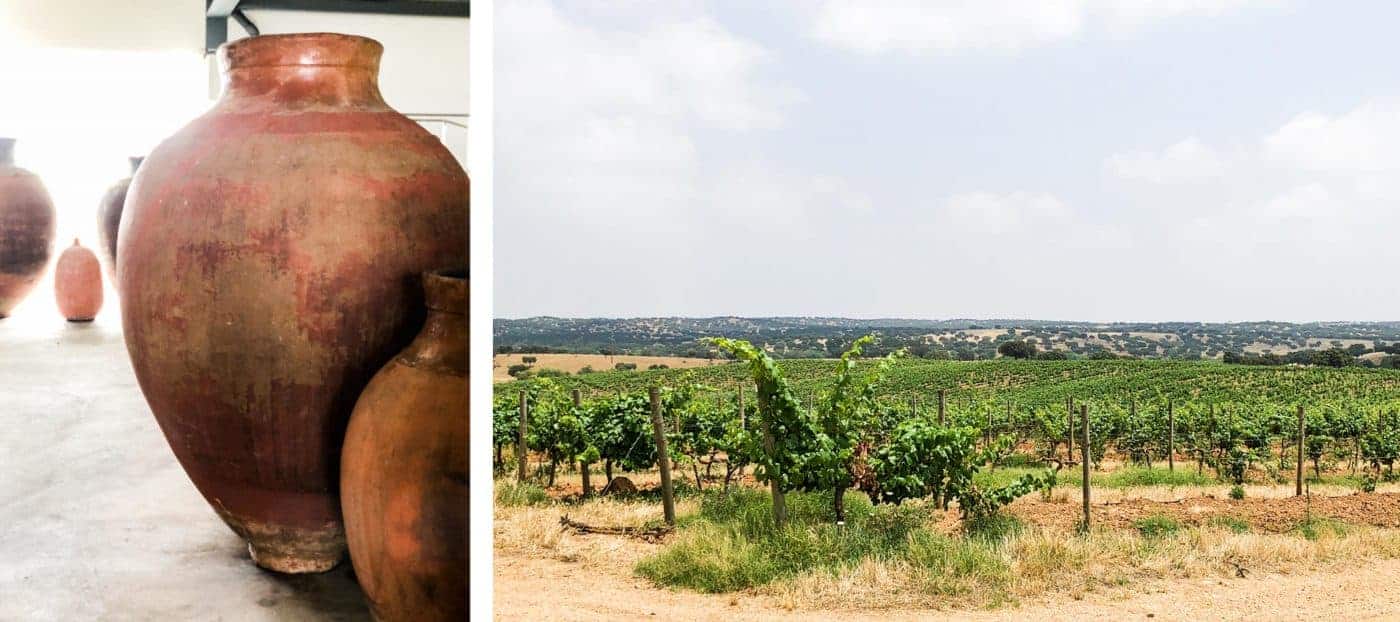
Amphora wine . Label it "orange wine" and it's hipster paradise. But amphora wine is more than that, much more. It usually has an orange color, but not all. orange-colored Wines were made in amphorae. Capice?
Amphora wine is made with a pot and a stick. That's all you need. " The easiest way to make wine," said Paolo, the winemaker at Herdade de São Miguel in the Alentejo. This tradition is two thousand years old and still practiced today. Talha Wine they call it here.
Once it's in the amphora, you can indeed serve your time, but what happens before and after? I'm getting a masterclass from Rui Falcão , one of Portugal's most famous wine writers and co-organizer of the conference. MUST Fermenting Ideas . It couldn't have been more perfect: the invitation to this conference coincided perfectly with my already-planned trip to Portugal. Those of you who read this blog regularly know that I'm often in Portugal. My friend Chantal emigrated there a few years ago (because of her raspberry empire), and I can't think of a better vacation spot.
The amphora is part of life in the Alentejo
It's hot in the Alentejo. Temperatures can reach forty degrees Celsius in summer. In the past, an amphora was the way to keep things cool. Today, it's simply a matter of programming a stainless steel tank.
Still, nothing beats an amphora in terms of sustainability. They're energy-neutral and last for hundreds of years. That does come with a drawback, though: there are no amphora makers left. With such a lifespan, it's not exactly a profitable business. Many wineries buy them from smaller farmers, or from people who inherited a pot or still have one "in the garage."
The amphorae were made from clay from different areas of the Alentejo, for example São Pedro do Corval, Vidigueira and Campo Major.
How do you make an amphora?
Welcome to the amphora-making course, the ultimate in pottery. Making an amphora takes at least four months, as it must be built up layer by layer. Only when each layer is dry can the next be added. Once the amphora is finished, the inside must be coated with a kind of sealant to prevent leakage. This can be done with pine resin, beeswax, honey, or olive oil. In the first few years, this sealant also imparts flavor to the wine. In the past, each village or group of amphora makers had its own recipe. Every fifteen years, the pot must be re-coated.
To allow it to penetrate properly, the amphora must be heated. Only when the pot is steaming can the inside be "painted" with the coating. It's a tricky business; you don't want to be responsible for breaking a two-hundred-year-old pot...
How do you make amphora wine?
The grape varieties used for amphora wine are local to the Alentejo region. These are the blue Moreto, Trincadeira, Castelão, and the white Antão Vaz and Diagalves.
Destemming & bruising
After harvesting, the grapes are taken to the winery, where they are destemmed. Traditionally, this is done by hand on destemming tables. Rui Falcão explains that if you do this for a morning, you can't move your hands for the rest of the day. Two people slide the grapes across the table, and the partially crushed grapes fall through the narrow openings, leaving the stems behind.
Fermentation in amphora
Then the grapes are placed in the amphora. Typically, the stems, or part of them, are also fermented because they can later provide natural filtration. After two days, fermentation begins spontaneously due to the natural yeasts in the grapes. During this period, the pulp and skins rise to the surface, forming a solid mass. This is pushed back into the must twice a day with a wooden stick to impart more color, aroma, and flavor to the wine. It also prevents the amphora from exploding during fermentation.
There's even more risk of explosion. The amphora's temperature must be kept under control. While high-tech tanks allow for easy adjustment, amphorae are also a breeze to do so: spraying water! Rui Falcão explains that the ring at the top of an amphora isn't just for decoration; it also helps ensure even water distribution. Mind blown . Even though it's 38 degrees outside, a little water over the amphora cools the wine to 17 degrees. Perfect fermentation temperature.
A piece of cake, if there's water, that is. In 2017, it was so dry in the Alentejo that in some areas, there were restrictions on tap water use.
Remain in the amphora until St. Martin's Day
Once fermentation is complete, the mass settles to the bottom of the amphora. There's a hole at the bottom of the amphora where the wine can drain. The first 25 liters are cloudy, but then it clears through the natural filtration of the stems. Beautiful, isn't it? In some Alentejo restaurants, you can taste wine straight from the amphora.
Nowadays, a little sulfite can be added to kill bacteria, but not everyone does this.

Note: The wine may not be removed from the amphora immediately after fermentation. The law requires that the wine remain in the amphora until November 11th (St. Martin's Day). To prevent oxidation, some winemakers cover the wine with a layer of olive oil. The olive oil will oxidize, but the wine will remain good.
Skinny dipping takes on a new meaning
Then, eventually, the amphora needs to be cleaned. Someone has to get inside to scrape the remaining pulp from the bottom. Hence, skinny dipping; you have to be pretty skinny to fit into an amphora like that.
Check out the video below – starting at about 1:45. It seems incredibly claustrophobic!
Amphora wine: love it or hate it?
Love it or hate it, that's the case with amphora wine. It's different from what you're used to – especially white wine. That's because the skins are also fermented. They're full of flavor, including bitters and tannins.
In the Alentejo, vinho de talha is often enjoyed with petiscos, the Portuguese version of tapas. Here are some examples from my own experience: multi tasteful are.
- Pica pau – Marinated pork belly. Super crispy and tender.
- Camarao a alho – Prawns in oil and garlic. Yummy .
- Ameijoas – Venus clams with tomato and onion rings. To die for .
- Salade de polvo – Squid can be very tough, but this was super tender and very tasty.
- Porco a alantejana – Clams with pork and potato cubes.
- Presunto – Dried Portuguese ham (freshly sliced tableside). Buttery soft.
Saude!
Share:
A wine lover in Georgia
A wine fan in Amsterdam