
No one ever asks for Armenian wine at the liquor store. Wine snobs often remember that the oldest winemaking discoveries originate from the Caucasus, but drinking Armenian wine these days? No, that's not the most obvious choice ever. And honestly, the same was true for me. When the vinologists' association organized a wine tour to Armenia, I saw it as the perfect opportunity to get acquainted with the country and its wine. That's how I've structured this story, so you can jump in wherever you like. First, you'll find more about the country itself, then about the best wineries, and finally, I've written my wine tips.
On October 19, 2025, we'll be tasting Armenian wines. Will you be there?
History and character of Armenia
Armenia has a rich, yet turbulent, history. The genocide in the early twentieth century, its time as part of the Soviet Union, and in 2023, the invasion of Nagorno-Karabakh (or in Armenian: Artsakh) by Azerbaijan… it's safe to say that these events have shaped the character of Armenia and Armenians. Armenians are proud of their country and are trying to make the best of it with their heads held high.
Enter with an Azerbaijani stamp
A few years ago, I traveled through Azerbaijan, about which I naturally also wrote an article . That Azerbaijani stamp in my passport immediately made my entry into Armenia a bit more complicated than that of my fellow travelers. Azerbaijan is undoubtedly arch-enemy number one, and the border between the two countries is dangerous territory. I was therefore faced with a series of critical questions at passport control, but ultimately, I was allowed entry.
Yerevan: hip capital full of wine and atmosphere
The capital, Yerevan, is a modern city. In the suburbs, you might still see the occasional Soviet apartment building, but the city center is incredibly hip. Every year, during the first weekend of June, the Yerevan Wine Days are held: a festival during which part of the city is closed off and the stalls of dozens of Armenian winemakers fill the city.

Add to that plenty of music and food stalls, and you have a fantastic festival. Serious wine tasting was out of the question; it was too crowded, everything smelled of delicious barbecue, and you usually couldn't understand what the winemaker was saying anyway. A shame? No way! Go with the flow: I had a great evening and made it a fun party. The atmosphere in Yerevan is wonderful: safe, tolerant, and open. My glass was regularly refilled by locals who were happy that tourists had discovered their country. Usually with semi-sweet pomegranate wine, mind you. Impossible, but still: drink it up and join the party.
Can't make it to the festival? Then definitely head to wine bar In Vino . They have a wide selection of Armenian wines, as well as a number of fine international wines.

Two wineries that stood out
In total, we visited about ten wineries and, of course, sampled many more. I'll highlight two wineries that really stood out to me, whose entire selection was above average, and which are therefore highly recommended if you ever find yourself in Armenia.
Zorah Winery: High-altitude vineyards with history
Zorah Winery is located in the Vayots Dzor region in southern Armenia. The region is surrounded on two sides by Azerbaijan, making it vulnerable. Due to the conflict since 2020, a number of winegrowers have fled, and some vineyards have been abandoned. However, there are also vineyards that were abandoned even longer ago. The Soviets decided that Georgia should produce wine and Armenia should produce brandy. As a result, much of the centuries-old knowledge of viticulture and winemaking has been lost, and inaccessible vineyards have been abandoned and left to rot.

These are now being revived, which is interesting: the soil consists of limestone and volcanic rock, phylloxera has never reached the region, and many vines are decades old. Zorah's vineyards are also located at an altitude of around 1,200 to 1,600 meters, resulting in a significant difference between day and night temperatures. This is perfect for ripening the grapes, and I drank several truly excellent wines there. Many of Zorah's wines are aged partially or entirely in karas, the earthenware jars known as qvevris in Georgia.

These tanks are partially buried. This ensures a lower temperature and prevents micro-oxygenation. The portion above ground creates a temperature difference, which keeps the wine moving. Ideal for perfect aging.
Karas Winery: at the foot of the mountain
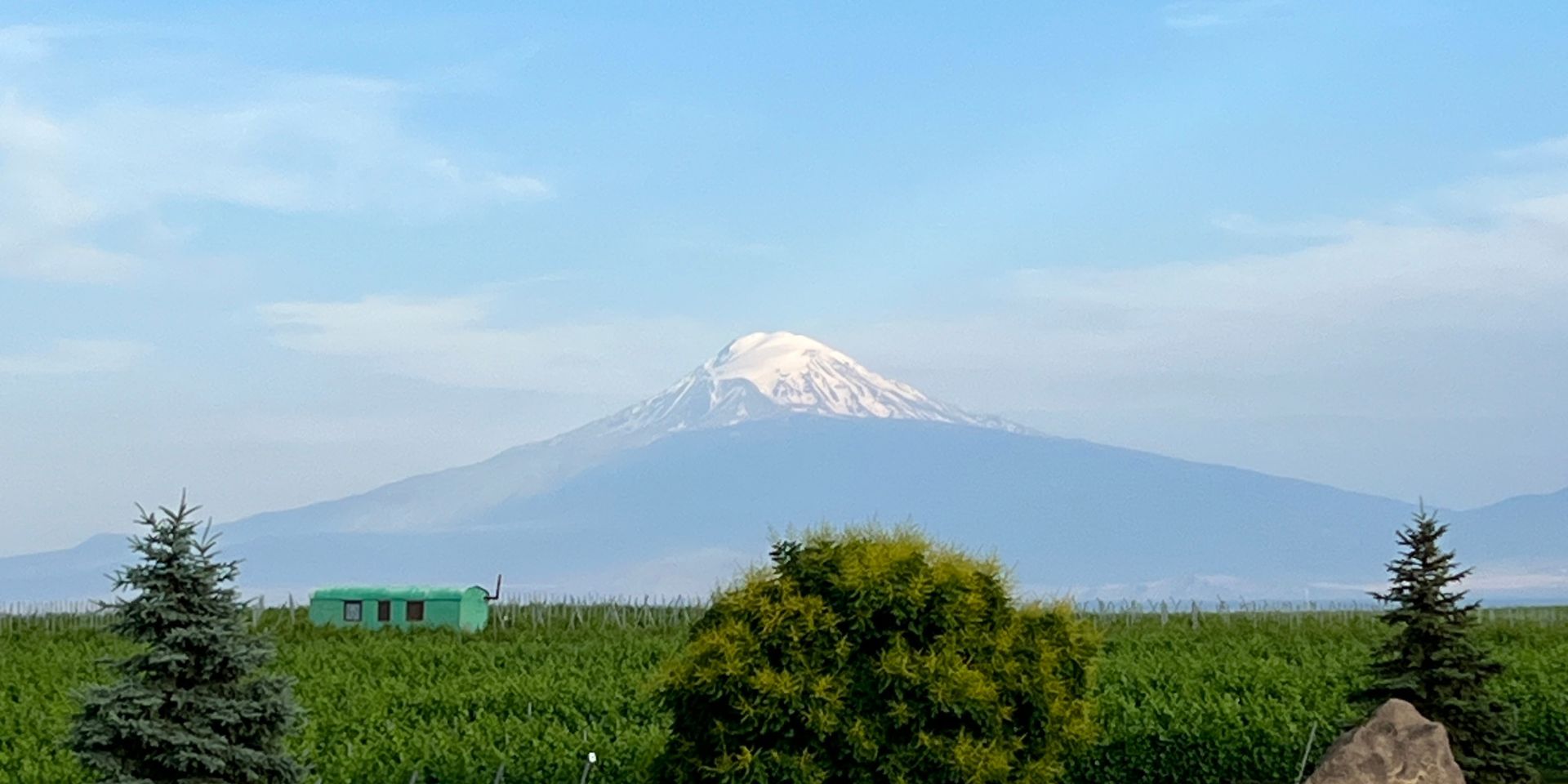
Karas Winery is enormous. By Armenian standards, but also by European standards. The owners are originally Armenian, but once fled to Argentina and were already making wine there (Fin del Mundo). Now they're trying to make Armenia great again. The vineyards (450 hectares, plus another 1,850 hectares owned for expansion) are situated at the foot of Ararat: a mountain of almost sacred proportions for Armenians. Sadly, the mountain is now located on Turkish territory, but it is still considered the symbol of Armenia. Everything in Armenia is called Ararat: wineries, brandy producers, the football club, a village, countless restaurants... Ararat is the mountain where, according to the Bible, Noah's ark landed after the flood and where he subsequently planted vines. Anyway, nowadays, the mountain is important for the wine in that it provides sufficient meltwater and volcanic soil.
Karas also makes fantastic wine from the areni variety. That's the red varietal from Armenia. If I had to describe it, I'd say areni falls somewhere between Pinot Noir and Syrah. The wine is generally lighter in color, has fresh fruit notes, but can also have the spicy and sometimes slightly musty notes of Syrah. I've had a lot of areni, but Karas's stood out. It's best slightly chilled, and what also helps: Riedel has released a special glass for areni. It's slightly tulip-shaped, and that makes it truly delicious.
Wine tips for tasting at home
Armenian wines aren't easy to find. Drink Rituals has a good selection online, and for in-store purchases, you can easily go to De Kaashoeve on Oude Binnenweg in Rotterdam. The owner is Armenian, and besides great cheese, they also have lovely Armenian wines.
Below I provide a list of wines that particularly caught my eye and that are undoubtedly fun to try.
- Voskevaz Voskehat Karasi Collection 2018 : Voskehat is Armenia's signature white grape variety. Voskevaz makes a wonderfully fresh, minerally wine from it, aged in karas and wooden barrels.
- Zorah Voskì 2022 : made from a blend of half voskehat and half garan dmak. Aged on concrete, it reveals salty aromas of peach and walnut.
- Zorah Heritage Chilar 2023 : Chilar is the grape variety, and the skins of this white grape were macerated for about two to three months. Fermentation and aging took place in karas. Because the grape has little pigment, this is an amber wine without much color. Aromas of flowers, tea, and chamomile.
- Zorah Yeraz 2019 : Yeraz is a red grape variety and literally means "dream." The wine is made from grapes from vines over 100 years old. Fermentation takes place in concrete tanks, aging in karas and barrels. Complex aromas of berry, blackberry, spices, and black pepper.
- Karas Areni Single Vineyard 2021 : aged partly in stainless steel, partly in oak, and partly in karas. The wine is then blended and aged for another 6 months in karas. This gives the wine elegance and complexity: red berries, cherries, thyme, and coffee.
- Karas Reserve Blend 2023 : a blend of areni (aged in karas for six months) for elegance and sireni (aged in Artsakh oak barrels) for body. Blackberries, plums, currants, and spices. It can still be enjoyed for years, but is already suitable as a winter red.
- Gevorkian Ariats Carbonic 2022 : The white Kangun grapes are macerated carbonically for 15 days. The wine is then pressed and aged for 6 months in karas. The wine is golden yellow in color. Aromas of orange (peel), zest, and peach. Filtered. Ideal for experiencing orange wine: not too strong.
- Gevorkian Kes Kakhani Areni 2021 : Kakhani means that the grapes are hung to dry in the sun and wind after harvest. Kes means half. So half of the grapes underwent the Kakhani method, and the other half are areni without this special treatment. A wine with jammy fruit (blackberries, plums), but still enough freshness to make it very interesting.

- Gevorkian Anaïs Armenian Icewine 2011 : made from voskehat. I have a soft spot for ice wine anyway because the makers take enormous risks to make it. Gevorkian did it in 2011 and never again. Peach, honey, a good balance of sweet and sour.
- Keush Origen Méthode Traditionnelle Brut : In Armenia, you'll mainly find sparkling wines made using the Charmat method. Sparkling wine made like Champagne is harder to find. The best I found was this one, and it's the Méthode Traditionnelle, with grapes sourced from the highest vineyards (1,700 meters). Made from voskehat and khatouni grapes, aged for 24 months. Ripe apple, a touch of brioche, and a touch of lactic acid. A good, understated sparkling wine.
- NOA White Reserve 2022 : made from chillar, garan dmak, khatouni, voskehat, and white areni. Matured in French oak. Its high complexity and more Burgundian style are unique in Armenia.
- NOA Natural Sweet White Reserve 2020 : consists of part ice wine and part regular late-harvest wine. Made with chillar, garan dmak, khatouni, and voskehat. Harvested in December 2020 under dangerous conditions: the vineyard was attacked by the Azeris. Dried peach, orange, and honey.
Share:
Wine and food pairing: pork belly, scallop and sweet and sour mango
Afterwards he completed the Ribera del Duero Educator Course