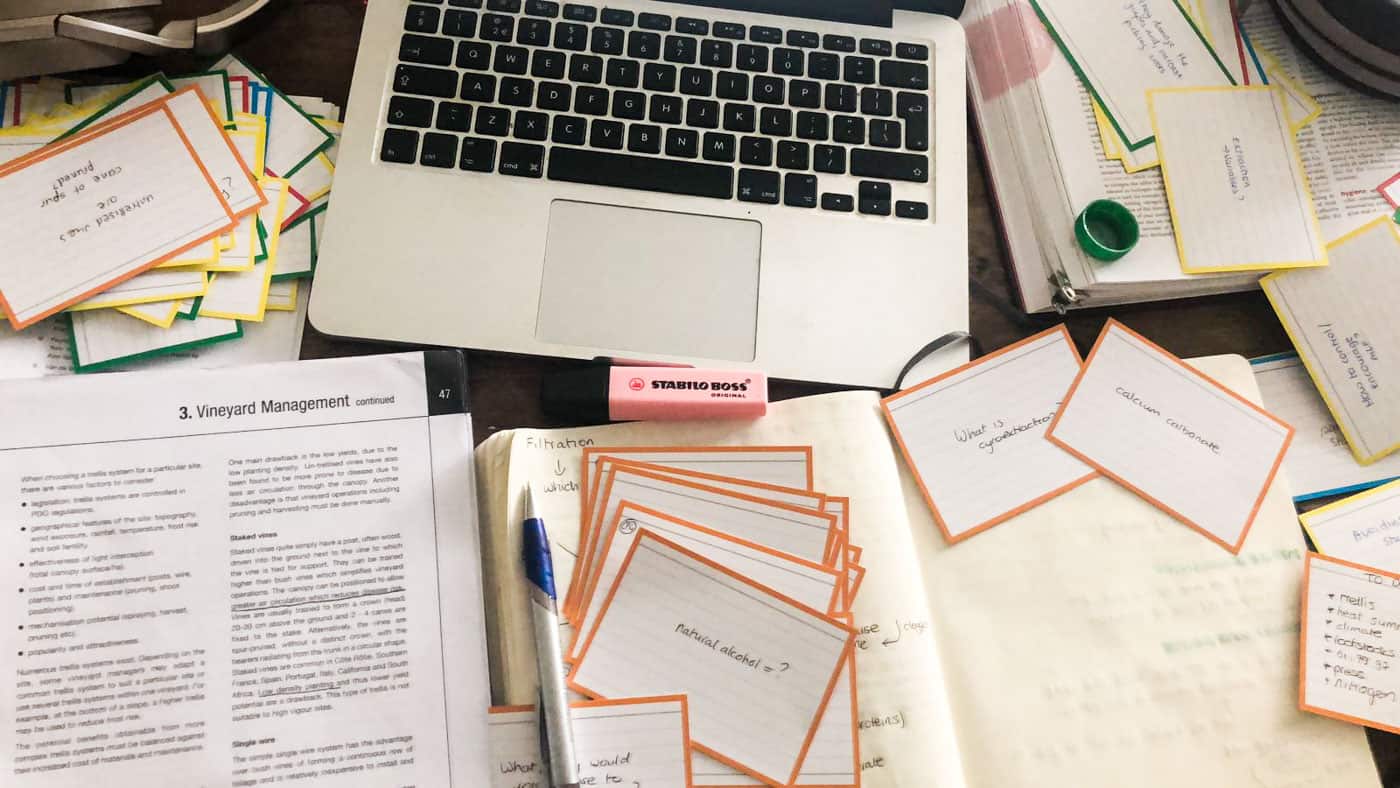
Think big. I want to become a Weinakademiker. On September 3, 2018, I started the WSET Diploma Course, which ultimately—if you add a thesis afterward—results in the title of Weinakademiker. In part 3, I'll talk about the first exam and what the program will look like in the coming weeks.
That same year, I quit my job to focus on my own business and start my WSET Diploma. I have to admit, I've had better ideas.
Cryoextraction, pectolytic enzymes, or maybe eutypa dieback. Terms I've never heard before, and now I have to know them inside and out for my first exam: viticulture & vinification. I'm doing well in terms of preparation. Although I have to say I'm rarely satisfied with it (yes, it's a tough life), and at the same time, I don't know what else I could have done besides lock myself away and just. But. Learn.
Although that's pretty much what my life has been like these past two weeks. Reading through the study guide, the Oxford Companion, and the WSET book "Vines & Vinification." That last one helps put things into perspective. A rotofermenter is nice, but what does it look like and how does it actually work? The same goes for pruning. When should you prune, how should you prune? Luckily, there's YouTube. The videos about cane and spur pruning helped me to better understand the whole happening in the vineyard.
Is it difficult?
I've been getting this question quite a bit these past few weeks. Is it difficult? Well, medium. It's a lot, but it's not necessarily difficult. It's not difficult if you understand that there are rotten grapes in the world, and while they can be fermented, they do contain nasty enzymes (laccase) that need to be suppressed somehow. How do you do that? Why do you do that? There are numerous ways to clear, filter, and stabilize wine. The easy answer, of course, is that you just need to harvest healthy wines 😉
Rootstocks are also a nice touch. Until WSET3, they were never discussed much. We know that phylloxera has made it almost impossible to find original European rootstocks in Europe. Because they die if the bug gets hold of them. Fortunately, a solution was found by grafting the upper stem of the European rootstock onto an American rootstock. The American rootstock is resistant to this pesky phylloxera aphid. But did you know that there are so many different rootstocks? Logical, of course. One is suitable for chalky soils, another not at all, but can develop deep roots. Is the soil fertile or is there not much to be had? Are we going to make bulk wine? Does it rain a lot? Just like choosing a grape variety, choosing the right rootstock also proves to be a crucial factor. Logical.
Passed or not?
I think so. I can't say anything more about it. We'll hear the results in two weeks.
UPDATE: I passed with 82% . Great! Pass with distinction #nerdalert
After the exam, we still had a day and a half of distilled spirits classes. Almost everyone stayed overnight in Belgium. We all brought a bottle of wine for dinner. #winning

The next day was another intense one. By 8:45 a.m., five glasses of vodka were already in front of us. Vodka—it has no color or smell, what the hell are you supposed to do with it? I have very limited knowledge of spirits. It used to be part of WSET3, but that's been removed. Starting next year, it'll be removed from WSET4 as well. Lucky me…
Just kidding. I'd actually quite like to learn more about it. Cognac is especially amazing. Not surprising, since it's made from grapes too.
In the coming period I will be delving into spirits and being able to distinguish between, say, a Lowland Whisky and a Cognac XO. I also have to concentrate on rum, because the subject of the 'course work assignment' has arrived: The Rum Revival. I have until March to do this. If anyone has a fascination with rum, let me know!
In addition, classes are scheduled again starting at the end of January. Each month, we'll have two class days, for example, one day focusing on Germany/Austria/Hungary and one day focusing on Alsace/Burgundy. I'll tell you more about this when the time comes.
👉 View all blogs from ' The Road to Weinakademiker '





Share:
A look inside La Cité du Vin in Bordeaux
Tour de France: Wine and Cheese at the French Embassy