
French cheese and wine tour
Round 1: White rind cheese – cow's milk
-
Brie de Meaux AOP
Comes from Meaux, east of Paris. -
Pierre Robert
Comes from Ile de France, around Paris. -
Chaource fermier AOC
Comes from Champagne – Aube.
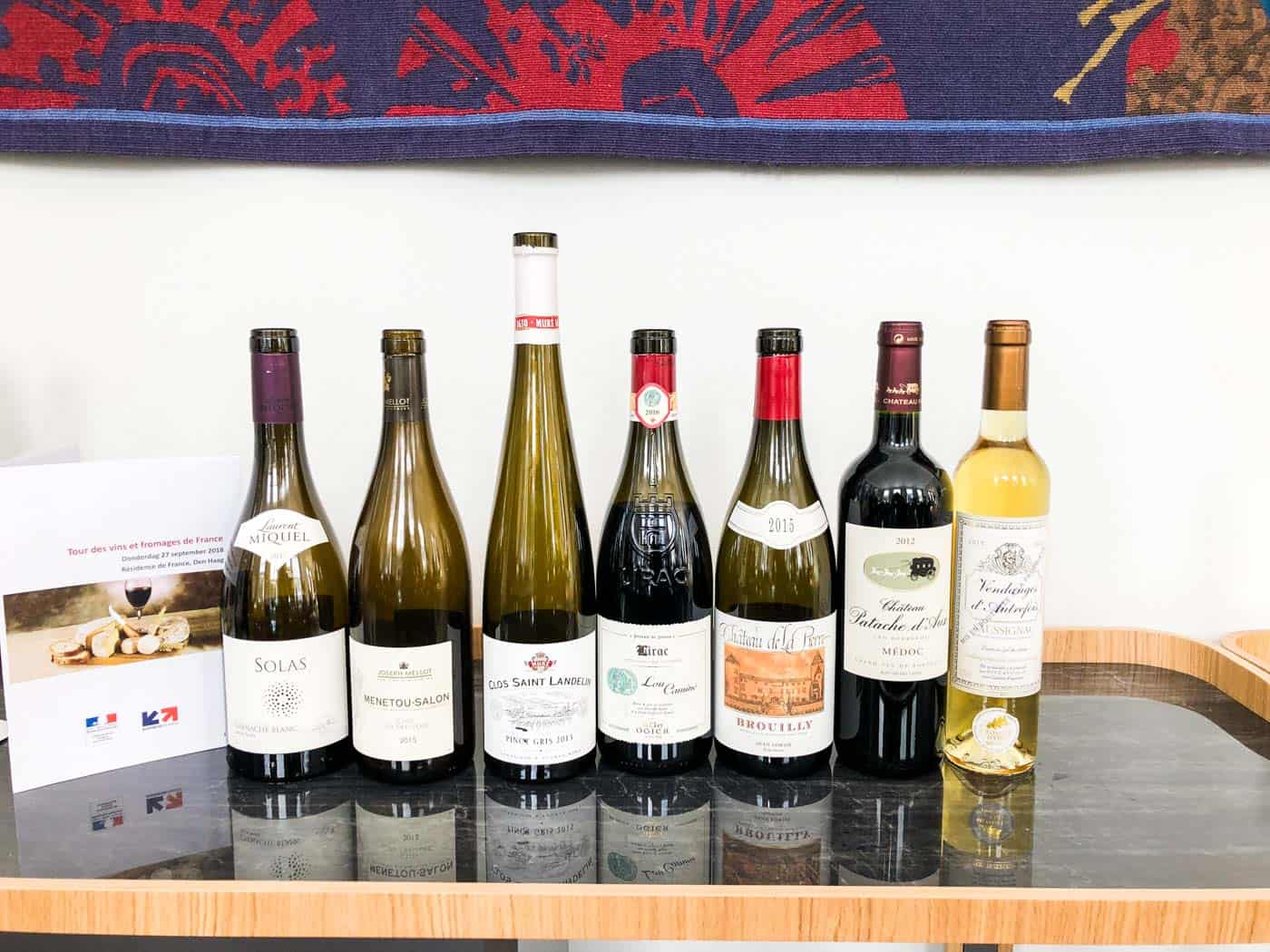
Wine: Laurent Miqual Solas Grenache Blanc 2017
Brie de Meaux, the king of French cheeses, has been around since 744 (or perhaps even longer). It pairs well with Grenache Blanc – a not-so-aromatic white wine with aromas of citrus and herbs. The second cheese, Pierre Robert, is made from the cream left over from making Brie de Meaux. The cream is enriched with crème fraîche, bringing the fat content to 75%. Ke-ching!
It gives the wine character, bringing out the spice more. Chaource fermier has a texture similar to goat cheese. In the cheese world, we call this a "chalk texture" and it's related to the way the cheese is curdled. The cheese therefore has a slightly drying effect—in a way that goat cheese can also have. The flavor is also a bit too strong for the wine.
Round 2: Goat Cheese
-
Saint Maure
Comes from Touraine. -
Little Fiancé
Comes from Pyrenees. -
Vallée D'Aspe
Comes from Aquitaine – Pyrénées Atlantiques.
Wine: Menetou-Salon Blanc Clos du Pressoir 2015 – Joseph Mellot
In every book I've read and every course I've taken, I hear that Sauvignon Blanc pairs so well with goat cheese. I've been disappointed several times, and now I finally understand why. The acids clash. There's a big difference in pH between the cheese and the wine. It's a rather technical explanation, but the end result is a dry mouth. That happens a bit with Saint Maure. This cheese needs a wine that's a bit less acidic. I try the (spoiler alert) Lirac from the next round, and it goes wonderfully. Its sun-drenched, earthy notes complement the goat cheese perfectly.
Betty points out that a very young goat's cheese can work well with a lively Sauvignon Blanc. I think, but I'm not sure, that's because these cheeses are a bit creamier and therefore less acidic. However, we're not sipping a young Sauvignon Blanc, but a three-year-old wine. That makes the wine so much more beautiful. With Petit Fiancé—which has a rather charming love story attached to it—it doesn't score twelve points, but the combination of the wine and the final cheese, Vallée d'Aspe, certainly does.
Round 3: Red Flora – Cow's Milk
-
Tamie
Comes from Savoie. -
Mont d'Or
Comes from Jura. -
Epoisses
Comes from Burgundy.
Wine 1: Lirac Lou Caminé 2016 – Ogier
Wine 2: Pinot Gris Clos Saint Landelin 2015 – Muré
From abbey to a state-of-the-art cheesemaker. Still with monks, but not as many. To address the labor shortage, they've turned to high-tech. I can picture robots making the cheese. Tamié Abbey is located in Plancherine near Albertville in the Savoie region. A stunning holiday destination, which you can easily combine with a visit to the producers of Mont d'Or. One bite of this cheese and you're already in the car. It's heavenly, so soft.
It's served on a spoon because it's so intensely creamy. While you're there, drive back via Burgundy for the famous, yet oh-so-delicious, stinky Epoisses cheese – the third cheese of this tour.

The Tamié and the Mont d'Or are delicious with Pinot Gris. Remove the rind from the Tamié. Prefer red? Then leave the rind on, because then the Lirac is the winner. Opinions were divided on the last cheese. Many opted for Pinot Gris, but I'm going for Lirac. It was a party in my mouth.
Round 4: Semi-hard cheeses – cow's milk
-
Morbier
Comes from Franche-Comté, Jura. -
Bethmale
Comes from Pyrénées centrales – Ariege. -
Tomme aux fleurs
Comes from Alsace.
Wine: Brioully Chateau de la Pierre – Jean Loron
Oh, I'm such a fan of Beaujolais. It took me a while, but please give it a try. It can be so beautiful. And affordable, too. A win-win.

We taste the Morbier, a cheese from the eponymous village of Morbier in the Jura region. This one also has a story behind it.
It has to do with Comté, the most famous cheese of the Jura. It couldn't be made in the winter because the cows didn't produce enough milk for the wheels of Comté. Instead, the farmers' wives made Morbier (and Mont d'Or).
The cows were milked twice a day: morning and evening. A greenhouse was created between these two productions, separated by a thin layer of ash (from the boiler). This was done in the past to protect the morning's cheese from insects.
Nowadays, there are other techniques for this, but there's still a gray layer between the two cheeses. The boiler ash has since been replaced by vegetable ash, such as norit. Delicious with Brouilly.
But the real winner of this list, in my opinion, is the Tomme aux Fleurs – both in terms of looks (floral crust) and the combination. The floral notes of the Brouilly come through. The cheese also has a hint of chamomile. A delicious combination.
Round 5: Hard cheeses – cow's milk
-
Comté
Comes from Franche-Comté, Jura. -
Beaufort al page
Comes from Savoie. -
Salers
Comes from Auvergne.
Wine: Chateau Patache d'Aux 2012
Making wine in the Médoc isn't easy. There are no mountains to block rain, which falls in abundance. Fungal diseases are a problem. Ripening the grapes is also a stressful affair every year. Cabernet Sauvignon needs warmth.
The best versions come from gravelly soils (gravel retains heat) and/or vineyards near water (water reflects sunlight). Château Patache d'Aux is "classic Bordeaux" and pairs perfectly with hard cheeses. Comté is hard, large, and heavy. Comté cheeses weigh between 32 and 45 kilos; over 450 liters of milk are needed.
We're given a piece of Comté from Ford St. Antoine, and it's quite special. Not everyone gets to take the cheese home, you know. There's a whole selection process beforehand. This means you get a tour and then get to taste the cheese. This tasting process must be extremely critical. Don't just say yes if the Comté isn't good.
As if that wasn't special enough, Betty comes up with another extraordinary story: Beaufort. Beaufort is a mountain cheese and is made in three styles: the regular version, Beaufort d'été, and Beaufort al page. The second is made in the summer, when the cows graze outdoors, and the third is made with milk from cows that graze at least 1,500 meters in the mountains from spring to autumn. They eat only what grows there (herbs, grass, and flowers). You can taste this in the cheese. It's floral, nutty, and absolutely... Delicious . Wonderful with the Médoc.
Finally, Salers from Auvergne, a primeval cheese similar to cheddar. The cows produce little milk, but what they do produce is very rich in minerals. This is partly because they graze in a volcanic area in the mountains. It's a cheese with a spicy character, slightly drying. Opinions were divided, but I also found it very good with the Médoc.
Round 6: Blue-veined cheese – sheep's or goat's milk
-
Blue of the Basques
Comes from Pays Basques. -
Roquefort Caves Baragnaudes
Comes from Occitanie. -
Persillé de Tignes
Comes from Haute-Savoie.
Wine: Saussignac Vendage d'Autrefois 2015 – Les Vignerons de Sigoules.
A botrytized dessert wine paired with a blue-veined cheese is one that immediately drew me to the world of wine. Even if you're not a fan of moldy cheese, straight up, chances are you'll be won over after a sip of this nectar. This wine from Les Vignerons de Sigoules comes from Saussignac, a small village near Monbazillac. It's an alternative to the Sauternes alternative, but certainly not inferior. And all for €11. A big, big tip.
Bleu des Basques is a delicious blue-veined cheese made from sheep's milk. Slightly sweet, nutty, and slightly floral. The cheese is pierced, and the mold develops in the holes. It pairs well with wine. Then there's Roquefort—traditionally the classic pairing with Sauternes. But beware: not all Roqueforts are created equal. "The old-fashioned Penicillium Roqueforti is added to the milk, and not, like many other Roqueforts, with a combination of five different types of mold (for shelf life, firmness, blue color, etc.). After a maturation period of at least six months to a year, they are inspected, and on average, one in three cheeses is deemed good enough to bear the name 'Caves Baragnaudes'." (source: Amuse ). The salty Roquefort is a party with the Saussignac.
The highlight has been saved for last: Persillé de Tignes. Only one farmer in Savoie—and therefore in the world—makes this cheese.
In love with France
After an afternoon like that, how can you not fall in love with France and French life? Next year, I'd love to do a Tour de France. Just hit the road, driving around all of France. I initially only had wine in mind, but I think I'll add a few cheesemakers to that list. In search of the best French cheese and wine.

What else I learned about cheese:
- You can always eat rinds. Even the fluffy moldy rind of a Lafor cheese. The question is: who likes it? Betty now knows there are people like that too.
- Contrary to popular belief, white wine often pairs better with cheeses than red wine.
- Many French cheeses have a creamy texture. This usually doesn't pair well with wines with high acidity. Instead, choose a wine or grape with low acidity, or one with some residual sugar.
- Leave the chutneys and jellies at home.
- Pregnant women can enjoy plenty of cheese. Check the Amuse website; it lists each cheese.
Seriously, I think I have a new hobby.
The "Tour des Vins et Fromages de France" was organized by Business France Pays-Bas. The wines are from the Verbunt Verlinden range.
Share:
The Road to Weinakademiker - Part 3 (Is it Hard?)
The most beautiful wines of 2018