
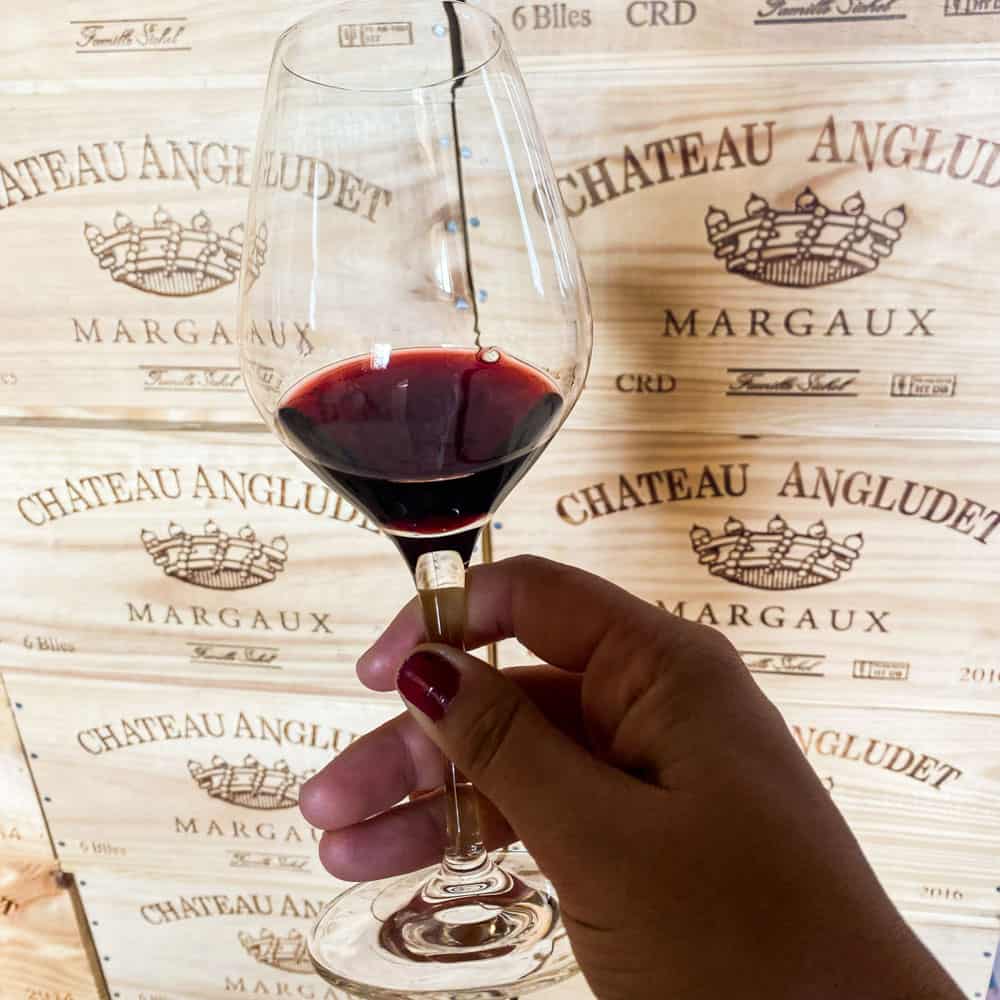
For an affordable and enjoyable Bordeaux, I highly recommend Château d'Angludet. It's the second estate of the Sichel family, who made their name with Château Palmer.
Upon arrival we are warmly welcomed by Daisy Sichel, the niece of the current winemaker Ben Sichel.
Biodynamic in Bordeaux
Like Château Palmer, Château d'Angludet operates entirely biodynamically. They haven't used chemical pesticides for fifteen years and have been Demeter-certified since 2015/2016. They do everything they can to stimulate soil life. Daisy tells us more about this as we walk through the vineyards. " We planted radish and red clover to increase the nitrogen level in the soil. " Several fruit trees have also been planted next to the vineyard. “It's to increase the competition. A vine performs better under a bit of (water) stress.” In addition, fruit trees attract birds and insects, which also benefits the ecosystem. “We are now looking for a place for bats. Bats eat larvae, so we create a natural enemy.”

Biodynamic farming in Bordeaux is challenging, to say the least. Bordeaux has a temperate maritime climate with a high degree of unpredictability. It can rain heavily, and if it doesn't dry up in time, mold lurks.
Once this happens, it's already too late. You have to prevent the mold. This is done with "Bordeaux porridge," a mixture of copper and sulfur that has been used for decades. Its use is being restricted in biodynamics. This results—especially in the wet Bordeaux region—in low yields (sometimes as much as 70% less!). See also this article by Jancis Robinson.
At the time of our visit, the harvest was in full swing. I counted about four people at the sorting tables. The grapes were thoroughly sorted, destemmed, and inspected again before going to the fermentation tank. After destemming, they were also passed over a vibrating plate to remove insects and other unwanted debris.
Angludet also used a laser for a while instead of sorting tables. Such a laser is pre-programmed with the "perfect grape," and anything that meets this requirement moves on to the next round. They weren't 100% satisfied with this, despite the 5% increase in yield. " We tried a laser, but it removes the personality. The best laser is your own eyes." “We're not making Coca Cola we make wine.”

From harvest to fermentation tank, one truckload of grapes is transported in an hour, and the grapes are collected in small crates so that they enter the cellar undamaged.
This also has to happen quickly, because Château d'Angludet works with natural yeasts. They use the yeast cells that are on the grape itself. To start the fermentation, they make a Pied de cuve . A few days before harvest, the ripest grapes are picked and placed in a small tank. Due to the concentration and lack of temperature control, the small tank usually begins fermenting quickly. This mixture is the kickstarter for the first batch of grapes.
 The cellars of Angludet
In the basement
After the sorting table, the grapes are crushed, and fermentation can begin in large concrete vats. The wine is occasionally lightly pumped over to prevent the cap (the skins that float to the surface) from drying out. After fermentation, the wine is aged for twelve months in oak barrels from Alliers and Jupilles.

Jupilles oak has denser grains and is more suitable for Merlot. Cabernet Sauvignon uses Alliers oak, which apparently provides better structure. They use four different barrels. The barrels always have a light toasting (light to medium-light). A small amount of sulfites is used when the wines are barreled. After aging, the wine is returned to a concrete vat and fined with egg white. The wine is blended in May or June and bottled in July. Surprisingly, no sulfites are used during bottling. Chateau d'Angludet uses argon gas (just like Coravin) to protect the wine from oxidation.
Another new thing: starting with the 2019 harvest, they will be experimenting with aging in amphorae. They have ordered 750-liter amphorae from Italy and they're in !
Grape varieties
“ We call petit verdot the diva, it's always the one we wait for. Once it's ripe you have three days to collect it otherwise it becomes overripe and you can throw it away. Cabernet sauvignon is the weak one, but it's the father of the wine. Merlot is the mother, it's part of the structure and softens the wine. ”

Thank you Angludet
Here, too, I'm amazed by Daisy Sichel's down-to-earth approach and enthusiasm. Earlier that day, we visited Mouton-Rothschild—a bit of a name-dropping—and things are very different there. The family is out of the picture; we're given a tour by a pre-programmed guide, and a museum has been created from the family's art collection (for example, the Baroness once received a sick necklace but didn't like it, so now it's in the museum). Don't get me wrong, the visit to Mouton-Rothschild was an unforgettable experience, but I prefer the family atmosphere. Daisy speaks passionately and proudly about the vineyards, the biodynamics, the work in the cellar, and her family's wines. And rightly so!
Big thanks to Peeters Wine Merchant for arranging this visit.




Share:
Now I know for sure: Jacquesson is my favorite
The ten wines that stuck with me from 2019