
After attending Barcelona Wine Week, I saw a different side of Spain. Elegant Monastrell and Pinot Grigio-like Garnacha – who knew they existed?
I knew these two grapes primarily as alcoholic wrecking balls, not as refined wines you can't get enough of. I've fallen head over heels for the wines from Sierra de Gredos , a wine region near Madrid that fell into oblivion after a number of setbacks, but has been the talk of the town in recent years.
The blog below contains three different garnachas From Sierra de Gredos: Comando G, Daniel Landi (also part of Comando G), and 4monos. We complete the Garnacha list with Bodegas Frontonio from Aragon, where Fernando Mora MW focuses on the wonderful old vines this region boasts.
The masterful Monastrell from Bodegas Cerron in Jumilla deserves a spot and is sure to amaze. We round out the list with El Corregidor from Luis Perez: a sparkling palomino fino from Jerez.
Luis Perez El Corregidor 2019 (Vino de la Tierra de Cádiz)
It had to happen someday: bubbles from Jerez. Of course, I'm all over them. It's nothing new, by the way; this was already happening in the 19th and 20th centuries. And that's precisely what Willy Perez of Bodegas Luis Perez is fascinated by. Back to the past, back to the time before the industrialization of sherry. He demonstrates this with the vino de pasto (El Muelle and La Escribana), the unfortified sherries (La Barajuela line), and now with these bubbles. This sparkling wine is made from palomino fino aged for a year under flor. It is then bottled with liqueur de tirage made from concentrated must from PX dried for 48 hours and its own yeasts. It is aged on lees for three years and is released without dosage. Mind blown!
Luis Perez wines are available through Anfors.
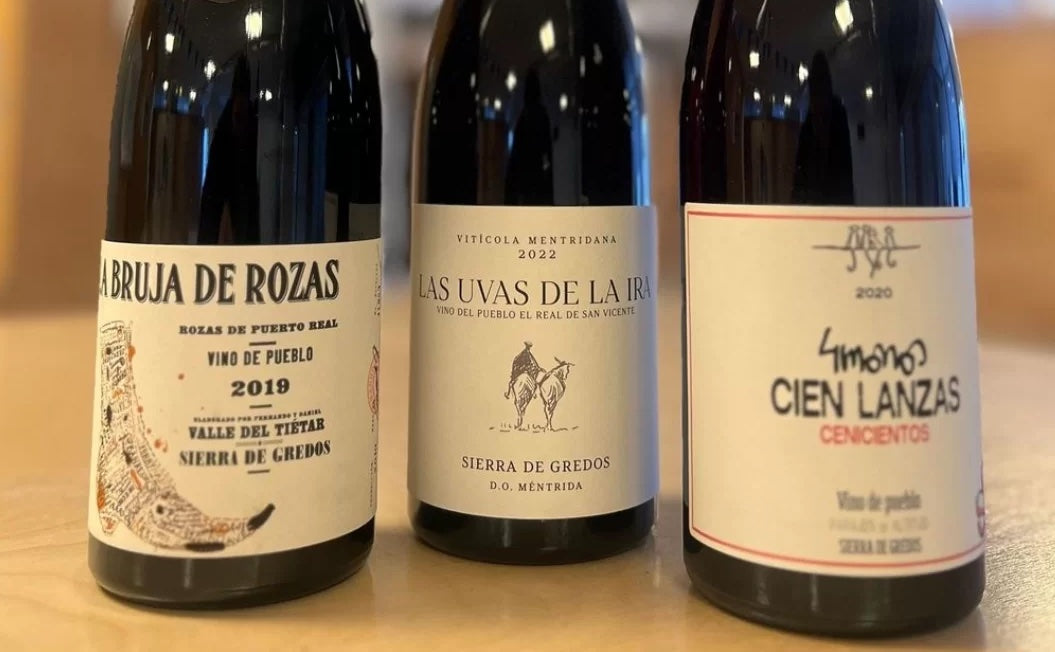
4 monos Cien Lanzas 2020 (DO Vinos de Madrid)
I was completely unfamiliar with 4 Monos, but stumbled upon them at Barcelona Wine Week, sharing a block with Ramiro Ibañez, Luis Perez, and Bodegas Ponce, among others. That must be good. It was still quiet, and Javier García Alonso, one of the founders and brother of Fernando García, co-owner of Comando G (next wine), told me all about the rugged landscape of the Sierra de Gredos. It's a mountainous region with granite soil, old vines, and "Pinot-like Garnacha." The Cien Lanzas comes from an altitude of 830–960 meters. Cool nights and the decision to harvest a little earlier, as tradition dictates, preserve the fresh acidity. A seductive wine and Garnacha like you've never tasted before.
4monos is available at Pieksman.
Comando G La Bruja de Rozas 2019 (DO Vinos de Madrid)
"The wines of Comando G are energetic, aromatic, highly expressive, and incomparable," I read on the importer's website. In terms of color, it could easily be a Burgundy. I'm curious to see what people will make of it in a blind tasting. Pinot Noir? Light Nebbiolo? It's Garnacha in all its glory. Stunningly beautiful. The vines are between 45 and 65 years old and grow on granite-rich sand. The wine is fragrant, bursting with red fruit (but not at all jammy), has fine acidity, and smooth tannins .
Comando G is available at Janselijn.
Daniel Landi Las Uva de la Ira 2022 (DO Méntrida)
Together with Fernando García, Daniel Landi produces wines under the name Comando G, but he also has his own project in the Sierra de Gredos. This wine is named after John Steinbeck's novel of the same name: Uvas de la Ira / "The Grapes of Wrath." The grapes are sourced from 850 meters of altitude in various vineyards in the Sierra de Gredos mountains. The soil is more slate than granite, and the vines are 70 years or older. Fermentation lasts 30 to 60 days and is done with whole bunches in open oak barrels. Biodynamic methods are used in the vineyard and a very minimalist approach is employed in the cellar. A pure expression of Garnacha. "Like a soft, down pillow to sink into," says Jancis Robinson.
Daniel Landi is available at Smaragd Wijnen.
Bodegas Frontonio Microcosmico 2022 (Vino de la Tierra de Valdejalon)
Fernando Mora MW is also devoted to old-vine Garnacha , but he works 450 kilometers away in a similarly rugged landscape in Aragon, near Zaragoza. Just like in the Sierra de Gredos, there are still many abandoned vineyards with old vines here. The reason? Nobody wants to live there anymore, and many young people are trading hard work in the vineyards for a well-paid office job in a big city like Barcelona. Fernando Mora is a busy bee and has also earned the prestigious Master of Wine title. In his MW thesis, he proposes a new system for classifying vineyards based on quality and age. Traditionally, farmers are paid per kilo of grapes; an old vine yields much less than a younger planting, so why leave them alone? With Bodegas Frontonio, he buys old vineyards and then restores them to their former glory.
Bodegas Frontonio is available at De Gouden Ton.
Bodegas Cerrón La Servil 2022 (DO Jumilla)
Never thought I'd become a fan of Jumilla wines. No offense, but those thumpers are often too heavy for me. It just goes to show you never stop learning in the world of wine. This Monastrell from Bodegas Cerrón was planted in 1954 on a soil of limestone, sand, and gravel. The vineyards are situated at an altitude of 960 meters with a northerly exposure. You'd think they'd have to harvest here—in the sweltering heat of Jumilla—as early as August, but nothing could be further from the truth. In 2018, they didn't finish harvesting until November 11th (!). Monastrell needs warmth and has found a favorable location here. The result is a layered Monastrell with aromas of black fruit, earthy notes, and Mediterranean herbs—all remarkably elegant without being heavy.
Bodegas Cerron is available at Anfors.
The new sound of Spain
These six wines represent, for me, the new sound of Spain. A sound that isn't louder, but rather softer, more refined, and more nuanced. Where Spain was once known for its heavy, powerful wines, we're now seeing a shift toward elegance and terroir expression. Producers like Comando G, Fernando Mora MW, and Bodegas Cerrón demonstrate that Spain has so much more to offer than just traditional powerhouses. They bring the finesse and subtlety of their terroir to life, with respect for old vineyards and traditional methods, but always with an eye to the future. This is Spain in its most authentic form: unique, captivating, and impossible to ignore. As far as I'm concerned, this is just the beginning.
These wines were part of the Great Spain Tasting Box, but unfortunately, it's sold out. Curious about the next box? Subscribe to our newsletter.




Share:
Do you already know these three winemakers from Andalusia?
Jette in Somontano: a journey to the north of the south