
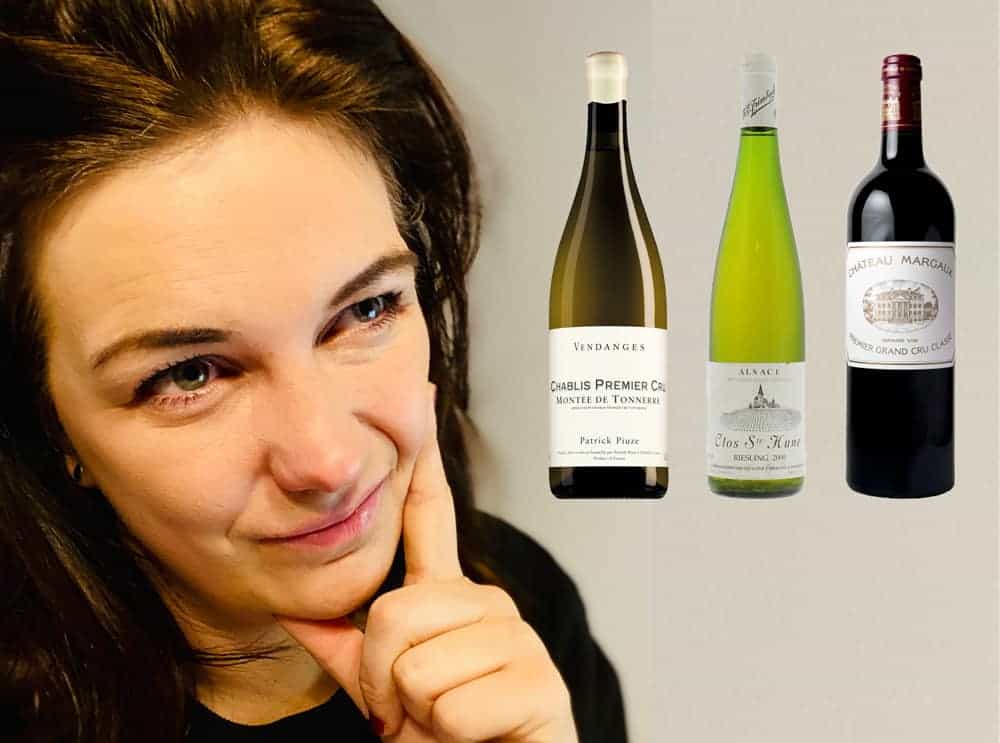
The #wijnvraagbaak section answers your burning wine questions. Have a question? Let me know via email or Instagram. This time it's about grand cru .
Yesterday I was talking to a group of students about Bordeaux. If that hits you hard, I can imagine you'd go crazy. In this case, we'd just covered the rules for Burgundy, and uh, hello: is there even more to come? Yes, folks. Each region has its own rules and classifications. No one ever said the wine world was easy. It's fun, though. It's the complete opposite of the tax authorities, really.
Hence this basic article about the different meanings of Grand Cru in France.
Le Montrachet, Grand Cru
Burgundy has incredibly comprehensive wine regulations, with the vineyards labeled Grand Cru at the top of the pyramid. There are 33 in total (actually 32, as Charlemagne is no longer used). Below that is the Premier Cru. There are 635 of these, so good luck learning!
Grand Cru vineyards are allowed to use the term Grand Cru on their labels in addition to their vineyard name, for example, Le Montrachet. Why is one vineyard a Grand Cru and another not? It all has to do with the terroir. Sometimes a Grand Cru consists of multiple vineyards, for example, Corton Grand Cru. If you want to delve deeper into Burgundy, the book "Inside Burgundy" is for you.
They know how to make it fun in Chablis. We'll explain it all in our Chablis podcast.
Altenberg, Grand Cru
The term Grand Cru is also used in Alsace, and like in Burgundy, it is reserved for the region's best vineyards. There are 51 vineyards authorized to use AOC Grand Cru Alsace on their labels, along with the name of the vineyard. There are (as yet) no premiers crus in Alsace.
Alsace Grands Crus are sometimes viewed with a certain degree of skepticism because they are large and therefore not truly representative of the terroir (or a single type). Moreover, Alsace boasts a vast array of terroirs, even more than Burgundy, and this isn't reflected in the AOC legislation. It's not particularly precise. But yes, a grand cru remains a grand cru, and the bottles are becoming increasingly popular. Want to know more? Check out the article on Trimbach .
In Burgundy, a Grand Cru has its own AOC, such as the Appellation Montrachet Controlée . This applies to the Côte d'Or, but not to Chablis (that would be too simplistic). Chablis operates the same way as Alsace: a single AOC for Grands Crus, such as AOC Chablis Grand Cru or AOC Alsace Grand Cru, plus the addition of the vineyard name. Capice?
Grand Cru Classé
1855 Classification de Grands Crus Classés de Médoc
The world's most epic classification is that of Médoc. This is a classification of wineries, not vineyards, as described above. The classification dates back to 1855 and was presented that year at the Exposition Universelle de Paris at the request of Napoleon III.
The wineries were classified based on their trading prices. The wineries with the most expensive wines were placed in the first class: Premiers (1st) Grands Crus Classés. A total of 61 chateaux were classified into five classes:
- Premiers (1st class) Grands Crus Classés – 5 chateaux
- Deuxièmes (2nd class) Grands Crus Classés – 14 chateaux
- Troisièmes (3rd class) Grands Crus Classés – 14 chateaux
- Quatrièmes (4th class) Grands Crus Classés – 10 chateaux
- Cinquièmes (5th class) Grands Crus Classés – 18 chateaux
The classification has only been changed twice since 1855. The first was the addition of Château Cantemerle simply because it had been accidentally forgotten. Oops. The second change was Château Mouton-Rothschild, which was promoted from the second to the first division. This took place in 1973 after considerable lobbying.
1855 Classification de Grands Crus Classés de Sauternes et Barsac
At the same time that the Médoc classification was created, the Sauternes and Barsac classification for sweet wines was also established. This classification has two classes: 11 chateaux in Premiers Grands Crus Classés and 14 chateaux in Deuxièmes Grands Crus Classés.
That proved insufficient, as Château d'Yquem towered above the rest in terms of quality and is therefore the only one classified as a Premier Cru Superieur. How convenient!
Classification de Grands Crus Classés de Saint-Emilion
The left bank is safe, they must have thought of the right bank. We can do that too. So, 100 years later, the official classification of Grands Crus Classés followed in Saint-Émilion. It would be too easy to cast this along the same lines as that of the Médoc. No, the Saint-Émilion classification has two classes: Premiers Grands Crus Classés and the ('regular') Grands Crus Classés.
It's incredibly confusing because in Burgundy, a Grand Cru vineyard theoretically trumps a Premier Cru, but here it's not about vineyards, and you'll also need to specialize in French. It's about the Premiers Grands Crus, or the first class of the Grands Crus. Top of the bill.
Still following? Okay, let's take it one step further. That first class, Premiers Grands Crus Classés, is further subdivided into Premiers Grands Crus Classés A and Premiers Grands Crus Classés B. Seriously? Yep. Four chateaux fall into A and 14 into B. Then there are 64 in the Grand Cru Classé category, the quality of which varies considerably.
The classification is revised every ten years, but this is not appreciated by everyone .
Saint Emilion Grand Cru
Saint-Émilion has its own classification with Grands Crus Classés, as explained above. They also have an AOC, a designation of origin—no joke: AOC Saint-Émilion Grand Cru. This isn't intended for classified chateaux; no, anyone can use it on their bottle, provided they meet the requirements, which are slightly stricter than those of AOC Saint-Émilion. So it's not about the chateau itself, but about (the authenticity of) the origin. They could have called this AOC Saint-Émilion Supérieur, but who am I?
Avize Grand Cru (Champagne)
The term "grand cru" is also used in Champagne. Here, it doesn't refer to a chateau or even a vineyard; it refers to a village. A total of 17 villages are labeled "grand cru," including Avize, Ambonnay, and Bouzy (and 42 premier cru villages).
This classification dates back to 1873, when the Échelle des Crus was established, and served as a benchmark for grape prices from 1911 onward. Grapes from a Grand Cru village yielded more than grapes from a Premier Cru village. The system was abolished in 2010, but the terms Grand Cru and Premier Cru are still used. It goes without saying that a Champagne house may only use these terms if the grapes used come 100% from a Grand Cru or Premier Cru vineyard.
Quarts de Chaume Grand Cru
Finally, the famous Quarts de Chaume, promoted to Grand Cru in 2014 (actually 2011), the first in the Loire Valley. It is perhaps the most famous Chenin Blanc vineyard in the world.
Share:
A wine fan in Stockholm
#165 Looking your best at Easter with Foodies Magazine 🐣