
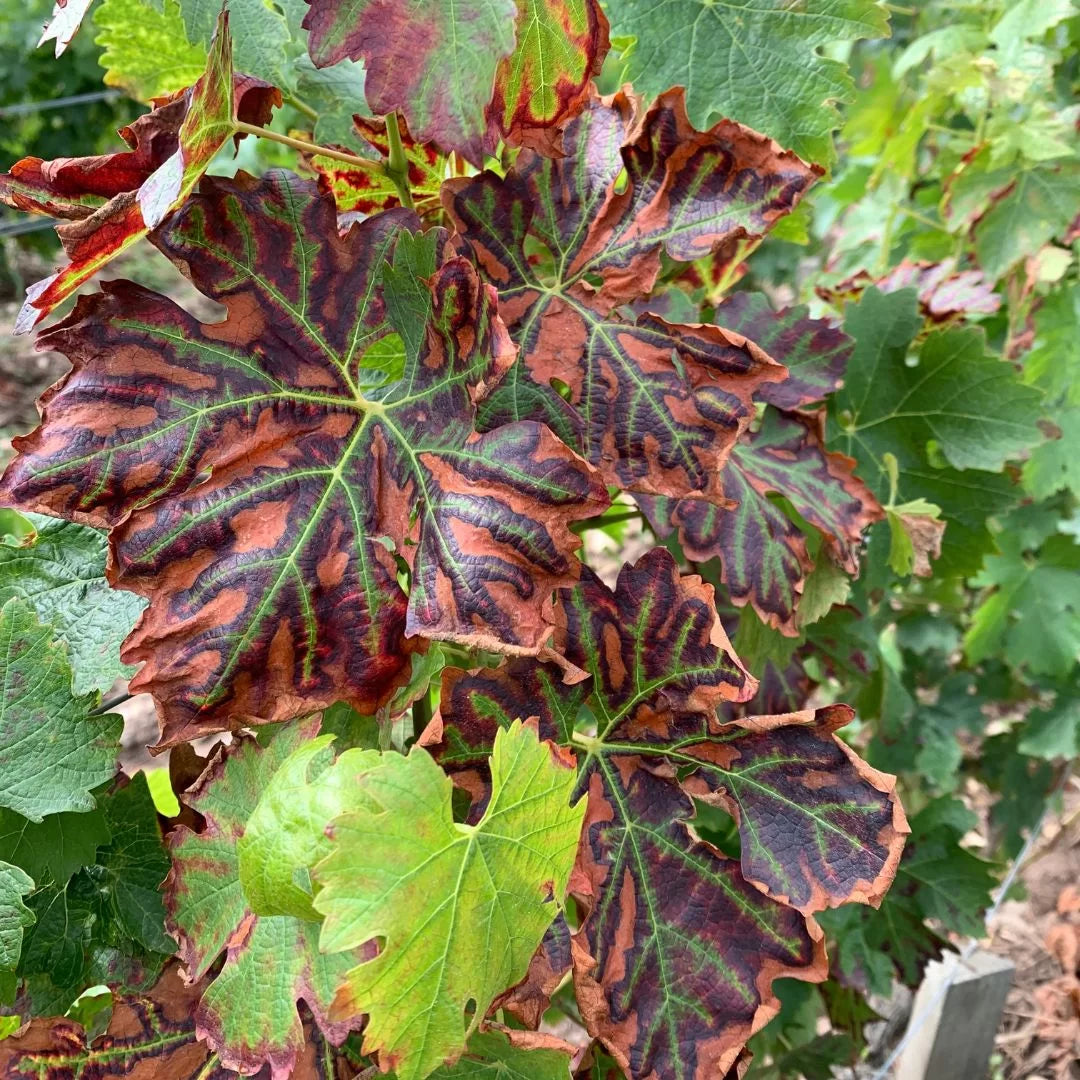
Mother Nature, we love her, but oh, how she makes our lives difficult sometimes. Harvest has already begun in most European countries. It's the time of year for winemakers, but for vineyard managers, it's precisely the time to evaluate. The hard work is done, and the first bets regarding the harvest (in hectoliters per hectare) have been made.
What percentage have we lost to powdery mildew? How much has been nibbled away by rabbits, wild boars, and birds? And what about black rot? Managing problems in the vineyard is a complicated story. Below are three examples of diseases I've been busy with over the past five months.
Downy mildew
This persistent fungus, caused by a pathogen called Plasmopara viticola, is a major obstacle to viticulture. Presumably originating in North America, it spread worldwide after the major phylloxera crisis of the 1980s.
Powdery mildew is a fungus that overwinters in the soil and releases its spores in the spring. The first signs of infection usually appear on the young leaves of grapevines. As the season progresses, shoots and grape clusters can also be affected. The spores multiply on the underside of the leaf, forming small colonies in the stomata.
Wet surfaces after a rain shower and nice warm, sultry weather are perfect for mildew. Powdery mildew is recognizable by light, oily spots on the leaves. As long as the weather doesn't remain dry and sunny for a prolonged period, the fungus continues to spread, making the leaves less efficient and drying out the grapes.


The fungal spores are released when they are ripe. The soil must also be moist and the temperature between 12 and 13 degrees Celsius.
Initial infection usually occurs through rain splash, which carries the spores to the young leaves, or through wind. It's important to note that leaves must have a surface area of approximately 6 to 8 square centimeters per 10 centimeters of shoot length to be susceptible to infection.
When approximately 10 mm of rain falls for two consecutive days at an air temperature of 10 degrees Celsius, the spores will germinate. This usually occurs at night, as sunlight and higher temperatures can slow the germination process.
What can you do about it? Spray! Do this before and after rain, using organic sprays that stay on the plant's surface. In a normal Bordeaux season, this means about 10 sprays; in a mildew-prone year, this can increase to 20 sprays. Miss a spray window? Then mildew has free rein, and you're immediately 5-0 down. Some farmers have lost as much as 50% of their harvest this year (2023).
That is why it is so important to closely monitor weather forecasts, starting in early spring.
ESCA
ESCA, also known as black measles, is the most notorious stem disease in European vineyards. It causes stem rot, reduced sap flow, and leaf necrosis, resulting in reduced photosynthesis.
A vine can live with ESCA for years, but it will never truly reach old age. The disease is caused by a combination of approximately 30 microorganisms. There are three different times when a plant can become infected. The vine can become infected through infected plant material in the nursery (this is less common these days due to improved hygiene), during grafting of the grape variety onto the rootstock, or through large pruning wounds in spring. Symptoms are most commonly seen in vines between 15 and 35 years old.
Once inside, the bacteria cause rot, which increasingly blocks the sap flow. Sap flow distributes all the nutrients throughout the plant. When this flow isn't efficient, the leaves struggle. This begins with reduced photosynthesis and ultimately, leaf loss. The vine still produces grapes, but with less acid and fewer polyphenols (tannin, etc.).

What can you do about it? Absolutely nothing, at most pulling out the vine and replanting it. A difficult decision, especially since a vine with ESCA only shows symptoms in years with drought.
Flavescence Dorée (FD)
FD is a disease caused by Candidatus Phytoplasma vitis and spread by the leafhopper Cicadelle scaphoideus titanus. So, try saying that sentence three times in a row. That's almost as impossible as combating this disease. FD is so feared that every infected plant must be reported to a national organization.
In Margaux, Bordeaux, it's a major problem. Châteaux are working together to combat this disease through mandatory insecticide spraying. (Pyrevert) in sensitive vineyards. Because once the vine is infected it can no longer be saved .
The plant is rigorously pulled from the vineyard and burned. Violent! How do you recognize FD? The leaves change shape and turn yellow or red, depending on the grape variety (blue or white). The vine's growth stagnates, and the grapes remain unripe or shrivel.

What can you do about it? Not much, at most monitoring. Fun tip: you can recognize the larvae of this type of grasshopper by the fact that they move across the leaves like little crabs. Monitoring, in practice, means trudging for miles through the vineyards, randomly searching for grasshoppers in various stages. A great game.
Phylloxera
Do you still remember him; The phylloxera that wiped out almost all the vineyards in Europe ? Don't be alarmed, this little bug still exists and is still active. Shocking!
I made this discovery in a newly planted vineyard. I was astonished to see completely distorted leaves covered in yellow and pink blobs. It's now known that phylloxera doesn't like American rootstocks, so we graft our European grape varieties onto those roots. Problem solved!
What I didn't know, however, is that this insect is particularly fond of the leaves of American grapevines. This is especially noticeable in new vineyards that don't yet have European grapes as their "tops." Fortunately, the threat of phylloxera is minimal these days, as most vineyards are now rooted in American rootstocks. So we don't have much to fear from it anymore.

Read more from Rianne?
Rianne Ogink studied in Bordeaux in 2022/2023. She now works as an assistant winemaker at a chateau in Pessac. She occasionally writes for Le Club des Vins. Find more of Rianne's blogs below.
Guest blogger: Rianne Ogink
I'm Rianne Ogink. From sports manager in Deventer, to sommelier at Zoldering in Amsterdam, to student of viticulture & enology in Bordeaux, France. You could say I've turned my hobby into my job. Spending whole days chatting with people about beautiful wines, regularly popping corks, and spending days learning how wine is made. I'd love to share my adventures on (digital) paper for you! Enjoy!



Share:
A wine lover in Cape Town
A wine fan in Jerez