
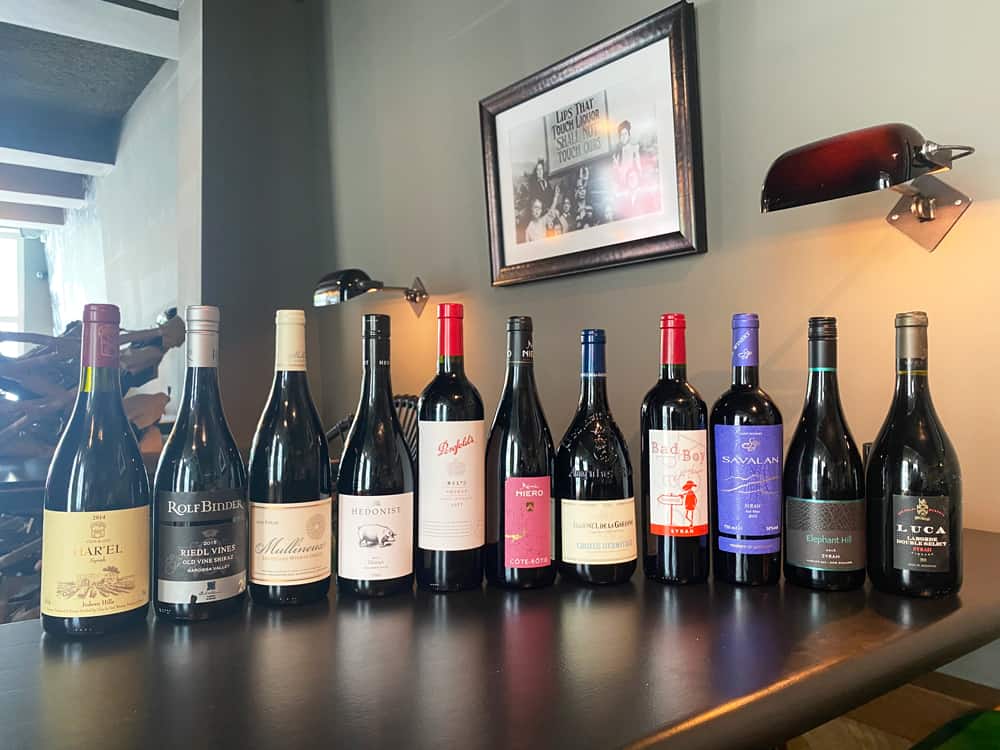
What do you think of when you think of Syrah? Côte Rôtie, Hermitage, or perhaps Barossa Valley, or perhaps South Africa. A northern Rhône certainly makes my heart beat faster, but there were several surprises.
🎧 We also made a podcast about syrah.
Syrah, the diva
It's a grape variety that's difficult to grow. A diva in the vineyard. When it's ripe, it's ripe, and you have to take action. If you're too late, the acidity drops, and you're left with basically Jam over. She's also quite picky about soil. While almost every grape prefers a chalky clay soil, Syrah doesn't like it. Syrah is sensitive to chlorosis. Chlorosis is a plant disease that attacks the leaves and therefore potentially also photosynthesis.
Besides, it shouldn't be too cold, but also not too warm. And above all, dry. Well, that sounds quite diva-like. Two years ago, I was at Château de Beaucastel in Châteauneuf-du-Pape and learned that it actually gets too hot here for Syrah. Grenache and Mourvèdre handle the heat better. That's why Syrah is the star performer in the northern Rhône, where a continental climate prevails.
Where to find?
Who is your father, who is your mother? Syrah descends from mondeuse blanche (Savoie) and deruza (sporadically found in the Ardèche). The grape variety originated in France and not in the city of Shiraz in Iran – as is often claimed.
For this podcast, we've found several wine shops and importers willing to sponsor bottles. We'll explain where to find Syrah, using the wines we tasted.
Northern Rhône
The Rhône is shaped like a Burgundy bottle (or, okay, a Rhône bottle). The bottom is thick, and that's the Southern Rhône, where much more is produced. The top, the neck, is long and narrow. Much less is produced here, and that's the Northern Rhône. The best vineyards are located on steep slopes along the banks of the Rhône, where they get the most sunshine. The northernmost slope is called Côte Rôtie, which literally means "roasted hill." Enjoy baking in the sun all day long. And that's necessary, because the climate here is continental. Pleasantly warm during the day, but it cools down considerably at night. Fortunately, the stony soil also retains some heat.
Chateau de la Gardine, Crozes Hermitage, 2018
Crozes Hermitage is the largest sub-region in the Northern Rhône. It is about twelve times larger than Hermitage and boasts a diverse range of exposures, locations, and soil types. Consequently, the quality is also high. As in many wine regions: I would rather have a Crozes-Hermitage from a well-known maker than a Côte Rôtie from an unknown one. Château de la Gardine proves this once again. It's incredibly well-made. It's a juicy glass with berries, blackberries, a touch of flesh, and violets. Fruitier and smoother than a Hermitage. Surprisingly juicy for the warm 2018 vintage.
Rémi Niero, Côte Rôtie, 2015
Very concentrated. This is what you'd expect from Côte Rôtie. We notice more pepper (typical of Syrah in a slightly cooler climate), meatiness, red berries, violets, and subtle wood (more cedar, no vanilla). Medium+ tannins and a long finish.
Bought this one in France, but Rémi Niero is available at Platenburg Wine Merchants and Vindict .
Bordeaux
Didn't see that coming, did you? Syrah isn't allowed in Bordeaux, but that used to be very different. In the 19th century, a dash of Rhône syrah was often added to the wine to fortify it. Since 2004, Chateau Palmer has been making the "Historical XIX Century Blend," a tribute to that era with 15% Hermitage syrah.
A completely different story is the story of Jean Luc Thunevin, the famous mechanic From the right bank. Always up for a bit of fun. Not for nothing is he called the "bad boy" by Robert Parker. Reason enough for Thunevin to release several wines under the same name, including a 100% Syrah from Saint-Émilion. And that's perfectly fine, of course. never ever So, it's simply labeled Vin de France. The vines are located next to Château Valandraud.
Thunevin, Bad Boy, Vin de France 2015
There's a lot going on here. Wood dominates the nose. Vanilla is present. Surprisingly high acidity (medium or perhaps even high). Substantial tannins. Jammy fruit. We'll leave it for a while and get back to you.
Bought in France, but sometimes in the Netherlands The Vineur for sale.
Israel & Azerbaijan
Two more regions you might not expect. We'll explain in detail in the podcast how we arrived at these destinations. The great thing is that both countries have been producing wine for a long time (and in large quantities). There's a lot to tell about both countries. A podcast about Azerbaijan is already in the works, and Israel will follow soon.
Is this the New World or the Old World? Actually, it's the ancient world of wine, because this is where it all began. Amphoras from thousands of years ago have been found in Georgia (but back then, the borders weren't as clearly defined as they are now, so it could just as easily have been Azerbaijan).
Ha'rel, Clos de Gat, Israel, 2015
Superb Syrah. Concentrated nose of plums, after-eight, and sweet tobacco, very measured and elegant use of wood, a touch of pepper. Good balance between medium acidity and ripe fruit. Naturally. kosher .
For sale at Wijnhandel Peeters >
Savalan, Syrah, Azerbaijan, 2015
“Black fruit with homemade strawberry jam”. It's ripe, full-bodied, and powerful. The black fruit blends beautifully with the aromas of charred and toasted wood. The medium-high acidity keeps everything perfectly balanced.
For sale at Wijnhandel Peeters >
New Zealand
Two areas in New Zealand stand out for syrah: Waikeke Island and Hawke's Bay. Rebecca Gibb MW has written an article about New Zealand syrah: Kiwi Rôtie: The rise of New Zealand Syrah (+100 points for this title).
Elephant Hill, Hawke's Bay, 2016
A surprising Syrah. Fresh, juicy, with distinct peppery notes. A bit funky thanks to the green undertone. Dark chocolate with cranberry, white pepper, green pepper, and mint. And of course, blackcurrant. Medium+ tannin, medium+ acidity. A great glass.
South Africa
We have previously a podcast made about South Africa And Mullineux is once again confronting us with the facts. We're always surprised. Bram also remembers our WSET Diploma Course lesson with Job de Swart MW, who claimed that South Africa is the ideal place for Syrah after France. We couldn't agree more!
Mullineux, Syrah, South Africa, 2017
A Syrah, not a Shiraz. South Africa's most gamey Syrah style. Elegant, despite its 14.5% alcohol. It's young, but hey, we're happy. Dried meat: "bilton and bai lekker braai." Mullineux has a whole line of Syrahs, and this is just the entry-level model. This leaves you wanting more.
Everyone goes to Wijncafé Lefebvre for a glass >
Argentina
Comparing a Malbec from Mendoza with one from Cahors is like comparing apples and oranges. The high-altitude vineyard and the intense sun create a fresher, fruity wine style. The same is true for Syrah, quite different from the Rhône, where the grape variety still struggles to reach ripeness. Yet, even in Argentina, they don't take the easy way out and are increasingly seeking higher altitudes. Temperatures are dropping and the soils are depleting; the vines have to work harder.
Luca Double Select, Syrah, Valle de Uco, 2016
Laura Catena is a boss. She's a mother, the director of Bodegas Catena, runs her own research center, is an ER doctor in San Francisco, and is a symbol for Argentine wines. What a hero.
Luca Double Select comes from a vineyard at an altitude of 900 meters in Valle de Uco. Ripe and jammy fruit, yet perfectly balanced with acidity. This is the common thread running through all the wines we tasted. It's full-bodied yet juicy. Blackberry dominates the aroma and flavor, complemented by leather, tobacco, and spice.
Australia
Shiraz is Australia's most widely planted grape variety. It's grown everywhere, in almost every sub-region. So it's a good idea to figure out where your preferences lie. Victoria's coastal vineyards, such as Yarra Valley, Geelong, and Mornington Peninsula, are characterized as cool climates. These produce a much fresher, elegant style of Shiraz. It's much warmer in the Adelaide Hills, where you'll find Eden Valley, McLaren Vale, and Barossa Valley. Elevation makes a difference here.
Max's Penfolds, Shiraz, 2017
Oh yes, this is shiraz. Eucalyptus, mint, but also blackberry jam, black pepper, bacon, and BBQ. Medium+ but very ripe tannins. But also medium+ acidity.
Want to read more about Penfolds? The great story of Max Schubert, the man behind Penfolds . And read more about how Le Club de Grange experienced it here .
Rolf Binder, Riedl, Old Vines, Barossa Valley, 2015
The grapes for this wine are harvested in multiple rounds. Only the finest and ripest fruit is taken to the cellar. The result is concentrated, with notes of mocha, mushroom, eucalyptus, cinnamon, chocolate, and after-eight. Medium acidity and ripe tannins.
Everyone goes to Wijncafé Lefebvre for a glass >
The Hedonist, McLaren Vale, 2017
Berry explosion, good acidity, greenish, mint, pepper, light cedar notes. On day two, Nadien, I tasted it again, and the wine actually came into its own even better. The oak also showed through more. Velvety smooth flavor.
For sale at Wijnhandel Peeters >
The observant reader might be wondering where the United States has gone. We haven't tasted any Syrah from the US, but we'd be happy to provide recommendations. Not only California produces top-notch Syrah, but Washington also regularly produces it. high points at blind tastings with syrah.
Share:
The best books on wine tasting
The Four Fermentations of Bollinger