
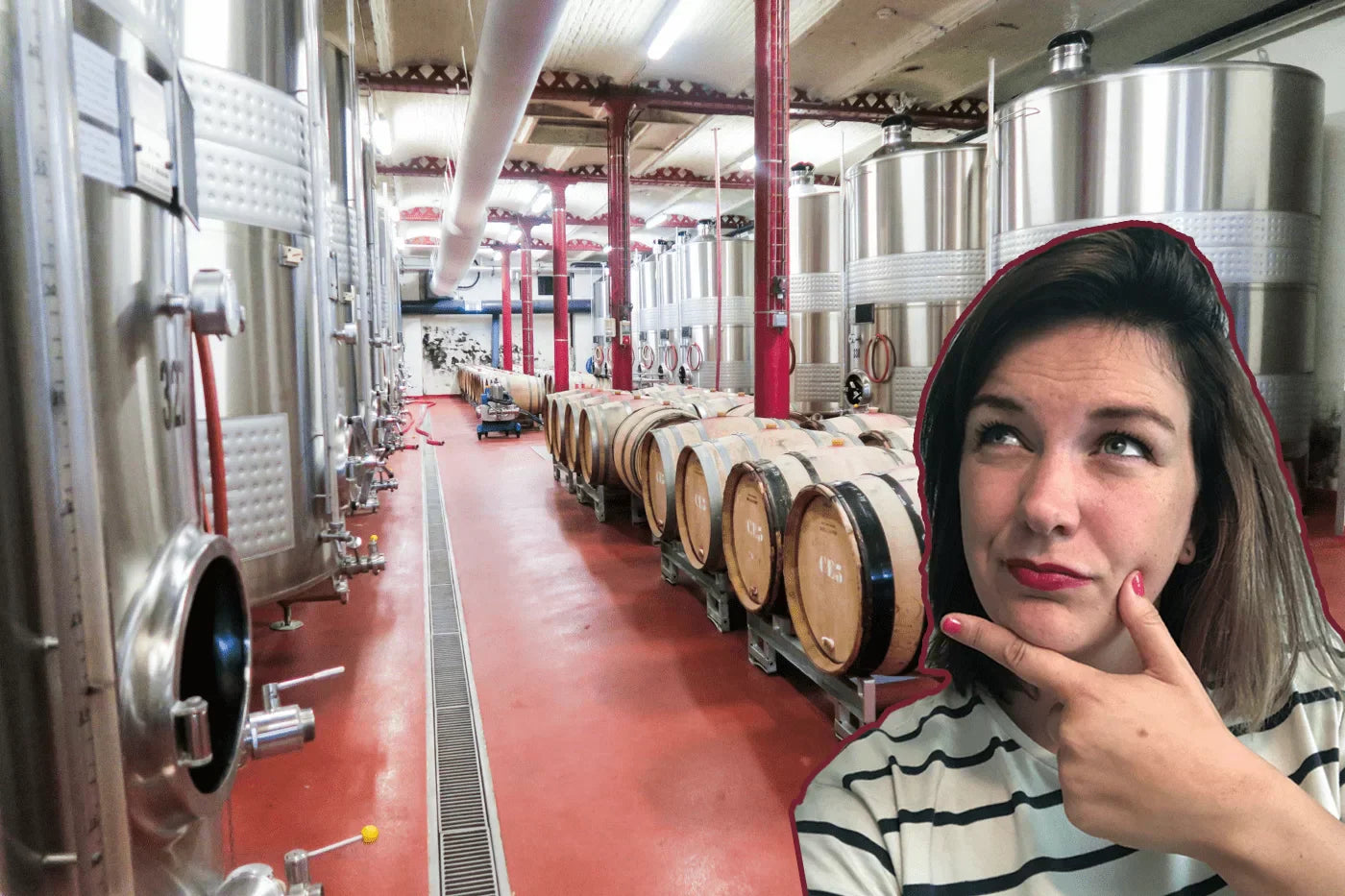
Once you've visited a few Champagne houses, you think you're starting to understand the process. Forget it. In early March, I visited Bollinger and had to start all over again. I was given a tour of the Champagne house's cellars and learned that there aren't two fermentations taking place here, but four... What?
We start with the alcoholic fermentation
The grapes are pressed according to the well-known Champagne rules. For your information: the pressing here is extremely gentle. If you were to compare such a press to a juicer, a juicer is a kind of guillotine. A grape press is more gentle; you can lie down in it without being crushed.
Bollinger uses only the first juice, the "cuvée," the "taille" (tall juice) that is sold to other houses. Considering how gently it's pressed, you can imagine how pure that first juice is, right?
That juice is fermented. Not in stainless steel tanks, like most Champagne houses, but in oak barrels. Bollinger uses old, used barrels from Beaune for this. Convenient, because the Bollinger Group also owns a winery there (Domaine Chanson Père & Fils). The wine is aged there for 6 to 9 months. Aging the wine in oak enhances its aromas and structure through contact with oxygen.
Then a malolactic fermentation
Yeah, okay, is it actually a fermentation? No. It's a Conversion . The conversion of sharp malic acid to mild lactic acid. There's no yeast involved, yet the entire wine world calls it fermentation, so I do too. It's about
This contributes to one of the taste pillars that Bollinger has defined: Creamy Effervescence.
Mini-fermentation of reserve wine
Without being overly dramatic, I have to say I can hardly describe what I felt when I first stepped into Bollinger's basement. It's truly stunning.

What exactly? Well, the fact that there are approximately 750,000 bottles stored there, for example. These are the reserve wines. One house stores the reserve wines in stainless steel tanks, while Bollinger stores all the reserve wines in magnum bottles. These magnums are stored by village and by year, so they know exactly how and what to do when they're ready to blend again. What's also special is that these bottles are sealed with a cork. Normally, this is done with a crown cap, because this is far from the final wine. So the cork has to be removed again. An expensive hobby. Bollinger stores the magnums for a maximum of 15 years. With a crown cap, there's a risk of oxidation after four years.
Besides the cork, something else special happens with this reserve wine. It already contains a quarter of the tirage. Tirage is the yeast and sugar mixture added to the bottles to start the secondary fermentation. Say what?
This already creates a small amount of pressure in the bottle. Is that allowed? Um, no. But Bollinger has been doing this since day one, creating a kind of loophole. This creates about 1 to 1.5 bar (a finished Champagne contains about 6 bar).
Non-vintage, a champagne without a vintage, usually consists of 10-15% reserve wine of 10-15 years old and two more or less equal parts of the previous two vintages.
The fourth fermentation is actually the 'second fermentation'
Once the blend has been determined, the wine can be prepared for the second fermentation—which in this case is essentially the fourth fermentation. Sugar and yeast are added to initiate the second fermentation. The bottle is capped, preventing the carbon dioxide from escaping and creating bubbles in the wine. The longer the wine rests on the yeast cells, the greater the chance of imparting some of these yeast aromas to the wine. This is called yeast autolysis. The minimum duration is 15 months (of which at least 12 months on the yeast cells) for a non-vintage Champagne.
In The Oxford Companion to Wine, Jancis Robinson indicates that yeast autolysis requires at least 18 months to show significant effects. But the best examples of Champagne are those that have been in contact with the yeast cells for five to ten years.
Bollinger ages its Special Cuvée for an average of three years. That's considerably longer than other non-vintage champagnes. Other cuvées are aged much longer. La Grande Année is aged for an average of 6 to 8 years, and the RD is often aged even longer.
Isn't it beautiful?
More about Champagne?
- Inside Billecart-Salmon – the traditional method up close
- A look inside Henri Giraud's home
- The forgotten grape varieties of Champagne
Sources :
- Visit Bollinger on March 2, 2018
- Bollinger's website
- Visit Bollinger Part 3 – WineAnorak
- What makes the Special Cuvée special? The Buyer Net
- The Oxford Companion to Wine – Jancis Robinson

Share:
Que syrah, syrah - everything about syrah
Now in the glass: Domaine de la Romanée-Conti La Tâche 1999