
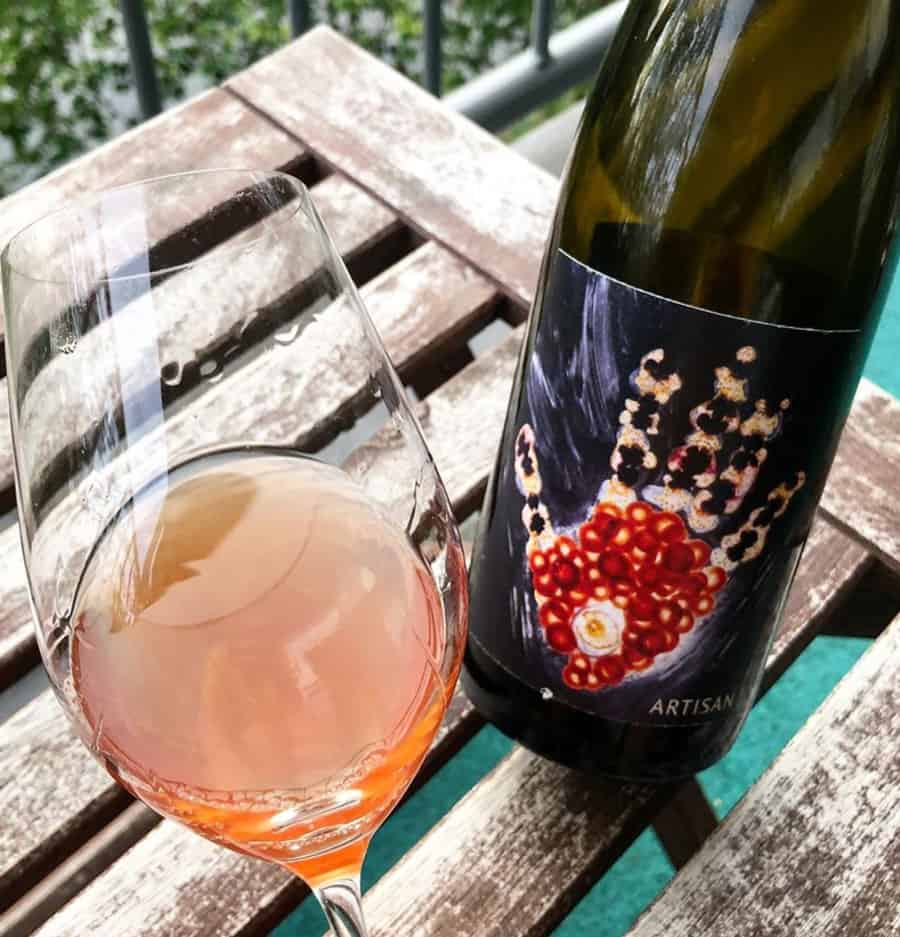
Vignoble du reveur, or dreamer's vineyard. It couldn't have been called anything else if the Deiss family were behind it. In this case, it's Mathieu Deiss, grandson of Marcel Deiss – the enfant terrible of Alsace. Mathieu isn't doing it alone and gets help from an unexpected source. Emmanuelle Milan (related?) assists him in the wine cellar. Isn't that a dream?
Reveur's Vineyard
Vignoble du Reveur has seven hectares of vineyards, which Mathieu Deiss inherited from his grandfather. It's located seven kilometers from Domaine Marcel Deiss in Bergheim. Mathieu has been making wines there with Emmanuelle Milan since 2016. Their approach is minimalist. In the vineyards, they apply the teachings of Rudolph Steiner and work strictly biodynamically (Ecocert and Demeter certified). This approach extends to the cellar, where they use no additives and allow the wine's natural process to unfold. This takes place in the cellar of Domaine Marcel Deiss, where Mathieu already works (along with his father, Jean-Michel).
Not familiar with the wines of Domaine Marcel Deiss yet? Then it's high time to delve deeper. Read the article: The Bottled Poetry of Marcel Deiss
You wouldn't expect it: it's carbonic maceration
They make six different wines, with Gewürztraminer and Pinot Gris being the stars – unlike in the rest of Alsace, where you'll find yourself stumbling over Riesling. My favorite – though I haven't tasted all six yet – is the Artisan, a blend of Gewürztraminer and Pinot Gris.

The color alone makes you curious: orange with a pinkish hue. I'd love to have it on my wall. The color is due to the long maceration process. Gewürztraminer and Pinot Gris already have quite a lot of pigment in their skins – you could call them pink (or "gris"), and if you leave the skins in the juice a bit longer, you can guess what that means. The grapes undergo carbonic maceration.
So, they're placed in whole bunches into the tank, which is filled with carbon dioxide (CO2) and sealed airtight. This creates an anaerobic environment—low in oxygen—which triggers intracellular fermentation.
Say what?
Can I squeeze more difficult words into one sentence? It sounds complicated, but it's not that bad. Intracellular fermentation means that fermentation takes place inside the grape. About one-fifth of the sugars is converted into alcohol. The rest is fermented normally. This method results in fruity wines with a bright color, few tannins (in the case of red wine), and abundant fruit aromas. Ideal for smooth, light red wines like Beaujolais.
This method is rarely used for white wines, because why bother? It extracts tannins and color from the skins. Something usually avoided when making white wine. For a fruity white wine, it's better to allow a normal—somewhat cool—alcoholic fermentation and avoid skin contact. If you want to make an orange wine, carbonic maceration can be a solution. Lesson learned.
And we haven't even mentioned the aroma yet. Grapefruit peel, rhubarb, white tea, strawberries, and floral notes. It might sound like a strong, funky natural wine, but no. It's different, but definitely not funky. It's incredibly well-made, and you can taste it. I'm not dreaming; good natural wine really does exist 😉
The wines of Vignoble du Reveur are for sale at De Bruijn Wijninkopers and Wijnhandel Peeters .
More of this?
Do you like these kinds of wines? What are these wines? I categorize them as "minimal intervention." Sometimes it's natural wine, other times it might deviate slightly from the definition of natural wine (although there isn't one, so take it with a grain of salt). Anyway, I have some tips for you:
- What the f*ck is Matassa?
- Crazy natural wines from Foradori
- The ins and outs of natural wine
Looking for more in-depth information? Then I recommend Isabelle Legeron MW's book, " Natural Wines : An Introduction to Organic and Biodynamic Wine Made Naturally."



Share:
Can I have a glass of corpinnat please?
A look inside Le Pin in Pomerol