
The sherry world is booming , with winemakers revisiting ancient traditions, rescuing nearly extinct grape varieties, and putting sherry back on the map. From unique, unfortified wines to centuries-old soleras, these bodegas demonstrate just how versatile and unique sherry can be. These are the houses you absolutely need to know about as a sherry lover – each one a pioneer with a deep love for wine and its history.
Bodegas Luis Perez
A few years ago, I met Luis Perez's export manager at Wine Professional and bombarded him with questions about sherry and the revolution that was (and still is) taking place, with Willy Perez (son of) at the forefront. He explained that it's not really a revolution, but rather an involution . Back to the way things were before the industrialization of sherry. Terroir used to play a much greater role. In 1868, the sherry region had 134 documented pagos, compared to about 40 today . Previously, many more grape varieties were permitted, and fortification wasn't mandatory. The grapes were left to dry in the sun for longer, increasing their sugar content and resulting in higher alcohol levels. Willy Perez is now doing the same with the Jerez La Barajuela series, the ultimate version of sherry without being allowed to call it sherry, because it wasn't fortified. The regulations have now been amended and it is no longer mandatory to fortify the wine (and you can also obtain the 15% naturally).
Willy Perez also makes a fantastic white wine, La Escribana. It's a vino de pasto, an unfortified white wine made from palomino fino, usually aged briefly under flor. A style that used to be quite common, but has since faded into obscurity. Now it's making a comeback. Cota 45 also makes some very fine examples.

Bodegas Valdespino
I visited Bodegas Valdespino with PitchPR and were given a tour by the winemaker herself. Valdespino Bodegas is one of the oldest wineries in the Sherry Triangle. It has a rich history dating back to the 13th century. After being rewarded with a vineyard for his help in liberating Jerez from the Moors, Alfonso Valdespino began producing wine in the area.
Over time, the family business grew, and the Valdespino brand became known for its exceptional quality. In 1999, the family sold the company to Grupo Estévez, which moved the Valdespino soleras (25,000 barrels!) to a new, state-of-the-art facility on the outskirts of Jerez. It was impressive to see all those barrels together, and even more rewarding to hear from the winemaker herself about the processes that resulted in, among other things, the superb Tio Diego Amontillado, to name just one.
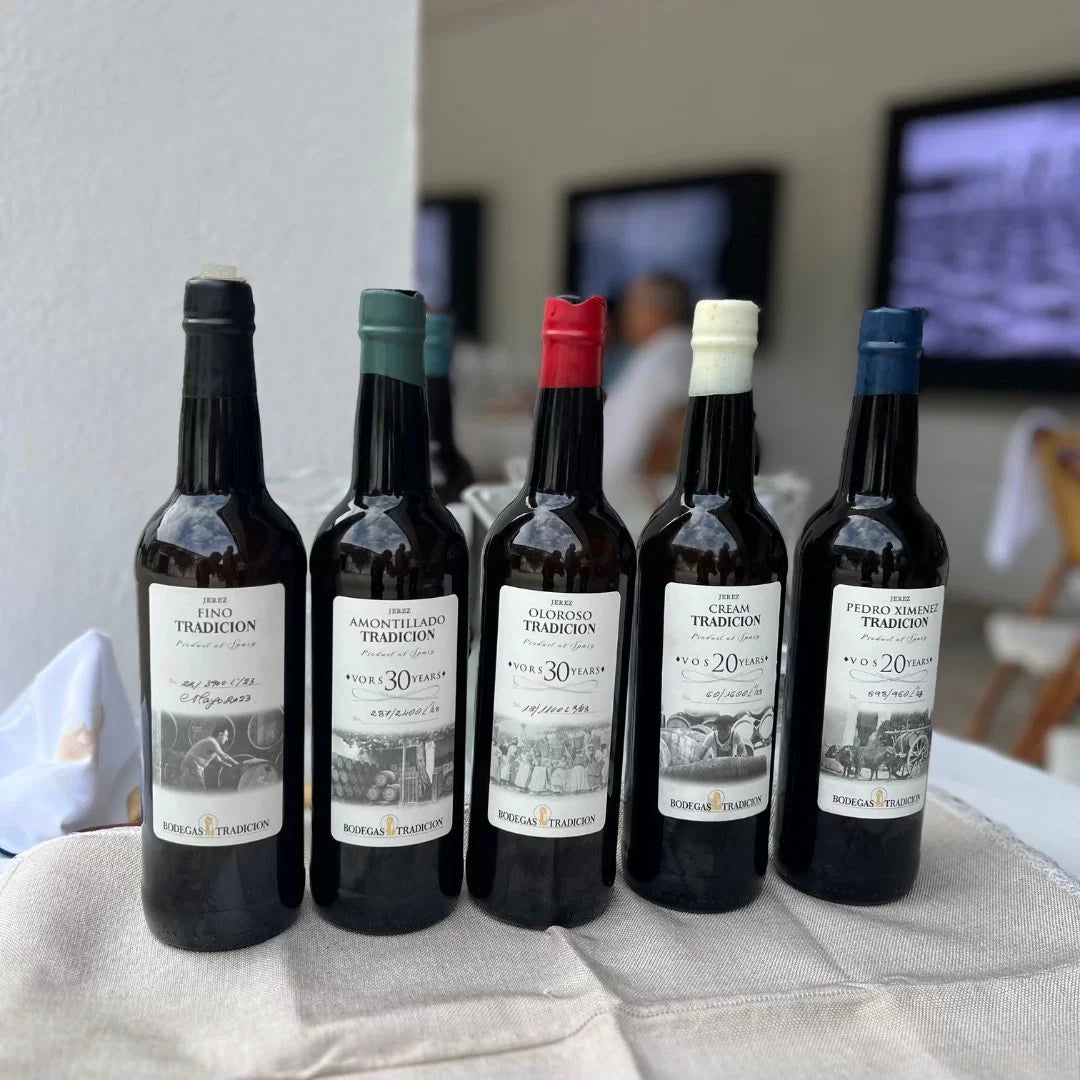
Bodegas Tradicíon
Bodegas Tradicíon is a boutique winery producing approximately 20,000 bottles annually. Their bodega is beautiful, including a museum showcasing works by Spanish painters and approximately 1,500 barrels. It exudes tradition— what's in a name? Yet Bodegas Tradicíon is still relatively young. It was founded by Joaquín Rivero in 1998. He acquired old soleras that were unused or from defunct bodegas and restored a 17th-century bodega to bring them together. So, Tradicíon is actually marketing wines that are older than the company itself . They produce sherries that will leave you speechless. Truly excellent.
Bodegas Ximénez-Spínola
Unlike other wineries, Ximénez-Spínola works exclusively with Pedro Ximenez for both dry and sweet wines. Almost all dry sherries are made from Palomino Fino. For sweet sherries, PX or Moscatel is (also) used, which are not even sourced from Jerez, but from the nearby region of Montilla-Moriles. Ximénez-Spínola has been pursuing its own path for over 250 years and has specialized in fine PX wines.
Available at Twaalf Procent of Meer in Middelburg or via the Anfors website.
Bodegas Ximénez-Spínola
Unlike other wineries, Ximénez-Spínola works exclusively with Pedro Ximenez for both dry and sweet wines. Almost all dry sherries are made from Palomino Fino. For sweet sherries, PX or Moscatel is (also) used, which are not even sourced from Jerez, but from the nearby region of Montilla-Moriles. Ximénez-Spínola has been pursuing its own path for over 250 years and has specialized in fine PX wines.
Available at Twaalf Procent of Meer in Middelburg or via the Anfors website.
Bodegas Williams & Humbert
Just when you think you've seen it all, you arrive at Williams & Humbert. This isn't just the largest winery in Jerez, it's the largest in Europe. It's the opposite of the bodegas mentioned above, which produce considerably less, but it's still impressive to see. Williams & Humbert is a Jerez winery.
It covers 17,000 square meters and holds 65,000 500-liter barrels, holding 25 million liters of wine. A significant portion of these barrels is destined for Scotland, where whisky producers are fond of sherry casks. These are new American oak casks, far too strong for sherry. Nevertheless, they are filled with sherry, not to drink, but to impart its flavor. After two or three years, the casks are sold to Scotland, and the contents are sent to a distillery to be turned into wine alcohol.


Share:
A wine fan in Jerez
Copa Jerez 2023: the atmosphere, the sherry and the prizes