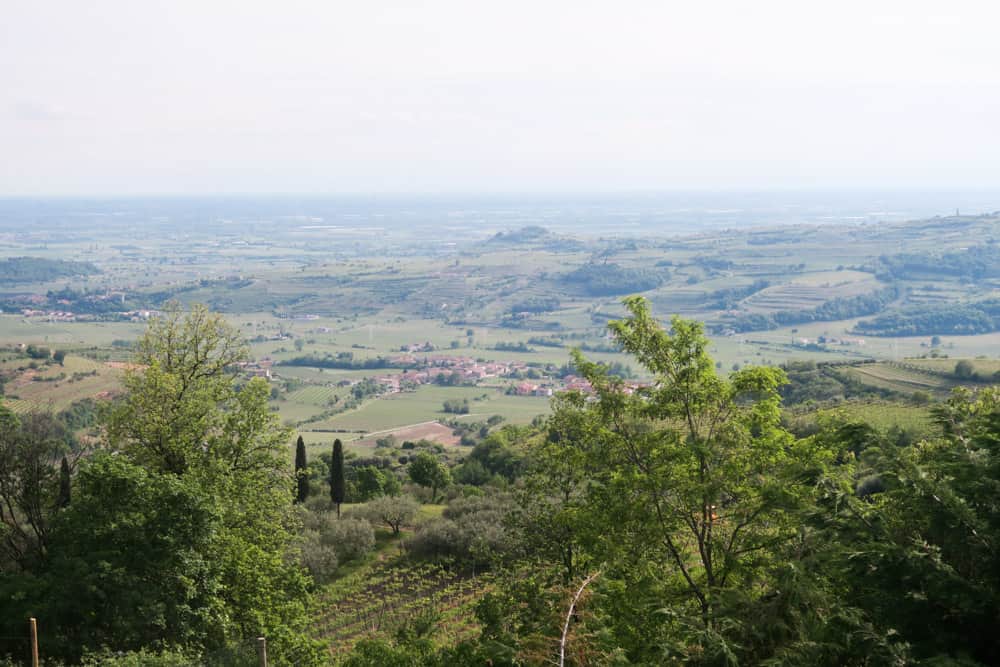
Soave is an idyllic village in the heart of the Veneto region. The old castle walls still stand, serving as a handy guide ("through the castle and then left") during my press trip to Soave at the end of May. Soave is more than just an idyllic village; it also produces one of Italy's finest white wines. Did I really say that? Yes, I did!
“ We want the world to be aware what Soave is all about.”
That's why I received an invitation in my inbox earlier this year for Soave Stories, an initiative by the Soave Consorzio to showcase the region. Soave, boring? No more. It's making a comeback, and everyone should know about it. Although that comeback will have to come from a long way. Over the years, the region's image has suffered a huge blow, a case of "anything goes, anything goes." Cheap junk was being sold under the same banner as the better products. That's a disaster for everyone involved. The producer can no longer differentiate himself. The consumer doesn't understand a thing, tars everyone with the same brush, and gives up. The end of Soave.
Luckily for us, there are wineries that have always stood their ground and prioritized quality over quantity. Taste these wines, and a whole new world will open up. Unfortunately, it's still difficult to gauge quality based on the label. As with all renowned regions, it's best to research the producers.
Soave's complicated regulations
Still, it's fun to briefly explain the regulations. Even if it's just to show how complicated they are. No wonder consumers don't (or no longer) understand them. It's taken me days to explain this as clearly as possible. It's a bit of a struggle... (or scroll down)
Theoretically, there are two protected designations of origin in Soave, namely DOC Soave and DOCG Soave Superiore . Within both appellations, a subzone applies: Soave Classico, the historical production zone. This refers to the volcanic soils of the hills between Soave and Monteforte d'Alpone.
Volcanoes in Soave? Yes, definitely. But for that, we have to go back millions of years. The volcanic and limestone soils were created by ancient submarine eruptions. The Consorzio has made a very clear video about this.
The historic production zone, Soave Classico, comprises some 1,500 hectares of vineyards. This proved far too small to satisfy the growing demand of international consumers. Soave was a huge hit in the 1960s and 1970s. This was reason enough for the Consorzio to support an expansion at the time. DOC Soave , which quadrupled the area and included the fertile plains between the hills and the Adige River.
Then the trouble began. Suddenly, everything was Soave. Whether you had a vineyard with volcanic soils and incredibly old (100+ years old) vines, or just a few rows of vines planted on one of the flat stretches by the river, both wines fell under the "DOC Soave" label. Not fair. Fortunately, a handful of wineries, including Pieropan, Gini, and later Inama, stuck to their guns, but with so much junk on the market, it was hard to justify the higher price.
Not only the origin was questionable, but also the towering permitted yield was a cause for controversy (and, according to the Ministry of Education, Culture and Science, the cause of the tasteless wines). It also didn't help that Trebbiano—the incredibly dull, productive Trebbiano Toscano, or Ugni Blanc—was permitted in the blend.
The Consorzio realised that it had to do something about the enormous quality differences and introduced DOCG Soave Superiore in 2002. Thanks, but no thanks . Many top producers expected Soave Classico to be upgraded to DOCG status, but it became "only" a Soave Superiore with wider boundaries than the Classico zone (so as not to sideline the largest cooperative). A minimum alcohol content of 12% was mandated, and yields were restricted (though still high at 10 tons/ha). Many top estates disagreed and refused to use the DOCG classification. They stuck with DOC Soave (with a Soave Classico subzone designation). For Roberto Anselmi, this was even reason enough to leave the DOCG.
Besides Soave Classico, there's another subzone within DOC Soave: Colli Scaligeri. These are the hills surrounding the city of Verona, which fall slightly or partially outside the Classico area. Therefore, the word "Colli Scaligeri" can be used on the bottle alongside DOC Soave to indicate that it belongs to this subzone. Colli Scaligeri cannot (yet) be used in combination with DOCG Soave Superiore. Capice? (It took me at least a week to realize this…)
Crus
The appellations don't necessarily tell us everything about the wine and its quality. The sub-zones do a bit more, but it's even more precise to indicate the cru on the bottle. That's why, in 2000, the Consorzio began mapping all its vineyards, including analyzing and determining their geology and soil type.

Soave boasts 33 crus, 29 of which are in the Classico zone – essentially the hills of this area, mostly with volcanic soil. In the eastern Val d'Alpone, two parcels with dark, volcanic soil have been designated as crus. There are also three crus with calcareous soils in the west.
These volcanic soils are perfect for shine, and the Consorzio is certainly doing just that. During Soave Stories, John Szabo, author of the book " Volcanic Wines, " was even flown in to give a masterclass. The masterclass featured not only Soave wines, but also wines from Santorini, Etna, and Tuscany. It was awesome – check it out! this article for more volcanic chatter.
Lady Garga
In Soave, it's all about Garganega, a grape variety that apparently few people can pronounce correctly, hence the nickname Lady Garga. When it comes to grape varieties, I like to quote my girlfriend Jancis Robinson:
“Veneto vine capable of making fine, lemon and almond-scented wines, notably but not exclusively from low-yielding vines in Soave, also Gambellara, Bianco di Custoza etc.”
I tasted dozens of wines during Soave Stories, and as a result, I got a good idea of Garganega's flavor profile. I wouldn't describe it as aromatic, but rather neutral. Terroir is crucial. Volcanic soils give the wine a hint of smoky saline. We could also call that minerality. The saline isn't necessarily a salty flavor; it's more of a texture that adds freshness and balance to the wine. Just as adding salt to a dish brings out the flavors, salinity in wine emphasizes the fruit and acidity. It's beautiful, isn't it?
Other grape varieties
Although most crus consist of 100% Garganega, the regulations also permit the use of other grapes. Up to 30% Trebbiano di Soave and Chardonnay are permitted. In addition, up to 5% local Veneto grape varieties are permitted in the blend.
Earlier, I mentioned Trebbiano Tuscan, or Ugni Blanc. Boring and incredibly productive, it was the ideal solution during its heyday. The grape was partly responsible for the dent in Soave's image, but thankfully, it has been decided that Trebbiano Tuscan can no longer be used. Trebbiano di Soave – synonymous with Verdicchio and Turbiana – is permitted, and the final word on this hasn't been said yet. Not in a negative way, quite the opposite – another part of Soave Stories was "Trebulanum," in which the role of Trebbiano was discussed in detail. Filippi Winery, my greatest discovery of the entire trip, even makes a 100% Turbiana. Of course, it doesn't fall under DOC Soave, but is 'only' an IGT Veneto.
The power of pergolas
I can't end this article on Soave without mentioning the pergolas. The pergola system isn't usually highly praised, as it's said to produce high yields and lower-quality grapes. Yet, Garganega thrives hanging from a pergola, locally called "pergolatto veronese." In a pergola system, the vines grow upwards like mini-trees, with their leaves providing excellent protection—like an umbrella—from the sun.

The Soave Consorzio has conducted research into the differences between Guyot and Pergola pruning. Their findings? The pruning method significantly affects the temperature of the grape cluster; therefore, its ripening; and therefore, its flavor! The study revealed that grape clusters pruned in Guyot spent 48% of their time in the shade, compared to 71% for the Pergola. "We measured temperatures of 40 degrees in Guyot and 28 degrees in Pergola. A difference of 12 degrees! Considering that many aromas are lost above 30 degrees , so this is crucial”, tells Chiara Mattiello (Soave Consorzio) as we walk through the vineyards of Coffele.
Soave must be put back on the map
It's clear to me: Soave needs to be put back on the menu. That's not easy, because you can still find a bottle of Soave at the supermarket for €3.99. These are made from grapes grown on the fertile plains with incredibly high yields. They're nothing compared to the old vines that grow on the volcanic soil. Whether they're labeled Soave, Soave Classico, or Soave Colli Scaligeri— who the hell cares?
It's just not easy to separate the wheat from the chaff. So, here's a quick list of discoveries during Soave Stories. The wines that surprised me, the ones that stuck with me the most.
Give Soave a chance. The region deserves it.
Wineries you shouldn't miss
- Pieropan
- Inama
- Gini
- Filippo Filippo
- Suavia
Sources:
- Guildsomm – Italy's Adriatic Coast (Part 1): Veneto and the DOCG
- Jancis Robinson – Soave but not as we know it
- Jancis Robinson – Serious Soave, seriously
- John Szabo – Volcanic Wines
- Consorzio di Tutela del Soave – website


Share:
A wine lover in Valladolid
The Road to Weinakademiker - Part 8 (How much does it cost?)