
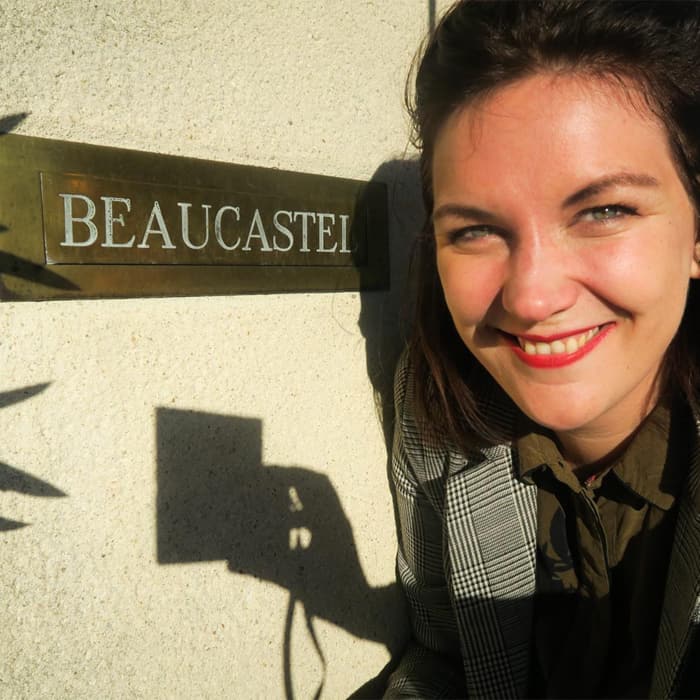
Visiting Château de Beaucastel. For real? Yes! It's one of Châteauneuf-du-Pape's top estates and is located in the northwest of the appellation. In this blog post, I'll tell you more about the visit.
The history of Chateau de Beaucastel
The château's history dates back to the 16th century, but the Perrin family only came into the picture at the beginning of the last century. In 1909, Pierre Perrin took over from his father-in-law and immediately suffered a severe blow: phylloxera. The first two generations were primarily occupied with replanting the vineyard.
A new light appeared at the end of the tunnel: Jacques Perrin. A visionary. He did things no one else was doing at the time. In the 1950s, he was already farming organically. About twenty-five years later, he switched to biodynamics. Jacques was far ahead of his time and didn't adhere to the bureaucratic rules. Unfortunately, he died suddenly, and his sons had to take over. They had to do everything they could to stay afloat, so they put the moonlighting on hold for a while. Currently, they farm organically and occasionally biodynamically. At 100 hectares, the vineyard is too large to operate entirely biodynamically.
The magical terroir
The special thing about Beaucastel is, of course, the terroir. My wine heart leaped at the sight of the rolled pebbles – les galets roulés. I sent a message to my friends, who responded with, "Huh, what – is there gold in those stones or something?" Uh, hello, where do you see a vineyard full of large pebbles? This is unique to Châteauneuf-du-Pape and is what creates the region's unique wines.


The magical terroir of Beaucastel
The stones lie on the surface, followed by sand, clay, and limestone. These layers are a remnant of the Rhone River, which once flowed here and was 9 kilometers wide at the time. In the past, these stones were especially necessary because they retained daytime heat for the night. Now, with global warming, heat is no longer an issue. What is useful, however, is that the stones retain some moisture (vapor) after a rain shower. In times of drought, this can make all the difference.
Another unique feature of the terroir is the wind, the Mistral. It was blowing quite nicely as we walked through the vineyard. "Oh, this is just a gentle breeze," our guide said. We almost blew away 😉
Thirteen grape varieties
While many wineries use only a selection of the permitted grape varieties in their C9dP wines, Château de Beaucastel uses all the grape varieties. That's thirteen, if you count the color mutations as one:
- Grenache
- Syrah
- Mourvèdre
- Cinsault
- Clairette
- Vaccarèse
- Bourboulenc
- Roussanne
- Counoise
- Muscardin
- Picpoul
- Picardan
- Black Territory
Here too, it's striking that the Perrin family isn't choosing the easiest path. That would be planting a generous amount of Grenache (noir). It grows easily and yields well. Global warming is forcing them to adapt, however. It's getting too hot for Syrah. Mourvèdre and Grenache are grape varieties that handle the heat better. Fortunately, Jacques Perrin had already recognized this, and Mourvèdre is widely planted in the Beaucastel vineyards. The average age of the vines is 60 years.
From grape to wine
Harvest time has arrived. With a team of around 30, it takes them six weeks to harvest 100 hectares of vineyard. It's hard work! After harvest, the grapes are taken to the cellar and sorted twice. Sorting takes place before and after destemming. Only the best fruit advances to the next round.
The next round depends on the grape variety. Each grape variety is vinified separately. All six grape varieties are used for the white wine, but Roussanne, accounting for 80% of the blend, is the king of the blend. For the red wine, all grape varieties are used, and white grapes make up approximately 5% of the blend.
The white grapes are pressed separately and then, using gravity (to minimize the risk of oxidation), transferred to the tank for fermentation. Approximately thirty percent of the grapes are fermented in oak. All grape varieties, including Grenache Blanc, undergo malolactic fermentation. They are then blended and aged for another eight months in large vats.

The press is at the top, the tank at the bottom. Handy!
A different process naturally applies to the red grape varieties. Syrah and Mourvèdre are fermented in oak barrels because they require more oxygen during fermentation. The caps are immersed twice a day to extract more color and flavor. The other grape varieties are fermented in cement tanks. After alcoholic fermentation—in oak or cement—they are transferred to large vats.
Château de Beaucastel is known for its controversial vinification method. Flash heating (also known as "flash heating" or "vinification à chaud") involves rapidly heating the grapes to 70 degrees Celsius and then quickly cooling them back down. This heats only the skins. This process deactivates laccase, an enzyme that promotes oxidation, and thus reduces the need for sulfites before and during fermentation.
After malolactic fermentation, the blend is made and aged for another 18 months in large vats. There are still a few small barrels scattered around the cellar, but these are only used to top up the large vats.

#strikeapose in the cellars of Beaucastel.
We are going to taste
Chateauneuf du Pape Blanc 2016
Roussanne is a real pain in the neck. This grape variety produces small bunches and small, thin-skinned grapes. It doesn't like rain or wind. You have to learn to tame it—good luck in the race. If you can, Roussanne is aromatic and offers structure. Despite the heat, it retains its crisp acidity.
We taste that too. Full and fresh at the same time, that's impressive. Floral, spicy, beautiful.
It's recommended to drink this white Châteauneuf within five or 15 years. During the first five years, it displays beautiful, primary notes. After 15 years, the tertiary aromas have taken over, and the wine has undergone a transformation.
Roussanne vieilles vignes 2017
The wine is very young, but the vines are ancient. The average age of the vines is 100 years. Older vines produce Typically less , but more concentrated juice. In this case, four sticks yield three bottles.
Although the wine is young, the aromas are phe-no-me-nal. What a wine! Apricot jam, honeysuckle, butter, brioche, exotic fruit.
Côtes du Rhône 2016 Coudoulet
The grapes come from "the other side of the road." Not Châteauneuf-du-Pape, but a Côtes du Rhône . The blend consists of 30% Grenache, 30% Mourvèdre, 20% Syrah, and 20% Cinsault. Otherwise, the wine is made in exactly the same way as C9dP.
"It's a spoiled Côtes du Rhône." The first thing I notice is the spiciness, complemented by dark fruit. The tannins are coming through, but the wine has only just been bottled. I'll leave it for a while.
Chateauneuf du Pape 2016
In a young C9dP, the juicy, youthful enthusiasm of Grenache dominates. Gradually, Mourvèdre takes over, giving the terroir a platform. For now, I'll note: "lots of fruit, cherries, blackberries, a touch of spice, black pepper." I find the tannins more pleasant than those of the Côtes du Rhône. But otherwise: be patient. You'll be rewarded in fifteen years.
Chateauneuf du Pape 2008
Luckily, we also get to taste an older C9dP, and I completely understand what's meant by Mourvèdre and the terroir. The juicy fruit has been replaced by dark fruit, raisins, dark chocolate, prunes, thyme, and pine needles. The acidity is still present, and the tannins are beautifully soft. Mmmmmmmm.
Chateauneuf du Pape 2001
Let's go back even further in time. I could smell this for hours. Each time, a different scent emerges. The aromas go a layer deeper: earthy notes. Much more mushrooms, forest floor, but also blackberry jam and prunes.
The wines of Chateau de Beaucastel are available in the Netherlands Sauter for sale.
Share:
Sussex vs. Champagne: Two Sides of the Parisian Basin
A look inside La Cité du Vin in Bordeaux