
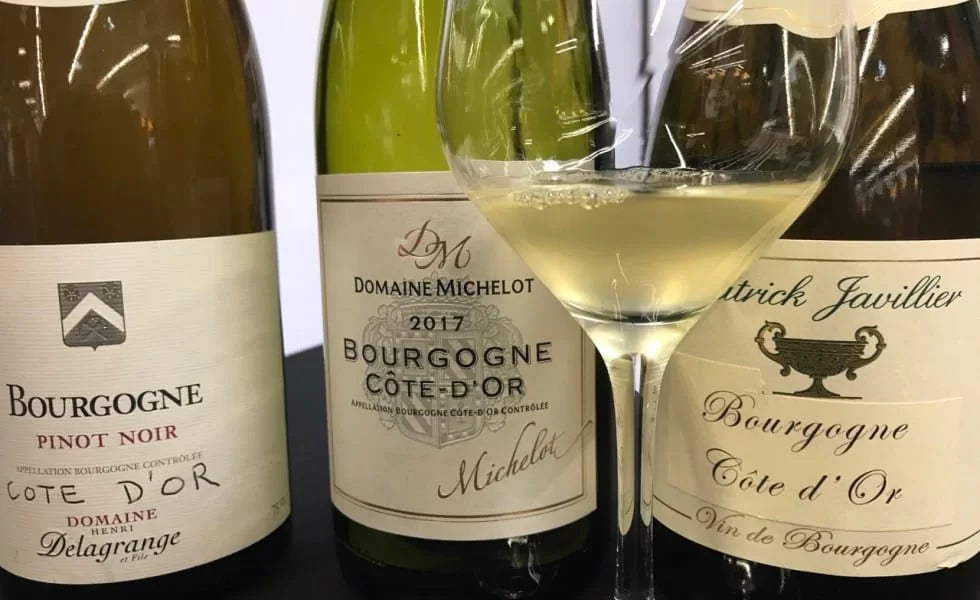
Burgundy is pure enjoyment. Unfortunately, that enjoyment isn't cheap. If you want to savor a good bottle, you'll quickly pay a premium. Especially if you prefer villages with an established reputation and a legendary name, like Morey-Saint-Denis or Puligny-Montrachet. Not to mention the Premiers Crus and Grands Crus produced here.
But there's a solution: buy a simple regional Burgundy, without the village name on the bottle, but from a reputable winery in the Côte d'Or. This will get you a front-row seat for next to nothing. Well, not exactly a penny, but you get the idea. Starting with the 2017 harvest, these wines can be bottled under the new regional AOC, called "Bourgogne Côte d'Or." In this article, Wouter Moll shares his experience with wines from this budget-friendly part of Burgundy.
The Côte de who?
For anyone thinking, "The Côte de what?" The Côte d'Or is the most important sub-region in Burgundy. This is where the world-famous Grands Crus are found. The Côte d'Or consists of the Côte de Nuits in the north (almost exclusively Pinot Noir) and the Côte de Beaune in the south (both Pinot Noir and Chardonnay).
A stone's throw from the big boys
Lately, I've been regularly tasting basic Burgundies from producers in the Côte d'Or. Aside from the relatively good price-quality ratio, the wine nerd in me enjoys finding out where the vineyards used for these anonymous entry-level wines are located. They're often located right next to or even in famous wine villages, a stone's throw from the vineyards where, for example, Vosne-Romanée or Meursault are produced. But because they lack ideal soil or sunny exposure, they used to fall under the anonymous residual AOC "Bourgogne." This has recently changed.

Left: the slope with village, Premier, and Grand Cru vineyards. Right: the plain where Bourgogne Côte d'Or is produced. Photo: Chambolle via Google Street View.
A new AOC
After more than twenty (!) years of talks and endless wrangling, an AOC has finally arrived. This wasn't without a fight, as the creation of this AOC was heavily criticized. This appellation was supposedly created to allow for slightly higher prices. Winegrower Bruno Clair from Marsannay also believes this regional AOC violates the principles of terroir. I don't understand that last point, because Côte d'Or is a stricter demarcation than Bourgogne Régional, which can be made from grapes from a much larger area and, on paper, can also be a blend of subregions.

Hot off the press: the first boxes of Bourgogne Côte d'Or at Henri Bloem in Utrecht (photo: Pierre Heckner )
An ordinary strip of land?
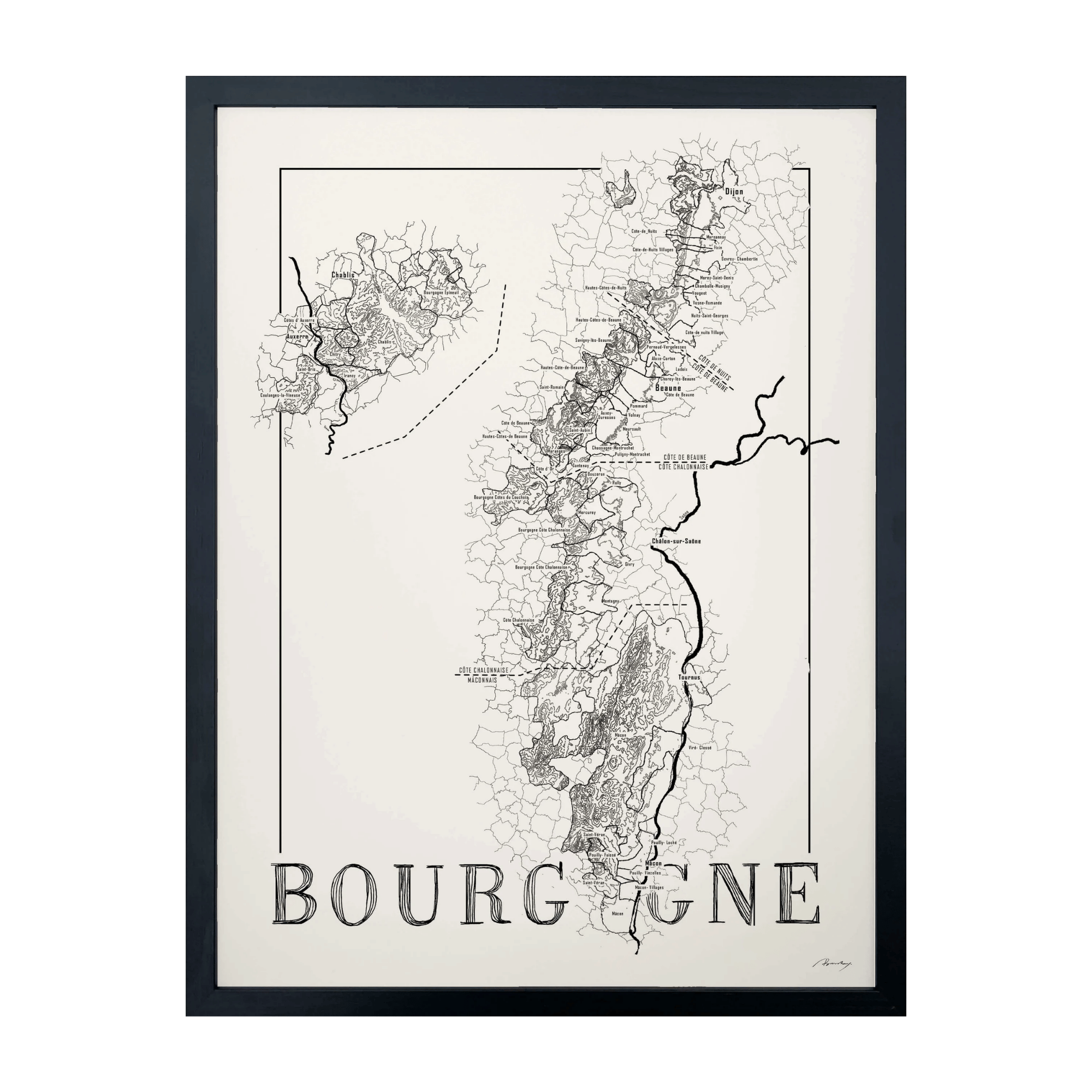
The area of this new AOC is estimated to cover around 1,000 hectares (not yet fully exploited) and is located primarily east of all the major wine villages in the Côte de Nuits and Côte de Beaune, from Marsannay to Maranges. These villages almost all have their own AOC at the village level, with Grand and/or Premier Cru vineyards on the slopes, but on the other side of the village, on the flat section on the "wrong" side of the highway, there are also vineyards. These parcels are described in the Lavallé classification, which dates back to 1855, as the "Région des Grands Ordinaires." Here, the soil is richer and deeper. In theory, this produces less exciting wines. Therefore, they cannot be compared to the grand terroirs of Burgundy. But they are certainly not ordinary. At least, not if you buy one from a reputable producer, because then you get a very good impression of the house style and quality of the higher-end wines in their range. Call it a peek behind the scenes.
Small wine from a great maker or the other way around?
A good Bourgogne regional can rival an average wine at village or even Premier Cru level. In fact, a group of trained Burgundy tasters recently mistook a well-aged (regional) Bourgogne blanc from Domaine Leflaive from 1996 for the Grand Cru Bienvenues-Bâtard-Montrachet ( link (Just in case you don't believe it!) I would personally opt for a regional Burgundy from an established name rather than a village wine from a farmer whose name isn't recommended anywhere.
How affordable is affordable?
Not all regional Burgundies are affordable. Entry-level wines from hyped producers like Coche Dury, Arnaud Ente, and Roumier will set you back well over a hundred euros. The most extreme example is the exorbitantly expensive white Bourgogne Blanc from Comte Georges de Vogüé. This is because it's actually the extremely rare white Musigny (one of the finest Grands Crus), which was declassified until a few years ago because the estate deemed the vines too young to bear the Grand Cru title. It's therefore an exception. These outliers aside, a Bourgogne Rouge or Blanc (soon to be called Côte d'Or) remains a good buy in this expensive wine region. If you're willing to spend 25 euros, you're in good hands by Burgundy standards.
Lines
The rules for AOC Bourgogne Côte d'Or are stricter than for the general AOC Bourgogne. For example, the mandatory planting density is higher, and the maximum yields are slightly lower. Blends between fruits from the east of the Côte de Beaune and the east of the Côte de Nuits are permitted, but blending with wines from the Hautes-Côtes, the wine-producing region west of the Côte d'Or, is prohibited.
Less relevant are the minimum alcohol content requirements, which are slightly higher for Bourgogne Côte d'Or. They're 11% instead of 10.5% for white and 10.5% instead of 10.2% for red. The only Burgundy I've tasted with such a low alcohol content was the Bourgogne rouge 'Grande Charme' from Alice Beaufort in Prusly-sur-Ource. That village is near the Champagne region, so that explains a lot.
Under the radar terroir for wine nerds
What I find fascinating about Burgundy is terroir: it's that one vineyard, on that one perfect slope, that makes the wine so unique. You can see exactly where the vineyard is located on a map. Vineyard names are printed in bold letters on the bottles of Grands Crus and Premiers Crus, but there are also a growing number of growers who bottle the individual plots of their village wines (AOCs) separately. One producer known for this is Jean-Marc Roulot from Meursault. Entry-level Burgundies usually don't have this label on the bottle. I secretly like that, because it encourages a bit of exploration.
You can often find out online where the wine comes from. Some producers, such as Michelot and Roulot , indicating precisely where the fields for their Bourgogne Blanc are located. Others don't do this, but those who dig carefully will often find it, for example on wine blogs like Steen Öhman ( Winehog ). The maps on the websites also help. weinlagen-info .de and burgmap.com the wine nerds among us have come a long way in unravelling such plots.

The plots of Roulot for Bourgogne blanc / Bourgogne Côte d'Or. (card: Kermit Lynch )
Are there any well-known vineyards in the new AOC?
There are a few vineyards in the Côte d'Or that have long been well-known, but according to Jasper Morris, were not granted Premier Cru status because they are not part of a village with its own AOC. They were classified under the regional AOC, but as a consolation prize, were allowed to use the vineyard's name after the Bourgogne label. These are Bourgogne-Clos des Marcs d'Or and Bourgogne-Montrecul in the suburbs of Dijon, Bourgogne-Le Chapitre in Chenôve (above Marsannay), and Bourgogne-La Chapelle Nôtre Dame, east of the Ladoix AOC boundary. I'm not certain, but I assume these lieu dits (vineyard names) are now also classified under the new Côte d'Or AOC, or at least are allowed to be. Another vineyard that enjoys some notoriety (but no independent status) is Bon Bâtons, east of Chambolle. This lieu dit is bottled separately by, among others, Ghislaine Barthod and Patrice Rion.

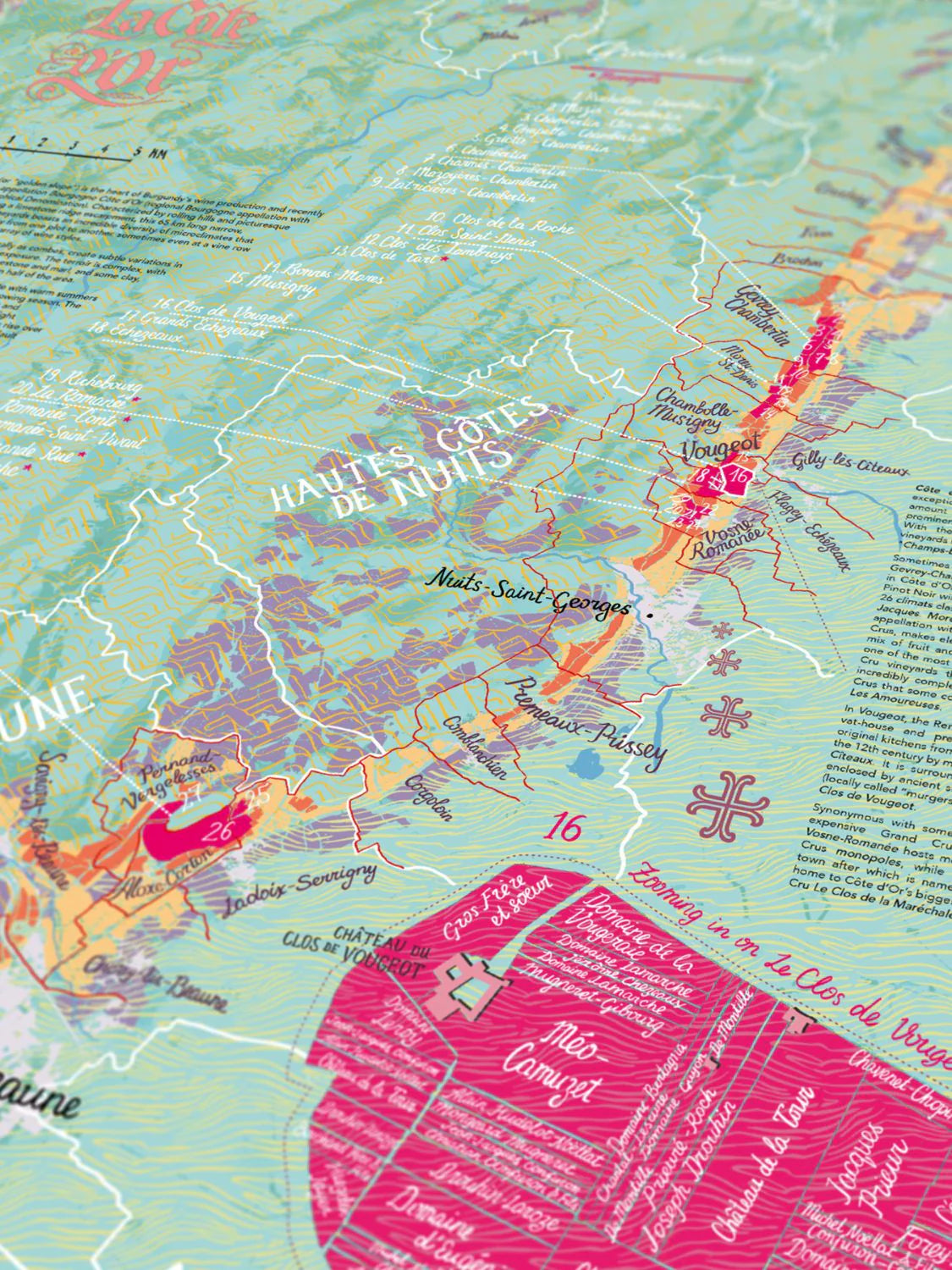
Vineyards east of the Clos de Vougeot (map: Burgmap)
Good idea, such a new AOC?
I think so. The wine-producing villages behind the Côte d'Or have had two of their own AOCs for much longer: the Hautes-Côtes de Beaune and the Hautes-Côtes de Nuits. So, you could actually see the AOC Bourgogne Côte d'Or as an upgrade for the area east of the Côte d'Or that was left out until recently. It also gives farmers who declassify village wines, for example, because the vines are still young, the opportunity to still indicate that it's a Côte d'Or wine. Moreover, delicious wines are made here by fantastic winemakers, with just as much attention and precision as for their great wines. I think the criticism that the new AOC makes these wines even more expensive is unwarranted, because even without the arrival of this new AOC, I fear that prices will continue to rise anyway.

The plot Les Bergeries near Puligny with the Côte d'Azur in the background. Jean-Marc Boillot makes fine wine here. (Photo: Google Street View)
The only question that remains is whether this AOC shares a common identity and quality. I think the quality is primarily producer-specific, and the slightly stricter regulations for this AOC won't necessarily lead to a quality boost. Then there's the identity: the climatic conditions in the Côte d'Or are slightly different than in, say, the Mâconnais. In my humble experience, this also results in a slightly greater degree of finesse in the wines. That's another reason why the stricter demarcation of this AOC wouldn't hurt. So I say: bring on Bourgogne Côte d'Or!
Tasting notes
Want to read more? I recently tasted a number of generic Burgundies that, starting in 2017, can be bottled under the new AOC Côte d'Or.
Burgundy white
Domaine Tessier (Meursault), Bourgogne blanc 'Champ Perrier', 2014, 2016 and 2017
From a small plot within the municipal boundaries of Puligny-Montrachet, but outside the AOC boundary of Puligny, bordering Meursault. I first tasted this wine in a restaurant in Beaune in 2014. A real discovery, both from the producer and this charming vineyard. The 2016 was still a bit young, and the 2017 was a bit full-bodied.
Domaine Tessier (Meursault), Bourgogne Blanc 'Les Herbeux', 2017
Next to Clos de la Barre, Dominique Lafon's 'backyard'.
Domaine Michelot (Meursault), Bourgogne blanc 2015
A blend from a laundry list of plots in the flat Meursault region: Le Buisson Certaut, Les Grandes Coutures, Sous la Velle, Les Grands Clous Perrons, En la Monatine, Les Magny, and Les Malpoiriers. This blew a group away at a tasting I organized, and I was amazed myself. Delicious!

Plots of Domaine Michelot (photo: Domaine Michelot )
Domaine Matrot (Meursault) 2015
Sourced from vineyards located near Meursault, according to the producer's website. It didn't quite measure up to the aforementioned Michelot, but I'd happily try them side by side again.
Domaine Hubert Lamy (Saint Aubin), Bourgogne blanc 2014
It took a while to get going, but after that, it's très Lamy. Contemporary style. Great, man!
Domaine Jean Marc Boillot (Pommard), Bourgogne Blanc 2014
From a lieu dit (Les Bergeries) that falls within the municipal boundary (so not the AOC) of Puligny-Montrachet, bordering Meursault, across from the Champ Perrier vineyard, but on the other ("wrong") side of the road. Man, I'm so bummed that the 2014 is no longer available.
Domaine Pierre Yves Colin Morey (Chassagne), Bourgogne blanc 2015
A blend of fruit from Saint Aubin and Puligny. This one beats many village wines.
Burgundy red
Domaine Bruno Colin (Chassagne-Montrachet), Bourgogne rouge 2016
From two plots in the commune of Chassagne: Grand Champs and Grand Près. Beautifully perfumed and deliciously fruity. Plenty of acidity. It does its job perfectly (washing down confit de canard).
Domaine Lécheneaut, Bourgogne rouge 2014
Fruit from three plots in Nuits-Saint-Georges, two of which are within the AOC boundaries (Les Maladières and Les Perrières). The third, Les Croix Blances, lies north of Nuits-Saint-Georges, on the "wrong" side of the road, bordering Vosné-Romanée. This vineyard should not be confused with the adjacent La Croix Blanche village vineyard in Vosné-Romanée itself. The wine was impressive and held its own against the Morey-Saint-Denis Premier Cru "Les Maconnières" from Domaine Stéphane Magnien, especially when considering its price-quality ratio.
Domaine Jean Marc Millot, Bourgogne Rouge 2017
Opposite Burgundy's largest monopoly vineyard, Domaine JF Mugnier's Premier Cru 'Clos de la Marchéchale', you'll find a plot with 45-year-old vines. Super delicious. Save the second bottle for later.
Domaine Ghislaine Barthod (Chambolle-Musigny), Bourgogne rouge, 2014
Barthod makes or made two different Bourgogne rouges: a generic one and a separate bottling from the Les Bon Bâtons vineyard (opposite Chambolle). Perhaps the fruit from Les Bon Bâtons is blended (in some vintages) with fruit from the village?
Recently purchased, but not yet tasted, Bourgogne rouge and blanc:
-
Méo Camuzet Frere et Soeur (Vosné), Bourgogne rouge 2014
A blend of older vines grown in 'La Croix Blance' in Vosné-Romanée and younger vines grown in 'Les Autrots' in Flagey-Echezeaux. -
Domaine Leflaive (Puligny), Bourgogne blanc 2016
A total of four hectares. A mix of two plots in Puligny (Les Houlières and Les Parties) and a third plot (La Plante des Champs) east of the village. -
Domaine Roulot (Meursault), Bourgogne blanc 2016
Among other things, from a plot directly behind the estate, bordering Les Herbeux, where he also has vines. He also has some vineyards under Clos des Mouches. Some are grown in oak and some in stainless steel.
Sources
- Featured Image – P anos Kakaviatos / Wine Chronicle s
- Decanter – Burgundy split over new appellation plan
- Decanter – New Burgundy Cote d'Or
- And Magume – C'est quoi un Bourgogne Cote d'Or
- Terre de Vins – Bourgogne Côte d'Or: a new appellation regionally identified

Share:
A look inside Le Pin in Pomerol
Quintarelli: The best Amarone of them all?