
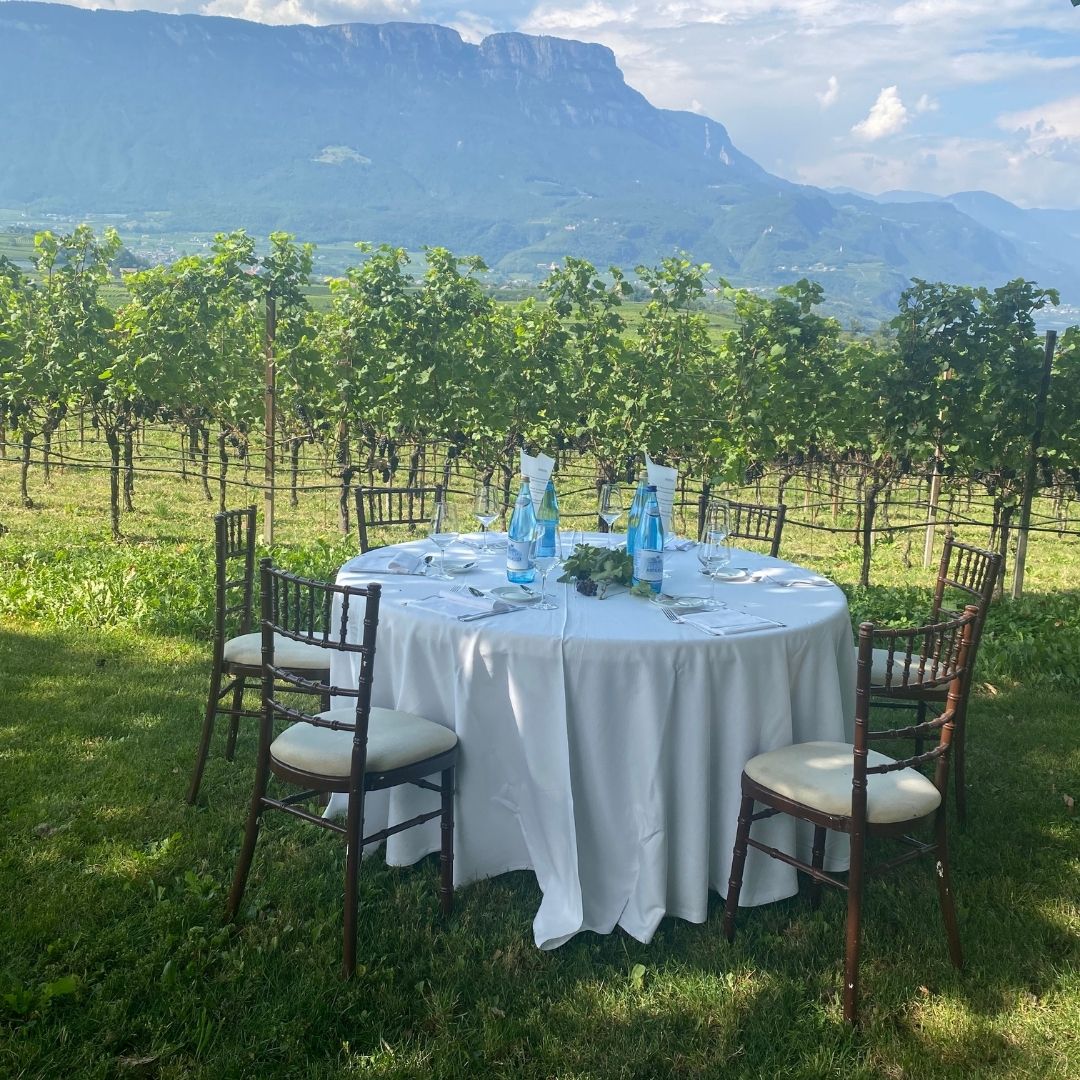
The excitement starts on the plane, as we fly over the Alps. What a magnificent view. In early September, I was able to go to Alto Adige, or South Tyrol as they usually call it here. It has a unique history. It's officially part of Italy, but it feels quite Austrian. If you didn't know, you'd think you were in Austria when you walked through the streets of the capital, Bolzano (big tip: Hotel Città ) is running. Although you do occasionally encounter some incredibly well-dressed types, and then you know: this is Italy (and you resolve to add elegance to your styling).
Anyway, we're here for the wines, and if you ask me, they also represent a perfect blend of German and Italian. The ripeness and spice of Italy with a German freshness. The latter has everything to do with the mountainous landscape I saw in all its glory during the press trip. It's just an hour's drive from Bolzano. all the way up to Alpe di Siusi, the largest mountain pasture in Europe, at an altitude of 2000 metres.

There are no strict rules about which language is used on labels. It's usually just listed twice on the bottle. So you have Valle Isarco (Italian) and Eisacktal (German). It took me a while to understand this. Be careful not to make a mistake with statements like: "Eisacktal? No, I don't care for that. Give me something from the Isarco Valley."
The climate
There's a pretty bizarre climate in Alto Adige. According to an article on Jancisrobinson.com Bolzano is the hottest city in Italy in summer. Even in September, the temperature remains exceptionally comfortable. Climate change is causing temperatures to rise, which is why winegrowers are moving to higher altitudes, planting vines between 200 and 1,000 meters. This also explains the diversity of grape varieties and wine styles, from aromatic Gewürztraminer to ultra-tight Kerner or complex Lagrein, and even Bordeaux blends.

They are immensely proud of their Bordeaux blends and are happy to show it off. The entire press is invited to a blind tasting where wines from Cortaccia (a subzone known for Bordeaux blends) shine alongside highly acclaimed Super Tuscans and grand crus from Bordeaux. The wines are undoubtedly well-made, but you'll have to be from a very good background to compete with Léoville Las Cases 2010. This bottle is also eight times more expensive than the bottle from Cortaccia.

Grape varieties
One of the main reasons we flew to Alto Adige was the large variety tasting. From 9:00 sharp ( deutsche Pünktlichkeit (That's definitely a thing here too) until 2:30 PM, with a short lunch break in between, I tasted at least 180 wines and got a good impression of the region. Below, I share the wines that stood out for me, along with a brief description of the grape variety.
Gewurztraminer
Who knew that Gewürztraminer was the second most planted grape in Alto Adige? Certainly not me. But it might have something to do with the village of Traminer, where the grape is said to originate. Be that as it may, please don't call me when you open a bottle. It's not my grape; give me Kerner.
-
Elena Walch, Vigna Kastelaz, Gewurztraminer, 2020
Good length, aromatic but with sufficient acidity -
Abbazia di Novacella, Gewurztraminer Praepositus, 2019
Also good freshness, then you score points, and recognizable aromas of lychee and roses

Riesling
We all know Riesling, of course. It often reveals itself in a blind tasting with its high acidity. What makes a Riesling from Alto Adige different from one from the Mosel or Alsace? It must be the mountainous freshness, the salty notes, the babbling brook.
-
Kuenhof Eisacktal, Riesling, 2020
High in acid, packed with citrus, impressive length -
Falkenstein, Riesling, 2019
Very focused and pure, mineral-rich, long aftertaste -
Abbazia di Novacella, Riesling Praepositus, 2019
Mountainous Riesling, very lively, citrus, juicy acidity
--
The best Müller-Thurgau in the world? Try Tiefenbrunner 's.
--
Sylvaner
It seems like underdog grapes automatically have an advantage with me. Aligoté, Kerner, Schiava—pour on. The same goes for Sylvaner. Sylvaner is a bit like Riesling's savory brother. It certainly doesn't have the same aromatic power, but it does have good acidity and often a hint of bitterness. My favorite for years was Kuenhof, but I found it a bit disappointing this year. Maybe it was just me?
-
Strasserhof, Baumgartner Hannes, sylvaner, 2020
Spicy, salty, flint, some lie ripening -
Pacher Hof, Alte Reben, sylvaner, 2019
Mineral, dry, green and fresh fruit
Kerner
A young grape, only introduced in our region in 1969. One of the most successful Riesling crosses. It originates in Germany, but I suspect it's more successful in Alto Adige.
-
Abbazia di Novacella, Kerner Praepositus, 2019
Crisp acidity, yet wonderfully balanced. Perfect as an aperitif.
Pinot Grigio
The most widely planted grape and one of the few places—besides Friuli and Alsace—where you can find beautiful Pinot Grigios. We encountered the grape almost ripe in the vineyard, and it was striking how dark the skins were. They were practically blue.
-
Cantina Tramin, Unterebner, pinot grigio, 2019
Very soft mouthfeel without sharp edges, super comfy, yet with a refreshing aftertaste

For exciting pinot bianco ( does it even exist?) you must be in Alto Adige. Cantina Terlan makes a so-called 'rarity', a rare cuvée of 100% Pinot Blanc with eleven years of lie maturation. Very cool!
Schiava
I've become a huge fan of Schiava. These are light red wines, with lots of fruit, fairly high acidity, and soft tannins. Perfect for everyday use. The best spots are in the Santa Maddalena subzone.
-
Glögglhof, Vigna Rondell, Santa Maddalena, Franz Cojer, schiava 2020
Sweet cherries, grenadine, bojo-style, tannins give the wine structure -
Weingut Schmid Oberrautner, Santa Maddalena, schiava, 2020
Licorice, cherries, slightly drying tannins give the wine more structure -
Pfannenstielhof, Santa Maddalena, Anniver, schiava, 2019
Keren, aards, rozen, nice schiava.
Pinot nero
Pinot Nero is also widely planted in Alto Adige. How do you distinguish it from other Pinot Noirs? It's all about the balance. The flavor profile, which on the one hand reveals incredibly ripe red fruit (strawberries, strawberry jam), but at the same time also has a lot of freshness (cranberry, rosehip, acidity).
-
Castelfeder, three cuvées – Buchholz, Glen and Mazon
Beautiful, lively Pinot Noirs, not too heavy, with a good balance of ripe fruit, oak, and freshness. Castelfeder is a house to remember. -
Franz Haas, Pònkler, pinot nero, 2016
One of the most expensive wines from the region, in my opinion. Rosehip, roses, strawberry jam, nutmeg, anise. -
Elena Walch, Ludwig, pinot nero, 2018
A very different style than the rest of the series. Pure, clean, fruit-driven. -
Cantina Girlan, Riserva Curlan, pinot nero, 2018 (the Flora is also good from Girlan; lighter and more red fruit)
Structured, very ripe, gripping tannins, blackcurrants, pepper, ripe -
St. Michael-Eppan, Sanct Valentin, pinot nero 2018
Vanilla, roses, raspberries, comfortable (there, I said it), structured

Lagrein
Lagrein, the regional hero, has been in the spotlight again recently. Good acidity, more tannins than schiava (which can also be a bit bitter).
-
Cantina Terlano, Porphyr Riserva, lagrein 2018
Rich, blackcurrant, clove, vanilla, coffee -
Manincor, Rubatsch, lagrein, 2018
Plums, elderberries, ripe, good acidity, structured, long finish
Conclusion
Alto Adige is beautiful and incredibly diverse. There's no single grape variety or blend that dominates here. What the wines do have in common is the (mountainous) freshness that prevails in all of them. But also: the high quality. I've tasted over 200 wines, and each one was better than the last, but there certainly wasn't a bad one. Arrivederci, tschüss, I'll be back soon!


Thank you Melman Communications and Alto Adige for this press trip.
Hail to Alto Adige!
Share:
A wine fan in Rotterdam
Le Club & Sommeljj's Grand Champagne Test (<40 euros)