
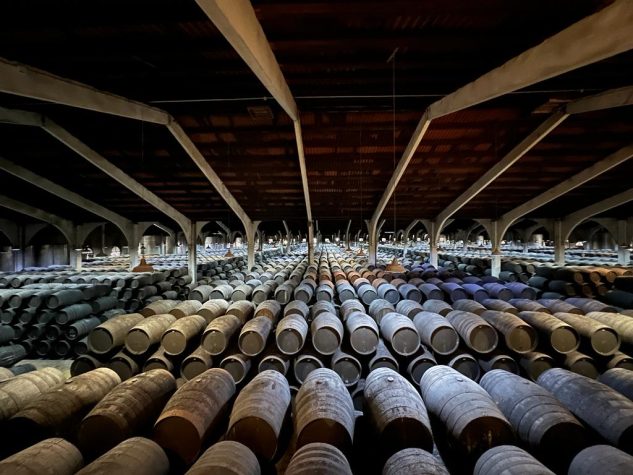
Valdespino is one of the oldest sherry bodegas in Jerez. Its official history dates back to 1875, but the Valdespino family may have been active in the wine industry as early as 1430. Documents have even been found showing that Don Alfonso Valdespino, a knight, was granted a piece of land by King Alfonso X in gratitude for his help in liberating Jerez from the Moors.
Bodegas Valdespino remained family-owned until 1999. That year, Grupo Estévez took over the company and moved all the soleras to a new location on the outskirts of Jerez. Easier said than done, as there were 25,000 barrels to move. Now they're all on display in the new bodega, and the view is phenomenal – just look:

Three sherries highlighted
Many bodegas in Jerez, especially the larger ones, buy grapes. Valdespino is one of the few large bodegas that sources its grapes from its own vineyards. They own approximately 186 hectares. They produce various sherries, including several (even) longer-aged VOS and VORS versions.
In this article we highlight the three most famous: Inocente, Tio Diego and Isabela.
Valdespino Inocente Fino Sherry
Inocente is an exceptionally long-matured Fino Sherry from Bodegas Valdespino.
Inocente is Valdespino's flagship wine. It's an ultra-traditional fino sherry that ages for a full 10 years under flor. According to DO Jerez regulations, a fino sherry must be aged for at least two years under flor Aging. There was never a separate category for longer-aged fino, while there is one for manzanilla, namely manzanilla pasada. This was changed in 2021 when Fino Viejo was introduced for fino aged for at least seven years.
But that's not the only thing that makes this fino special. It starts in the vineyard. The grapes come from Macharnudo Alto, the famous vineyard of Jerez, also known as the "Montrachet of Jerez." This vineyard has long been known for its exceptional terroir (a soil of pure albariza), but has been forgotten due to the industrialization of sherry. Fortunately, we're now seeing the name Macharnudo reappear on labels, a sign that the importance of terroir is gaining renewed appreciation.
Unlike many other bodegas, alcoholic fermentation at Valdespino still takes place in oak barrels instead of large stainless steel tanks with indigenous yeasts. According to Peter Liem's book "Sherry, Manzanilla & Montilla," Valdespino is unique in this respect, although I suspect that smaller bodegas are also rediscovering this traditional method.
After fermentation, the wine is fortified to 15.5% ABV and placed in the solera system. Inocente's solera system consists of ten criaderas – an exceptional number; most fino wines come from a solera system of two or three criaderas. Bottled twice a year, the top criadera is then refilled with new wine (sobretabla). At the time of bottling, the fino is approximately 10 years old.
The result is a sherry for the books – and it is, for example in This book is exceptionally complex, with aromas of fine saltiness, salted almonds, yeast, dried apricot, hay, and orange peel.
Fun to listen to: Guild of Sommeliers Podcast – Sherry with Peter Liem, author of Sherry, Manzanilla & Montilla

Valdespino Tio Diego Amontillado Sherry
Tio Diego is an amontillado from Bodegas Valdespino with an age of about 15 years.
Amontillado is a combination of organic and oxidative aging, and Valdespino's Amontillado is a prime example. How is this kind of amontillado made?
According to theory, amontillado begins as a fino (or manzanilla) and is therefore aged for several years under flor. To become amontillado, the flor must be killed. This can be done in two ways. The most common is that the sherry is fortified again, to 17%–18% alcohol by volume. The flor can't handle this much and dies.
The other cause is that the flor naturally dies because there are insufficient nutrients, for example, because the barrels are not or less frequently replenished with new wines. And that is exactly what happens with Valdespino's Tio Diego Amontillado. Furthermore, the location of the barrels within the bodega plays a significant role. We see this in Valdespino's Tio Diego Amontillado. Due to natural air circulation, cold air sinks, meaning that barrels that are higher up are in a "warmer climate." This would intuitively lead you to think that the alcohol content decreases, as with whisky, where the so-called "angel's share" evaporates in the cool Scottish climate.
With sherry, the opposite is true: due to the higher temperatures in the bodega (for example, in higher-lying barrels or a specific part of the bodega), water evaporates faster than alcohol. Because water molecules are smaller, they can escape more easily, resulting in a higher alcohol content in the wine. Fascinating, isn't it? Any remaining flor that might have survived is now completely destroyed by the high alcohol. Thus, the wine matures for another eight years without flor.

Tio Diego showcases the best of both worlds: organic and oxidative. The floral notes and salty character of fino still linger in the background, but it's wrapped in an oxidative layer of almonds, walnuts, and salted caramel. A delightful glass.
Valdespino Isabela Cream Sherry
Isabela is a cream sherry from Bodegas Valdespino, a sweet blend of oloroso and PX.
Cream Sherry, one of the sherries so beloved by old grandmothers in the heyday of sherry. The most famous (and infamous) cream sherry must be Harveys Bristol Cream. In the late 1950s, Rumasa , a sherry producer who was rather overzealous and fixated on euros or pesetas, signed a contract with Harveys for the next 99 years. Spoiler alert: they didn't make it.
Back to Valdespino, who makes a delicious cream sherry. Cream sherry is a collective name for various sweetened sherries. This sweetness can be achieved in various ways. A cheap cream sherry is often a simple oloroso sweetened with grape must. Often, the color also needs to be adjusted. Caramelized, reduced grape must is often used for this.
That's not what Valdespino does. For Isabela, Valdespino's cream sherry, three-quarters of a 10-year-old Oloroso is blended with one-quarter of a PX. It's then blended in the solera for another five years before being released. The sugar content is approximately 120 grams per liter.
Seductive cream sherry with rich aromas of walnut cake with figs and dates, dried orange peel, and even Tony's Chocolonely Caramel Sea Salt. Serve this with your next dinner and everyone is happy.
The wines of Valdespino are imported by Verbunt-Verlinden and are available at the Wine circle available to order online.



Share:
The sommelier's favorite sherry
A wine fan in Santorini