
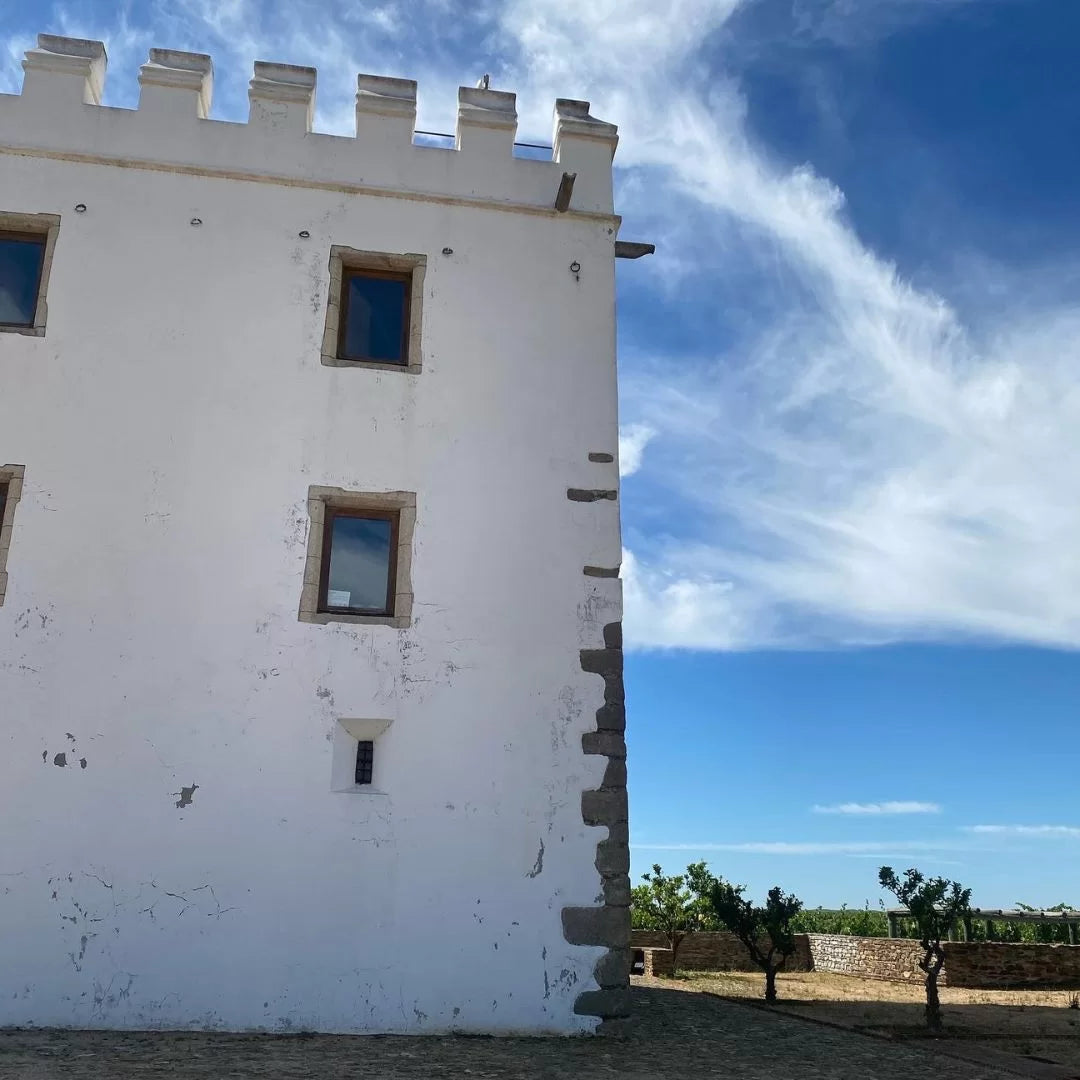
Organic viticulture, fruit-driven wines, top-notch Sémillon, and superb olive oil. That's Herdade de Esporão in Alentejo, the region between the Algarve and Lisbon, Portugal. The estate covers 2,000 hectares, of which almost 600 hectares are planted with vines. Sustainability and respect for the soil and nature are paramount here. And that's quite an achievement on such a large plot of land.

“ It's hot here, but the worst part is that hot wind,” says Pedro Lopes Vieira, sales manager at Herdade de Esporão. I can confirm this; sweat is dripping from my forehead. It feels like a hot hairdryer is blowing on your face. “That's why you see a row of trees here and there between the vines, which break the wind.” These green spaces attract animals, which provide natural pest control. It quickly becomes clear to me that they're not choosing the easy way out here. Slow forward is the house's motto. Speed alone doesn't make you progress.

Bats are welcomed with open arms, as they are the best pest controllers. They even build nests for them. Sheep graze the vineyard and weed in the winter. The organic waste from the winery and olive grove is composted and used to improve soil fertility. That's how it can be done.
From Trincadeira to Loureiro
After Italy, Portugal is the country with the most grape varieties, from Trincadeira to Loureiro. Most grape varieties are still relatively unknown to the general public. They're not exactly known for traveling; you rarely encounter these grapes outside Portugal's borders. The names aren't easy either. Merlot sounds better than Antão Vaz. What also makes it difficult is that Portuguese people love synonyms. Tempranillo, for example, is called "Tempranillo" in the Alentejo. aragonez but in the Douro it goes like tinta roriz through life.
Yet, the Portuguese were very early adopters. Winemaking in Portugal goes back centuries. In fact, the Douro was the world's first demarcated wine region. But due to wars, dictators, and economic setbacks, the wine industry didn't grow as quickly as in other European countries. Today, Portugal is gaining ground. Where those unknown grape varieties once caused difficulties, they are now actually driving innovation. Not that eternal Sauvignon Blanc again; give us Alvarinho or Loureiro instead. It's a country with much to discover. It also helps, of course, that Portugal didn't suffer from frost or hailstorms like France (and other European countries) did in 2020 and 2021.
Esporão embraces this diversity to the max. In 2011, they decided to dedicate a portion of their estate to plant an experimental vineyard. 189 grape varieties have been planted there, including:
- All grape varieties from Alentejo
- All grape varieties from Douro
- The main grape varieties of each Portuguese wine region
- Other, native grape varieties that have potential
- International grape varieties that have potential in Alentejo (the winemaker said, for example, that he is achieving good results with Cabernet Franc)
The goal of this ampelographic vineyard is to preserve the national wine heritage, even in times of climate change. It's part of a 50-year study. Talk about slow-forward.


Tasting notes – Herdade de Esporão
Herdade de Esporão has 600 hectares of its own vineyards in the Alentejo. They also collaborate with around 40 winegrowers who supply the grapes for their entry-level wine, Monte Velho.
Below you will find tasting notes of my favorite wines.
Monte Velho Branco 2021
Peach, pineapple, mandarin, floral, fresh, and light. With a price tag of around 7 euros, this could easily become your new house wine. Very drinkable.
Esporão Reserva Branco 2021
Orange, mango, banana, vanilla, butter. Anyone who loves oak-aged Chardonnay will love this. It's the most successful wine in the Netherlands, and I understand why, because you get a lot of wine for your money (14 euros in stores). It has enough intensity, acidity, and complexity to age well. Excellent. I'm curious to see how this tastes in five years. I think it will age beautifully.
Esporão Colheita Tinto 2020
About the same price as the red Monte Velho, but I prefer this one. Blackberries, ripe fruit notes, dark fruit, pepper, no wood, but a powerful flavor with slightly drying tannins.
Esporão Reserva Tinto 2019
Round, rich, and full. Aromas of ripe cherries, blueberries, and blackberries, with hints of spice, vanilla, and nutmeg. Rounder than the Colheita.
Esporão Private Collection Tinto 2016
The Private Collection is made from grapes sourced from the region's finest vineyards. Made with Alicante Bouschet, Aragonez, and Touriga Franca in 2016, the blend can vary from year to year. Vinified separately. A beautiful wine with a modern style. Ripe berries, plums, blackberries, nutmeg, cloves, bay leaf, a touch of mint/after-eight chocolate.
Esporão Private Collection Branco 2016
Australian David Baverstock has been the head winemaker at Herdade de Esporão for twenty years. When he was tasked with creating a wine that would challenge the region's white wines, he came up with the idea of bringing Australian Sémillon to the Alentejo. The climate of the Barossa Valley, which produces excellent Sémillon alongside Shiraz, is very similar to that of the Alentejo.
A superb wine with a distinct beeswax aroma, so characteristic of Sémillon. But also honey, mandarin, white flowers, honeysuckle, marzipan, almonds, and vanilla. A full mouthfeel, as befits a Sémillon. It pairs perfectly with the equally superb Sémillon from Boekenhoutskloof in South Africa.
Another absolute must-see is the olive oil from Herdade de Esporão. During my visit, I was given a tour and a tasting of three different olive oils. Here too, varietals, age of the tree, and terroir play a major role. Logical, of course, but I'd never thought about it. A thousand times better than supermarket oils.
Not everything yet
The complete portfolio of Herdade de Esporão can be found at their website . In the Netherlands the winery is represented by DGS Wine .
In addition, Esporão produces wine not only in the Alentejo, but also in the Douro and Vinho Verde. Quinta dos Murças is located in the heart of Cima Corgo, or the Douro Valley. Here they produce port wines and unfortified wines in both white and red. Quinta do Ameal is everything you not Expected from a Vinho Verde: no alvarinho, no sugar, no carbonation. But: top-quality loureiro, crisp dry, lively acidity, and plenty of body. You'll find more about this soon on Le Club des Vins.
Thanks to Delta Wines for this wonderful press trip.
Share:
A wine lover in the Azores
A wine lover in the Alentejo