
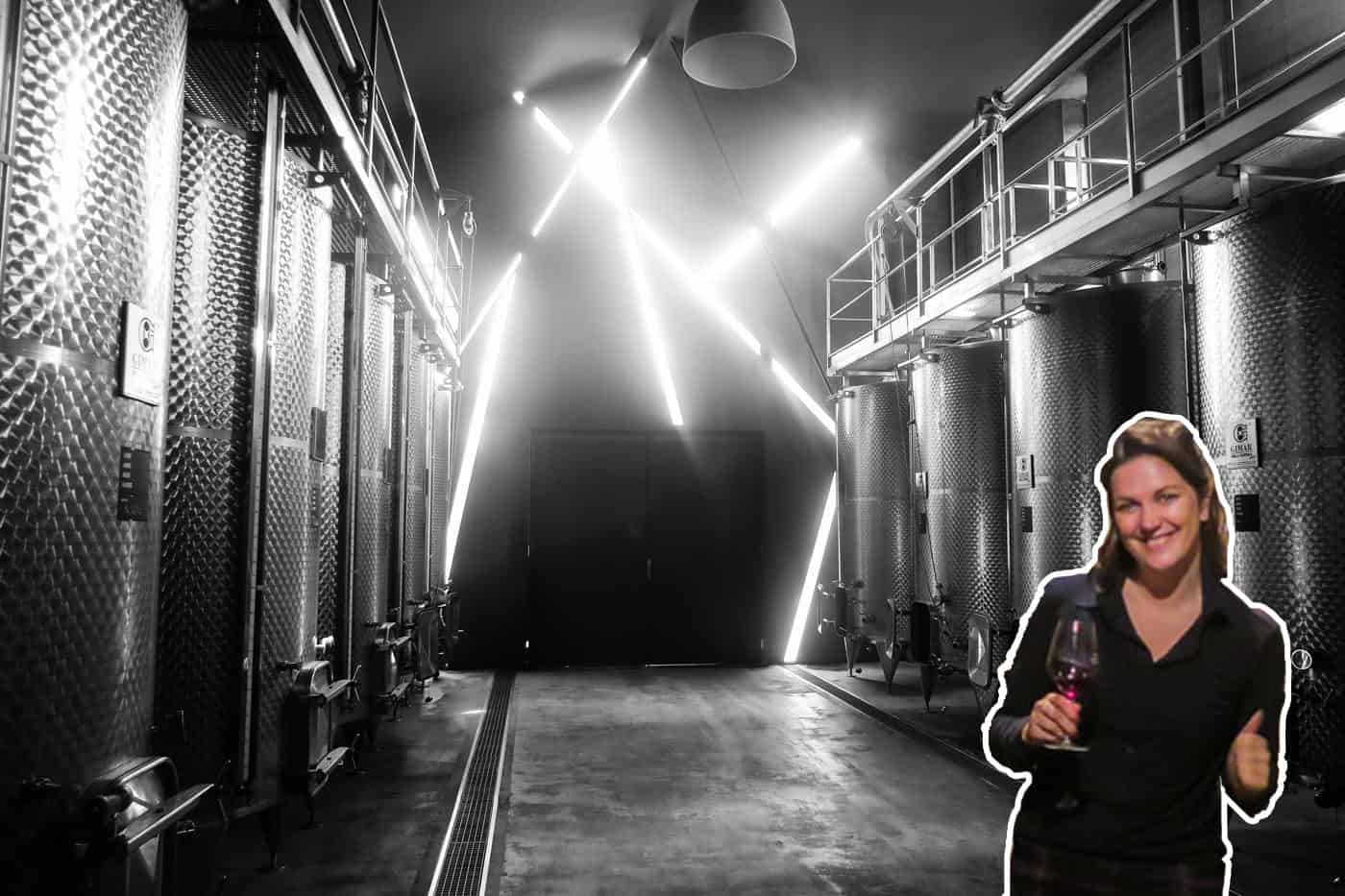
On a beautiful autumn day, we arrive at Domaine de Trévallon. There's not a cloud in the sky, but the wind is blowing hard. The mistral is making its presence felt. We're met by Ostiane Durrbach, the founder's granddaughter, who takes us through the vineyards.
The grape varieties
Domaine de Trévallon is located near the village of Saint-Rémy-de-Provence in the western tip of Provence. What grape varieties would you expect here? Mourvedre? Grenache? Nope, not at Domaine de Trévallon. They have a total of 60 hectares, 15 of which are planted with red grape varieties. There are equal parts Cabernet Sauvignon and Syrah. Ostiane explains that Cabernet Sauvignon belongs here. In Provence. For phylloxera Much more Cabernet Sauv was planted. This makes sense, as it's a late-ripening grape. Here, it always ripens; in Bordeaux, that's still questionable.
In 1993, the INAO (National Institute of Origin and Quality) decreed that AC Les Baux de Provence, under which Domaine de Trévallon had previously been incorporated, could not contain more than 20% Cabernet Sauvignon. Eloi, Ostiane's father, saw no reason to change the blend. So, it was downgraded to Vin de Pays. Domaine de Trévallon Rouge is a blend of 50% Cabernet Sauvignon and 50% Syrah.
In addition, they have two hectares with Roussanne, Marsanne, Clairette, Grenache Blanc and a small plot with Chardonnay.
The average age of the blue vines is 40 years, while the white vines average 20 years. The yield for white vines is around 30 to 35 hectoliters per hectare, while for red vines it's 25 hectoliters per hectare. For the record, this is exceptionally low.
Where we in the Netherlands considered ourselves happy With the good weather last summer (2018), winegrowers in the South of France were devastated. The rain poured down. It was a complete mess. Mildew took over the vineyards and dried out the grapes completely. The white grapes were particularly affected. " We could already smell vinegar at harvest," says Ostiane. “We therefore had to write off Clairette completely.” In total, they harvested 60% fewer white grapes than in previous years.

It doesn't get more natural than this
Domaine de Trévallon has been organic from the very beginning. It's clear from every aspect that they do this for quality reasons – it's better for the vineyards, the vines, and the wine. While natural wine may suddenly be a fad, here they've been working as naturally as possible for years. Just like a farmer in the middle of nowhere doesn't go around proclaiming they're organic. It's simply a matter of using common sense.
In Provence, it's mostly hot and dry (except last year). Herbs are grown in the vineyards until May, which maintains a natural balance. After May, it starts to get hotter and drier, and then the herbs are removed so that everything (water, energy, nutrients) can reach the vines.
 Architectural masterpiece in the cellar of Trévallon.
Domaine de Trévallon is certified for organic viticulture but chooses not to mention it on the bottle. Wine lovers know exactly what's going on. Ostiane explains that organic viticulture goes much further than it used to. It used to be just the vineyard, but now it extends all the way to the cellar. Their sulfite use is low, even by organic standards. For fining, they use bentonite (clay) for white wine and organic protein for red wine.
Nice example: who is your target group?
A novice wine drinker obviously won't understand this wine at all. A Vin de France, 80 euros, no (organic) certification or anything. Overpriced.
In reality, it's a top-notch gem, of course. One that enthusiasts prefer to keep to themselves. Domaine de Trévallon doesn't need to shout about it. It's truly magnificent.
From grape to wine
Okay, harvest time has arrived. Chardonnay was picked on August 25th in 2018, Clairette almost two months later. The vineyard is higher up, so the grapes take longer to fully ripen. Everything is picked in the morning because it's too hot in the afternoon. Roussanne was picked on September 5th and 6th, while the Roussanne, which was 50 meters higher, was harvested fifteen (!) days later.
For a long time, the blue grape harvest started on September 25th, but for the past three years, it's taken place a good two weeks earlier. They harvested Syrah (7.5 hectares) in four days. That was hard work. There were fifteen days between Syrah and Cabernet Sauvignon. August was a busy month, but that didn't continue into September. Lots of cold nights. #globalwarming
Books often mention that grapes are picked in the morning to preserve their freshness. Ostiane explains that this is especially true for aromatic grape varieties. Here, it's not so important. Freshness depends on the time of harvest and the ripeness of the grapes. They are, however, considering picking red grapes in the morning as well. The grapes arrive at 30 degrees Celsius. At 33 degrees Celsius, the yeast dies. This is a problem, because the alcoholic fermentation also releases heat.
In principle, all grape varieties are vinified separately. This year, however, this wasn't possible because the yield was so low, so the barrels had to be refilled.
 Hmmm...we're going to taste it!
 White wine
There is no sulfite Used to protect the freshly picked grapes from oxygen or bacteria. They are pressed immediately. Then, the solids are separated from the juice using debourbage, and fermentation can begin. Here too, no additives, no commercial yeasts. They let the juice do its thing. Just like the Malolactic transformation . If it happens, it happens. Sometimes it doesn't happen, and that's okay too. Some winemakers block malolactic transformation—especially in warm regions—because they want to preserve acidity. This is done with sulfur dioxide. At Domaine de Trévallon, they leave it to Mother Nature.
Then it's time for oak aging. Trévallon never uses more than 20% new oak and uses its barrels for a maximum of five years. The new oak undergoes a long, slow toasting of two hours, so the oak doesn't impart much flavor to the wine. The oak is secondary. The wine matures in the barrel for twelve months. The lees (yeast cells) are stirred two or three times. The wine is then clarified with bentonite and lightly filtered before bottling.
Red wine
The grapes enter the cellar through the pipes. They fall with whole bunches at a time In the tanks. The grapes are not destemmed. This isn't a problem, as stems always ripen in this heat, providing more oxygen and space. This slightly reduces the final alcohol content. Remontage is performed daily, so there's no risk of carbonic maceration. This takes two to three weeks.
Wow, remontage, carbonic maceration. Just hold on for a moment. No idea what these words mean? Check out " words used in the wine cellar " and you'll be completely caught up.
No sulfites or yeast are added. Fermentation takes place at 25 to 30 degrees Celsius. If it reaches a dangerous temperature (>33 degrees Celsius), they cool it, but otherwise, they let it continue.
After fermentation, the wine remains in contact with the skins for another two weeks. Then, the wine is pressed and transferred to oak barrels for two years of aging. Only then is the wine blended. The wine is fined with organic egg white and bottled unfiltered.
Both the white and red wine contain 50 mg of sulfites. For white, it used to be 100 mg, but they've managed to reduce this. They're currently experimenting with a substance from grape seeds that has the same effect as sulfites. However, the organic committee has banned its use. It's a remarkable story; what could be more natural than grape seeds?
Also want to taste it
We conclude the tour with a tasting session. It's special to taste Cabernet Sauvignon. It's so different from what you're used to (from Bordeaux, for example). You expect a bomb of blackcurrant in this climate, but here the violets and garrigues (herbs of Provence) are much more prominent. This begins in the barrel; we also get to sample a barrel. As a grand finale, Ostiane cracks open a 2009. This is where the real enjoyment begins. And that's beyond words.
In the Netherlands, Domaine de Trévallon wines are available for sale at Past support and Sauter .

Share:
A wine fan in Rheingau and Rheinhessen
Which wine with carpaccio