
Friday, March 1, 2018.
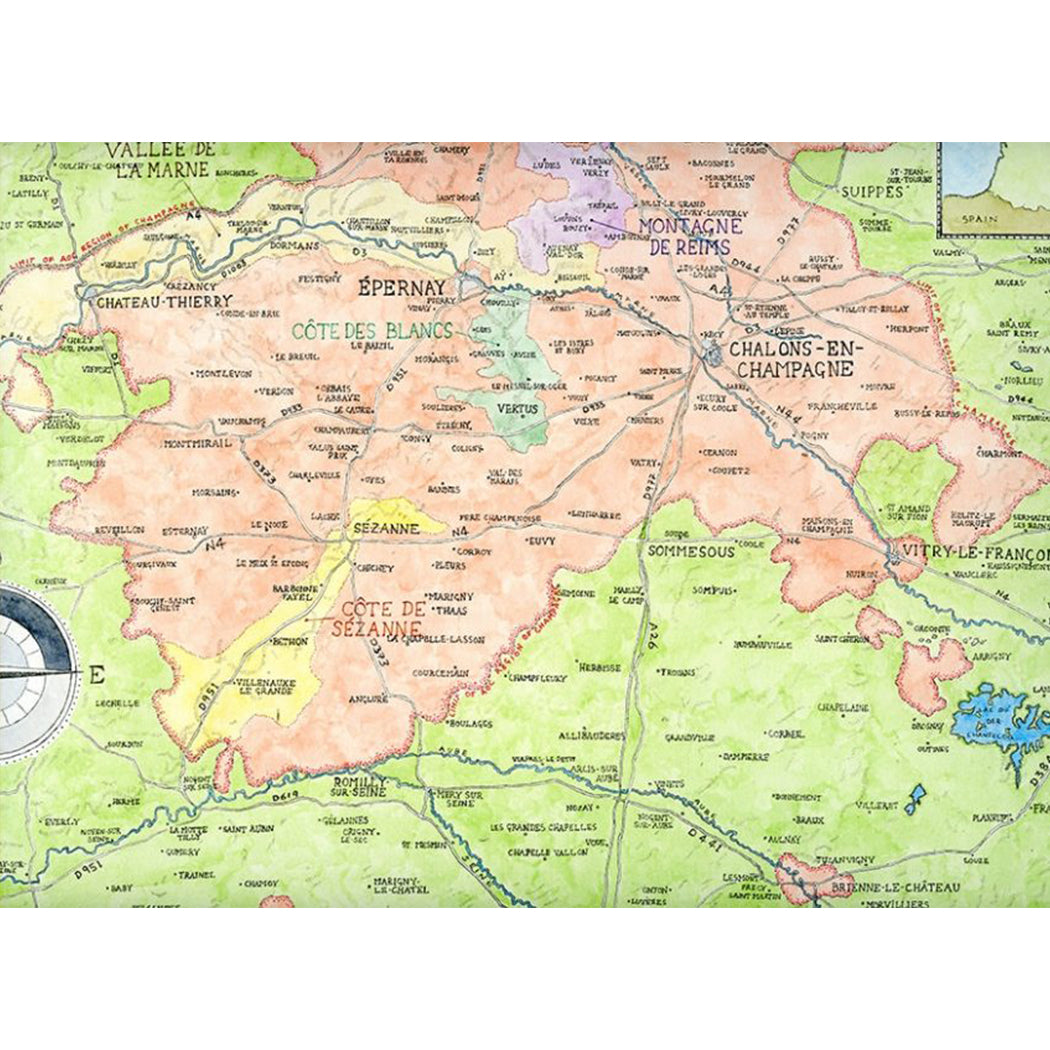
It's Friday, and just after noon, I drive into the town of Ay. If you didn't know better, you'd probably drive right past it. It's not exactly bustling, but excitement courses through me. It started on the way there. No matter where you look, there are vineyards everywhere. That's magical enough, but it becomes even more so when I pull into the Bollinger parking lot.
Clos St Jacques
This is located right next to Clos St Jacques, Bollinger's ultra-special, walled vineyard. Ultra-special, because this vineyard has never been affected by Phylloxera. Phylloxera is a grape louse that rapidly destroyed a large portion of European vineyards around 1900. In Champagne, three plots were spared, Clos Saint Jacques being one of them . It remains a mystery to this day that phylloxera didn't strike here. The soil is the same as other areas in Champagne that were destroyed. This also means that the vines here are not grafted onto American rootstocks. These are native vines, hence the name of the champagne made from these grapes: Vieilles Vignes Francaises . Make no mistake, it's a tricky business. The vines are extremely sensitive, and phylloxera can strike at any moment. This happened to another plot in 2005. Now there are two left. These are treated with the utmost precision and care. Normally, a vineyard takes about 500 hours of work, but here it takes 1,500. Much of the work is done by a horse, which is first given a foot bath before being allowed into the vineyard. Nothing is left to chance.
The New York Times once described this champagne as “It's not a wine. It's the dream of a wine.” I can only agree. I was lucky enough to taste it once: Vieilles Vignes Francaises 2006 .

Of course I have to take a picture with this #lifegoals
The history of Bollinger
The Bollinger story begins with Athanase de Villermont, the youngest son of a noble family, who inherited the estate in and around Aÿ in 1829. He immediately recognized the beauty of his estate. But as an aristocrat, it was not done. to become a winegrower. He met Joseph Bollinger, a well-traveled German who had left his native country to learn about Champagne, and Paul Renaudin, a wine enthusiast from the region. Together, they founded Renaudin-Bollinger & Cie (where "cie" stands for "company"). Coincidentally or not, Joseph married Athanase's daughter in 1837. Their two sons, Joseph and George, eventually took over the business.
In 1920, Jacques, George's son, took over the winery. He married a Scotswoman who would later become known as Lady Bollinger. When Jacques died in 1941, Lady—Lily—Bollinger took over. She purchased more vineyards, developed the Bollinger RD series, and handled the necessary marketing. Her quotes are still as Instagrammable as ever:
“I drink it when I'm happy and when I'm sad. Sometimes I drink it when I'm alone. When I have company I consider it obligatory. I trifle with it if I'm not hungry and drink it when I am. Otherwise, I never touch it—unless I'm thirsty.” – Lily Bollinger
They had no children, but Lady Bollinger ensured that other family members could continue running the business. In 2008, the champagne house decided it was time for a change and chose someone outside the family as director. That person was Jérôme Philipon, former European director of Coca-Cola. He was succeeded in 2017 by Charles-Armand de Belenet, but the true responsibility for the quality of the champagnes lies with the chef de cellar: Gilles Descôtes.
Bollinger's style
In Champagne it is good to own vineyards To own. Otherwise, you have to buy grapes from other winegrowers – also a good business. A winegrower receives approximately €5.89 per kilo of grapes ( source ). The yield (in kilos) per hectare is determined by the Champagne Committee, but is considerably higher compared to other wine regions. In 2015, for example, it was 10,000 kg/ha. Bollinger sources more than 50% of its grape needs from its own vineyards.

Wine is made here.
The grape requirement consists largely of Pinot Noir . All Bollinger champagnes consist of at least 60% Pinot Noir. Then they are aged in oak barrels – this is so important to Bollinger that they even have their own barrelry. All wines above the Special Cuvée (the unvintaged brut) are fermented in oak. The base wines are aged in oak barrels for a total of six months.
Krug is often mentioned in the same breath as Bollinger, as this Champagne house also uses oak aging. However, they only do the alcoholic fermentation in oak – so only one month.
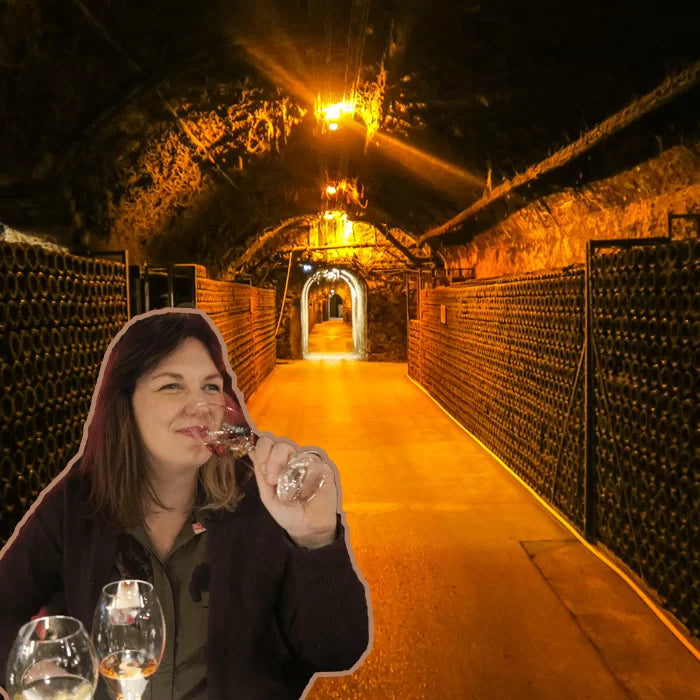
A visit to Bollinger isn't complete without a tour of the cellar. Here, no fewer than 750,000 magnums of reserve wine are stored. My heart leaps as I enter the cellar... "A blend is like a painting," our guide muses as we walk past the stacks of bottles.

Bollinger's cellar
The last feature – time – is not only the time sur lattes , or the time champagne matures on its lees. Entry-level champagnes (the wrong term, as they cost €47.99 per bottle) are aged for an average of three years – twice the recommended ageing time by the AC Champagne. Other cuvées are aged much longer. Time also affects reserve wines. Bollinger ages its magnums for a maximum of 15 years. A similar "entry-level champagne" from Bollinger consists of 10-15% reserve wine aged 10-15 years and two more or less equal parts from the previous two vintages.
What does time do to taste?
"The base wine is like a Granny Smith apple. A spoonful of yeast turns it into apple compote. Five years of aging turns it into an apple pie, ten years into a tarte tatin." – according to our guide at Bollinger.
Want to learn more about Bollinger's style? Then read " The Four Fermentations of Bollinger ."
The only champagne house with its own 'tonnelerie'
Bollinger is the only one in Champagne that still has its own barrel shop. It's like stepping back in time. Tools hanging on the wall are over a hundred years old. Beautiful!
Incidentally, no new barrels are made here, but used barrels are restored. Bollinger has a total of 3,500 barrels. They all come from Burgundy, where they were used in a previous life, as the tannins of new wood are undesirable. The average age of the barrels is forty years, but some are even a hundred years old. Sustainability is a topic of discussion.

Gabriel and Bollinger's Secret Room
It sounds like Harry Potter. I heard this story from our guide during the tour of the vaults. It's not spelled out online in these terms, but it's too good to describe otherwise.
The story begins with an intern named Gabriel, who had been assigned to create a map of the tunnel system—Bollinger's five-kilometer-long cellar system. He began and stumbled upon a corridor full of broken and empty bottles—a fact everyone knew, but had assumed for years. Gabriel asked if he could clear away the bottles so he could finish his map. He succeeded, and he discovered that the corridor led to a secret room...

Inside was an incredible collection of 600 bottles, the youngest of which turned out to be from 1921 and the oldest from 1830. What a find! It inspired them to create a special "hall of fame" to commemorate their champagnes. The collection comprises 65 vintages, including the very first vintage (1830) and the first Vieilles Vignes Francaises (1969).
A total of 54 bottles dating back to 1830 were found. Just think, that's almost 190 years old. The big question, of course, is it still drinkable? During the opening of this hall of fame in 2016, they opened a bottle, our guide tells us. It was still drinkable, but due to its age, the taste is more like sherry than champagne. Still, it's insane that it's still drinkable at all. You're drinking history! Isn't it wonderful? I wonder if you could keep today's bottles for another 190 years?
What a hero! Exactly how this could have happened is unknown. It's possible that this passageway was deliberately closed off during the war to prevent the bottles from being looted.
Bollinger, je t'aime.
There's a lot going on in the Champagne region. Where once only the big names mattered, it seems the time has come for small farmers. Small winegrowers who distinguish themselves by working biodynamically, using little or no sulfites, revitalizing forgotten grape varieties, or making terroir-driven champagne.
Such a development is good and keeps the great brands Nice and sharp. With an annual production of 2.8 million bottles, Bollinger is certainly no small fry. Yet, I don't think Bollinger is letting itself be led anywhere. In fact, perhaps they're even at the forefront? They're the ones who launched a terroir-driven cuvée (Vieilles Vignes Francaises) in 1969. They're the ones who age their champagne even longer than even the average vintage champagnes (Bollinger RD series). For me, it's clear: Bollinger isn't a follower, but a leader.
Want to know more about Bollinger?
Yes, want to know even more? Then I recommend taking a trip like this one. De Wijnstudio regularly organizes wine tours. The Champagne tour was curated by Romana Echensperger, Master of Wine. Keep an eye on the Wijnstudio website for more tours.
Want to try Champagne Bollinger? You don't have to travel to Champagne for that. Peeters Wine Merchants sells them. online and in the store in Rotterdam.
Like what you read?
Then follow me on Instagram or Facebook And stay informed about my adventures and new articles. Le Club des Vins sends out a monthly newsletter called "Wine Fun in Your Inbox." Want to join ? I'd also LOVE it if you left a comment below ❤
More about Champagne?
- Inside Billecart-Salmon – the traditional method up close
- A look inside Henri Giraud's home
- The forgotten grape varieties of Champagne
- You can learn how to saber champagne
Sources:
- Visit Bollinger – March 2018
- Bollinger in style by Lars Daniels – Perswijn 5 – 2017
- Visiting Champagne Bollinger, parts 1 to 3 – Wine Anorak

Share:
A wine lover at Ecorkhotel, Ecoresort in Alentejo – this is where you want to go!
Great wine trips less than 4 hours away